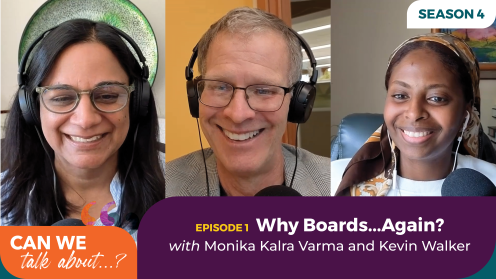
Kevin Walker (00:00):
The board has the potential to be wind in the sails of a mission-driven organization, but it also has the potential to be a headwind blowing in the opposite direction, or to be the drill that is drilling holes in the hull of the boat. I mean, there's a lot of mischief that can happen.
Mares Asfaha (00:15):
Yeah.
Kevin Walker (00:16):
And I think a good benchmark is does the CEO think they are spending too much time on the board stuff? Because if so, maybe there needs to be a boardroom conversation about that, saying the real stuff out loud, and figuring out how do we all spend our precious time in the best possible ways? It can be done, but it takes trust, and it takes talking about the scary stuff.
Mares Asfaha (00:43):
Hello, and welcome to Can we talk about...? Philanthropy Northwest's podcast on leading for racial equity and philanthropy. I'm Mares Asfaha. I'm an Associate Director of Programs at PNW, and I'm really excited to be hosting this season of the podcast where we are going to be talking all about equity-centered boards, and welcome to the very first episode of the fourth season. We are on camera, and I do want to cry about that. I miss the days of no camera on podcasts, but we're here, and we're excited that the tech is working.
(01:14):
So if you've been with us from the start, then you know that our first season of the podcast was also focused on boards, so this topic may look familiar. And the reason that we wanted to talk about boards again is because we have really been hearing a lot about the challenges, the potential opportunities that there are with boards.
(01:35):
So we're really excited today to have Monika Kalra Varma and Kevin Walker join us to talk all about why boards again, why boards still, why are we always talking about boards, to just dig into this topic more. So for folks who don't know, Monika is the President and CEO of BoardSource, which is a fantastic resource for foundation and nonprofit organizations who are really looking to work on their boards and centering purpose on their boards. Kevin's the President and CEO of Northwest Area Foundation, and that foundation has been on an intentional journey to really build racial, social, and economic justice in their region in lockstep with their boards. So thank you both so much for joining us today. Yeah, welcome.
Monika Kalra Varma (02:20):
It's wonderful to be here.
Kevin Walker (02:21):
Yeah, great to be here with you, Mares, and Monika. Really looking forward to the conversation.
Mares Asfaha (02:26):
So to get us started today, we want to tackle this question of why boards again? Monika, I would love to have you start. So just for some background for folks who are listening/watching us, in 2025, PNW surveyed our members and we saw that boards were mentioned a ton, and people were really talking about how boards can be one of the biggest challenges or they can really be one of the biggest vehicles to help advance equitable outcomes in their organizations. And Monika, I know you have been steeped in this conversation at BoardSource, and would love to have you chime in on unpacking this a bit and telling us a little bit about why is this so important right now?
Monika Kalra Varma (03:10):
Yeah. Well, first, I'm really excited that we're talking about boards because as you mentioned, they are the thing that stands often in the way of an organization fulfilling its mission and purpose or really the engine and the possibility. And I like to think about it as how do we make our boards truly partners in our possibility and hope for the world that we're all trying to create? If it's helpful, I can just take a step-up and say, "Okay, so what does that mean? What does it mean to have conversations that guide us in the direction that we all want to go and the change that we're trying to make?"
(03:49):
We have a framework called purpose-driven board leadership, which I think you alluded to, is how do we lead with purpose? And it doesn't change the function of the board, we still have to pass the budget. We still have to hire the CEO, fire the CEO, whatever the oversight and accountability piece is, the compliance for the organization. But the way that we have those conversations are really built around four different things. So one is a principle of centering our purpose over our institution. When you're trying to pass a budget or many organizations are deciding whether they should spend out more right now in the foundation world or looking at reserves in a nonprofit that may have them, is the decision that we're making moving us closer to purpose or further from it? Are we just thinking about preserving this structure in the way that it's structured, or really thinking about where we all need to collectively go?
(04:47):
The second principle is a respect for ecosystem. And these times, I like to say radical love and collaboration with an ecosystem. We're all part of communities. Often at the team level, we're thinking about where do we fit in this collective goal that we're all moving towards? That doesn't always happen in the boardroom, so really thinking about what is the ecosystem that we're operating in and asking questions about that.
(05:11):
The third is an equity mindset. How do we get to fulfill our purpose? What are the barriers that stand in our way? Are we living our values? Do we center equity? Not just on our website and in some of the work that we do, but do we really understand that in order to fulfill a purpose, we have to understand the barriers that stand in the way, whether that's the structural violence of racism, or whether it's other systems of poverty.
(05:37):
There's a whole range of systems that we have to have in mind. And then when we're in the boardroom, are we living those principles? How are we standing shoulder to shoulder with our CEO? How are we working together and treating one another in that boardroom? All of that then requires us to look around the room and say, "All right, do we have the right authorized voice and power? Do we have people in this room who truly understand our purpose, have the trust and knowing of our communities that we partner with?" And that unlocks something in a boardroom.
(06:14):
And at BoardSource, we really try to live, and Kevin is a member of our board and until recently was our vice chair, we really work hard at living that to set an example for something different. The house has to be built strong. We need to be thinking about the conversations that we're having in those rooms so that our decisions are moving the organization in the right way. And that unlocks hope. That unlocks a completely different possibility. And what it does as well is, and there's a lot of uncertainty in the world right now and particularly in our sector, and we're all human and we as natural, the anxiety may increase. A lot of time boards and individual board members and all of us go to an anxiety place. We go to a fear-based decision-making place. Purpose-driven board leadership, asking the right questions is that deep breath that we need to say, "Okay, wait, what's our purpose? Why are we here? Who's in our community? How are we going to move forward?"
Mares Asfaha (07:17):
Right. Thank you, Monika. I love so much of what you just shared, and I want to just highlight a couple of the questions and points that you said. Well, one thing that also comes up for me is the way that you're talking about this version of strong governance is, I think, very different from the idea of "strong governance" of 20, 30, even 10 years ago, it was very traditional. It wasn't so much focused on what was best for community or equity. So I really appreciate this different kind of framing about what can strong governance look like today. And I think this question of are we moving closer to our purpose, or further from it is so important.
(08:04):
And I think a great question for folks to take back in their board work as they're making all types of decisions with each decision that you're making, are you moving closer to the world that you want to build? Are you moving closer to your mission or further away from it? And the answer cannot be you're moving closer to it because you're going to be around in perpetuity. Perpetuity cannot be the answer. That's what I'm hearing from you. There has to be something else that is driving these decisions that is really based on what community is asking for and what community needs.
Monika Kalra Varma (08:35):
And the hope of most folks didn't start foundations with, there was always an imagination or a desire to give, to do something in the community. And so I think it just brings us back to that.
Mares Asfaha (08:51):
Yeah. Thanks. Kevin, I feel like you probably have a bit that you want to respond to in terms of what Monika just shared.
Kevin Walker (08:59):
Well, like you, Mares, I applaud everything that Monika just shared. I deeply believe all the same things that she just articulated, and I've been trying to live those things in my leadership role at Northwest Area Foundation, and as a member of Monika's board, as she said.
(09:17):
One thing I would add to the mix is that in our boardrooms, as in everything that we do as foundations, this is a relationship business, and we don't always frame it that way. We frame it as being about resources. We certainly are willing to say it's about our mission, but it happens at the speed of the trust that's built into our relationships. Building trust with the board, building real relationship creates an environment where the most important things can happen in the boardroom, the most important conversations can actually be how the board spends its time and its energy.
(10:00):
That's not an easy space for many boards to get into. They will, I've found even get stopped cold even by some of the concepts that Monika just introduced, like the very first one about placing purpose before organization. If there's not good relationships that have been built in that boardroom, people's response to that will be, "I don't even know what you mean by that. Aren't they the same thing?" To get to a place where you understand, no, there's an ecosystem around us that we need to respect. There's a higher purpose that brought us all into this room, and it is even more important than our fiduciary duties to this organization. That's a heavy concept, and to get there requires that you know and trust one another.
(10:51):
So I guess my opening thought would be, I would urge my colleagues in philanthropy to find a way to inspire the board to spend the time to actually get to know and trust one another. An entity that comes together sometimes just four times a year, that's a heavy lift, but it's essential.
Mares Asfaha (11:12):
Kevin, I feel like you perfectly segued into the next piece. Before I do that, I do want to, again, double tap on what you just said, which is really around this piece of how do you make decisions that are best for the mission, even if on paper, budgetarily or financially, it might not look like those decisions are "good" for the business side of the foundation. So I just really love this point here. And Kevin, tacking onto what you just shared, what has that looked like in your organization? Because I know you've talked a little bit about the fear that can take place within foundation boards around these conversations. So what has that looked like for your organization, particularly in these last 18 months to two years?
Kevin Walker (12:03):
Well, for us doing, so I think you cited at the outset, Mares, that the board made a commitment in the winter of 2025 to double our grant making, to double the line that was on the grants line of the budget. And then they maintained that enhanced level of giving in 2026, and I think are likely to maintain it or more or less maintain it in 2027. So that was in a context where traditionally we have had a very disciplined spending policy. We are a foundation whose founder said we are supposed to exist in perpetuity. He didn't express a lot of donor intent back in 1934. Very little, but he said that, so we know that we're not spending down this asset, but we also know that we have a mission that is what gets us all up in the morning and in the door.
(12:55):
And our mission is to stand alongside change makers in our region, which comprises eight states and 76 Native nations, and fund work that leads to racial, social, and economic justice. That's the mission statement. So in this time that we're living in, we recognized it simply was not enough to turn to our community partners and say, "Well, you know our hearts are in the right place, but we can't do anything more or anything different." That just doesn't really fly.
Mares Asfaha (13:28):
Right.
Kevin Walker (13:28):
So the board decided to color significantly outside the lines of our very disciplined spending policy. Now, I would also say though, important to our story is that for years we had been experimenting with doing things in addition to our very disciplined spending policy, which when I say very disciplined spending policy, I'm basically saying managing to the 5% minimum payout requirement as if it was the ceiling rather than the floor. We had already gotten good at going beyond that, so we do program related investments on top of that, and we've done several other things, including emergency response funding during the COVID era where we simply added to the budget on top of the spending policy to try to meet the moment, but nowhere near the scale of what the board committed to in the winter of 2025.
(14:20):
So to get there, and then to sustain that enhanced level of giving took a lot of trust accumulated over years, and it took having the right people on the board, so not as big a gap between the communities we purport to serve and who's in our boardroom as many foundations experience. And it also took a willingness to just do something we recognized as very bold.
(14:48):
The final thing I'll say about this though, and we can talk more about it if you want, we had one interesting thing going for us, which is that for years we have tracked the difference between our original donor corpus, which is to say what our donor who was a railroad entrepreneur, or the son of a railroad entrepreneur, what the original donor corpus was adjusted over time for inflation, gives you a dollar amount, which is the current inflation adjusted value of our original donor gifts. And on the same graph, we track the market value of our asset base. We had socialized within the board an understanding of the fact that there's a big positive variance there, which is to say at this moment today, the market value of our asset base is getting close to $600 million.
(15:44):
The inflation adjusted value of the original donor gifts is more like 250 to 300 million, almost two to one. So yes, we need to exist in perpetuity, but what does that mean? It doesn't mean we have to be so prudent that we don't respond to a crisis that is putting everything we care about in jeopardy. So that's how we got here in a nutshell, and we're heading into what I hope will be our third year of enhanced giving.
Mares Asfaha (16:13):
Thanks for sharing that, Kevin. You mentioned you all ended up doubling your payout rate, and I know for folks listening, it's not always possible to double, so I don't want people to be hyper-focused on, "Oh, we can't double it." But I think what you're saying is there were some specific questions and research that you did research into the assets that you have, the assets that you started with, where you are now. And again, going back to that question of what's your purpose, and are you really getting closer to the purpose in the way that you're spending your assets?
Kevin Walker (16:45):
Yes, and I just want to build on that for a second, Mares, because one of the things I've learned is that the words have real power, and we didn't double our payout rate.
Mares Asfaha (16:57):
Thank you for correcting me.
Kevin Walker (16:59):
We might have, but we didn't, but that is very inside foundation language, right? But we realized, let's use some plain English here, what we did was we doubled our grants budget. These are public records, this is all public information, I might as well be explicit. The grants budget for 2025 was established at $17.5 million for us. The board doubled it to 35 million, and then we've maintained that level of giving, 35 million since then. So in terms of the inside baseball of payout rate, our payout rate over that period has been a little above 8% as opposed to the 5%. So I don't want to mislead anybody.
Mares Asfaha (17:45):
Yeah.
Kevin Walker (17:46):
What we doubled was the dollars on the grants line. But to what you said, I am very aware that not everybody can do that either because the board will simply say, "Hell no," and that'll be the end of the conversation, or because for some other reason, it's not practical to go that big. And some can go bigger, and some have gone bigger, obviously. Our friends at the Marguerite Casey Foundation are on a much more evolved planet than what I'm talking about.
(18:14):
But for us, we found a way to be bold that we could support and sustain. And that's what I would urge all of my friends and peers in the field to do. If my story makes you think, "Oh, well, we could never do that," well then, tune my story out, but ask yourself, what does doing more mean for us? Because I really do believe we will all look back on the 2020s as an extraordinary time of hardship and strain and stress for our democracy and for the communities that I know everybody listening to this podcast is deeply invested in. So what are we doing about it? Finding your own way to do more is what I would advocate for. It's not some specific move.
Mares Asfaha (18:59):
Right. Thank you, Kevin. With that, we are going to pause for our Soapbox Snack Break. The moment we've all been waiting for. So we did want to see if Kevin or Monika had, oh my God, you have your snacks.
Monika Kalra Varma (19:18):
I do. Can I lean out and grab it?
Kevin Walker (19:20):
Yes, everybody. Philanthropy Northwest mailed us Skittles.
Monika Kalra Varma (19:24):
It's off to the side, I have it.
Kevin Walker (19:24):
Isn't that exciting?
Mares Asfaha (19:26):
Oh my God. Did you specifically ask for the purple bag Skittles or were you like, "Just any Skittles"?
Kevin Walker (19:32):
I did not, and I'm not a Vikings fan, if that's what you're thinking, although I do like Prince, but I'm a New York Giants fan.
Mares Asfaha (19:39):
Oh, you both got-
Kevin Walker (19:39):
I didn't get the blue Skittles bag, I got the purple one.
Mares Asfaha (19:42):
I don't know why I'm so excited about this. So I have a topic that I want to talk about. Hopefully people can, I think other people are feeling my pain. The yellow button in Microsoft Teams. Come on, people, what are we? The person who decided, actually, I want to snitch on people whenever they leave their computers. Sometimes I'll leave because during the day I like to go see what's in the fridge. I like to go see what's in the pantry. I need a snack and I'll come back and it's yellow already. I'm like, "This is not fair. First of all, you're lying about me, yellow button. And second of all, you're telling people my business." Let's get rid of the yellow button. The person who decided we needed the yellow button, you're out there somewhere. We can forgive you as a society, but I'm just saying, you didn't help your fellow humans out. Okay, I'm done.
Kevin Walker (20:42):
Well, when you do an entire podcast devoted to the Soapbox Snack Break, I'm going to subscribe, Mares. That was, it's fine.
Monika Kalra Varma (20:49):
Thanks for that.
Mares Asfaha (20:52):
Thank you. So I don't have a great segue to get back. I usually, I have a more clever segue to get back into our conversation, but I do want to get into a little bit of what you all have touched on in this conversation, something we talked about in our prep call, which was this idea of how much time people are spending on their board work with their board members, and people are confusing the idea of spending a lot of time on board stuff with spending the right kind of time on supporting their board and embedding equity and practices. So would love to just get some insights from you all. A lot of people spend so much time on their boards, but they're not getting anywhere. So what advice and thinking would you want to offer to folks? So Monika, I think we'll start with you and then Kevin, you can close us out on this question.
Monika Kalra Varma (21:46):
Sure. Well, I have a board meeting tomorrow. I'm not sure when this is airing, but I have spent a lot of time recently on my board meeting. But I think just to go. There are a couple levels of where we spend our time. One, I would say it is important that we spend time, and there's lots of different percentages out there. I think 30% is probably about accurate depending on the time of year, but how we spend our time is really important. I think there's going back to something that Kevin said around the importance of the relationships and the trust, and so there's time that a CEO will spend in building those relationships, but it's also the relationship and the intentionality around how we design our board meetings and our structures.
(22:34):
And so one of the simple practices that we do at our board, and we have put out different guidance through BoardSource around is just having a certain level of social time so we get to really connect as human beings, and see each other. The beauty of a board is what we're sometimes struggling to do these days, which is that you bring people together with very different perspectives that can grapple with hard issues, and then come together to a decision to do something good in their community. And so how we spend our times structuring those conversations is really important. How much time are we spending making sure that the governance house is built and that we're having the right conversation?
(23:20):
Simple trick that I often will talk about is in how we spend our time looking at the arc of board meetings over the year and how we're designing them, that design time is important, but not just to report out. We really encourage boards to, you've got to do your fiduciary duty, but you got to spend time on generative and strategic thinking. How are we engaging with the macro of why we exist?
(23:49):
So I think that the places that we spend our time, relationship, making sure the infrastructure is functioning, we're meeting, we're doing the things we need to do, but then really designing and spending the time to be thoughtful about designing spaces to have some of those bigger conversations is really important. That's how you get to the great work that Kevin just talked about. It's really making sure that those spaces feel intentional and well-structured and able to get to a decision point.
Mares Asfaha (24:19):
Yeah. Thank you, Monika. I think that piece around not just report out time in board meetings is a good one for folks to reflect on. How much of your board meetings is more about reporting out versus the strategic and generative conversations to really push the org forward? Kevin, what would you add?
Kevin Walker (24:39):
I would second everything Monika said, and build on what you just closed on, Mares, which I actually think the desired amount of the board meeting time that is spent on report outs is zero. So aspire to that, I would say. Governance theater doesn't help much of anything, right? If it's a rote performance, that's probably not the best use of the board's time, and there are other ways to convey report out level information. So yeah, I'm a big believer in focusing as much of the board's time together on the actually most important things as possible.
(25:23):
In a foundation context, for me, it feels like those things are most often about strategic learning, which is to say what's happening in the communities we're trying to impact, what are our grantees accomplishing? What are they learning? How can we support them better or adapt to meet community needs better? That kind of stuff is so much richer than one committee after another reporting out on what it did in the last quarter. That can be done in writing, et cetera.
(25:54):
The other thing I want to put in a plug for is that Northwest Area Foundation has been doing very intentional ongoing work around what we call JEDI: justice, equity, diversity, and inclusion. We embarked on that as an organization-wide commitment 10 years ago, and it from day one included the staff and the board. We collectively agreed, staff and board, we need to do that work together, which has taken many, many hours of time in board meetings. If you want to move together on a DEI journey, you need the time. And it was a negotiation at times. I will admit between me and the board chair, our board has term limits, so I've had multiple board chairs over the years we've been doing this, but especially early in that very intentional DEI work, it was a bit of a negotiation about, "Wait, you want us to spend another 90 minutes in the next board meeting on this? Didn't we do DEI at the last meeting?"
(26:54):
And the coin flipped eventually to where now the board really embraces doing this JEDI work with us. They expect it to be a meaningful part of every board meeting. You need to break through to where people trust one another on a deeper level, and know one another's real stories on a deeper level if you want to move what we call a JEDI agenda. I went to this point because I know that many of your listeners are as committed to this kind of journey as I am, and let's face it, there are serious headwinds facing that kind of journey these days. A board that doesn't know and trust one another and come to love one another's different perspectives and stories really can't center that equity perspective very well and keep it centered, I don't think.
Mares Asfaha (27:43):
Yeah.
Kevin Walker (27:43):
So that is worth the time. One other thing I would say on this topic of how much time do you spend on board stuff? Monika cited a rule of thumb of maybe 30% for an executive director or a CEO, I think is what you meant, Monika. I've never actually tried to quantify how much time I spend on board-related stuff, but I think in one of our prep calls, somebody floated that they had heard from somebody that they were spending 60% of their time working with the board. And my reaction to that was, I don't think that's what the board hired the person to do. What board is excited to bring in a new president or CEO so that they can spend 60% of their time working with the board? I think that's absurd on the face of it, and yet it is reality for many folks in our seats.
Mares Asfaha (28:32):
Yeah.
Kevin Walker (28:33):
So it goes back to the thing Monika said at the very beginning, or maybe you did, Mares. But the board has the potential to be wind in the sails of a mission-driven organization, but it also has the potential to be a headwind blowing in the opposite direction, or to be the drill that is drilling holes in the hull of the boat. I mean, there's a lot of mischief that can happen.
Mares Asfaha (28:53):
Yeah.
Kevin Walker (28:55):
I think a good benchmark is does the CEO think they are spending too much time on the board stuff? Because if so, maybe there needs to be a boardroom conversation about that, saying the real stuff out loud and figuring out how do we all spend our precious time in the best possible ways? It can be done, but it takes trust and it takes talking about the scary stuff.
Mares Asfaha (29:18):
I think you spend time on things that you care about, so we understand why people spend time with their boards, but if you're not spending that time with your boards building towards that mission, then to your point, you're kind of creating your own headwinds against the work that you're trying to do and you're making it harder for yourself.
Kevin Walker (29:41):
Yes.
Mares Asfaha (29:42):
So in closing, I can't believe we're already closing, but Monika and Kevin, we really want to offer folks some action steps that they can take after listening to this episode. So when you think about a prompt or a question that you want to offer to folks, what would you end the episode with. And this time we'll go to Kevin first and then Monika, what journal prompt or action prompt would you offer to folks as they're exploring this work with their boards?
Kevin Walker (30:13):
Oh, I love the question. And I guess I'm going to start from the premise that executive directors or presidents and CEOs don't do this alone. You need allies within the board. So I'm going to imagine a world, first of all, where I've got a good enough rapport with say the board chair, that I have a partner in thinking about trying to take it to a higher level. And the thing I would urge people to focus on is what are the things that don't get discussed in the boardroom, but people kind of know they should be. Most organizations I think have those.
(30:48):
The thing that people tiptoe around, it doesn't feel safe to talk about. Maybe there is even fear around it. So if you have an ally within the board who is influential and you can do some thought partnership about what is it that we might be afraid of and why are we afraid of it? What are those topics we avoid and why do we avoid them? That's where a lot of the richness lies and it's where a lot of the trust building lies.
(31:17):
So I'll use a quick version of our own story to say that back 11 years ago, I recognized that we didn't know how to talk about race in our boardroom. We were positioned at that time explicitly as an anti-poverty funder, which to many of us meant of course, that we needed an analysis about racial dynamics and racism because race and poverty are so closely correlated, but there wasn't shared understanding of that in the boardroom. And we stubbed our toe on it in one board meeting where it became clear like, "Oh, we haven't learned how to talk about race here in this boardroom." So we spent the next 10 years learning how to talk about it and how to center it. So that's an example where a discovery about the thing that wasn't getting talked about really lit our pathway forward.
Mares Asfaha (32:04):
Thank you, Kevin.
Monika Kalra Varma (32:06):
Well, I appreciate that, and I'm always trying to hold, because it's often not the case, this idea that there's a better way, that boards can really be enablers. And the way to do that, not surprisingly, I'm going to say is to have clarity around the boardroom of why everyone is there. And so we talk about collective purpose, why does the organization exist? Asking the question of how do we move closer to purpose, or further from purpose in our decision making. But if we're not clear on why we're there and why everyone in the room is there, we're not going to get there. And if you ask that question, what often will come up is that not everyone is there for the purpose of the institution. And that's where we have to be willing to lean into those harder places.
(33:03):
And we released a resource on authorized voice and power for foundation boards. And one of those really important questions is why are we all here? Where are we trying to go? Do we understand that? And do we understand our community? That really forces us to ask ourselves really difficult questions. And I think going to some of the things that Kevin said, leaning into those places. And I think purpose really helps us to unlock that. And the beautiful part of it is we just did an exercise with our own board of really telling the stories of why we're all there, what brought us to the nonprofit sector without talking about our careers, really sharing who we were as individuals. And we found such richness in each other, and that almost lays the foundation for the harder conversations that Kevin was talking about. So my thing is always going to be just in those moments where there's a lot, just take a deep breath and say, "What is the purpose here? Why am I here? Where are we all collectively trying to go?"
Mares Asfaha (34:11):
Thank you both. I think these are great final prompts for people to take on as they approach more of their board work. I think the conversation was full of other questions and prompts as well, so we really invite folks who are listening to really take what Kevin and Monika said and try to put it into action. We're not here just for fun, we want people to be able to actionize what we talked about today. So again, thank you Kevin and Monika. We know that y'all could talk about boards all day, so we really appreciate it. And yeah, thanks to folks for listening, and I guess we'll see you on the next episode. That feels so weird to say, I don't know why, but yeah, thank you again to the both of you.
Kevin Walker (34:57):
All right, thank you.
Monika Kalra Varma (34:58):
Thank you so much for having us, and for creating the space for these conversations.
Kevin Walker (35:03):
Yeah, it's a lot of fun to be a part of it, Mares. Thanks very much.
Mares Asfaha (35:08):
Can we talk about...? is a podcast by Philanthropy Northwest, written and produced by Aya Tsuruta and Emily Daman, with production support by Podfly, and graphic design by Asha Hossain. You can find more information on this episode, including guest bios, show notes, and additional resources at philanthropynw.org/podcast. I'm your host, Maras Asfaha, and we'll see you next time.
Overview
Wait, wasn’t Season 1 also about boards? Turns out there’s more to talk about. Can we talk about..? veterans Monika Kalra Varma and Kevin Walker join us to share why we’re revisiting this topic in Season 4, and how foundation staff can harness the potential of their boards to accelerate their missions and values.
Tune in for a behind the scenes look at the Northwest Area Foundation board’s decision to double their funding, an exploration of the "right" percentage of time CEOs and EDs should spend on board work, and tips and tricks to get the best use of your board members' limited time.

Monika Kalra Varma
Monika is the President & CEO of BoardSource, a globally recognized organization dedicated to creating and strengthening governance and leadership systems that enable nonprofit organizations and civil society to fulfill their purpose and missions. For over thirty years, BoardSource has been at the forefront of nonprofit board leadership, research, and support.
Monika brings over twenty dedicated years leading human rights and social justice organizations in the United States and abroad. From 2017-2021, she served as the Executive Director of the Lawyers’ Committee for Civil Rights of the San Francisco Bay Area (LCCRSF), the oldest civil rights institution on the West Coast. Monika and her team partnered with local communities to advance racial, immigrant, and economic rights. She led an organizational transformation at every level. As a result, the LCCRSF’s staff size nearly tripled, the organization’s revenue and budget doubled, and the organizational culture transformed to center staff well-being.
Monika also served as the Director of the Center for Human Rights at the Robert F. Kennedy Center for Justice & Human Rights (RFK Center) where she advanced human rights through partnerships with social movement leaders around the globe. Monika was the Executive Director of the D.C. Bar Pro Bono Center, the largest provider of pro bono legal services in the District of Columbia serving 20,000 individuals, nonprofit organizations, and small businesses, and also served on the D.C. Bar’s executive team. She began her career with the Office of the Prosecutor at the U.N. War Crimes Tribunal for the former Yugoslavia. Monika currently serves on the Board of Advisors for the Foundation for System Change.
Monika has dedicated her career to community-centered work, guided by the belief the solutions to the most entrenched human rights and social justice challenges are found in the communities most impacted by those challenges- and a deep commitment to building and creating systems that will one day enable everyone to live out their dreams.

Kevin Walker
Kevin spearheads the Foundation’s efforts to stand alongside changemakers in our region of eight states and 76 Native nations and fund work that leads to racial, social, and economic justice. At the heart of this approach is the Foundation’s commitment, honored every year since 2012, to target 40 percent of its giving to Native-led organizations.
Other signature aspects of the Foundation’s work during Kevin’s tenure include an expanded commitment to impact investing and an organization-wide drive to advance justice, equity, diversity, and inclusion (JEDI).
Prior to joining the Northwest Area Foundation, Kevin spent 13 years with the Charles Stewart Mott Foundation in Flint, MI. His career in the nonprofit sector began in the early 1990s with Food Gatherers, a kick-ass community-based anti-hunger organization in Ann Arbor, MI, whose mascot is a giant carrot.
Kevin serves on the board of BoardSource, the national organization dedicated to excellence in nonprofit governance. He previously chaired the boards of Philanthropy Northwest and the Minnesota Council on Foundations.
He lives in St. Paul, MN, with his wife, a public school teacher. He and their adult sons are avid sports fans. Kevin stands by his New York Football Giants through thick and thin. He has celebrated in person at two of their four Super Bowl wins (XXI and XLVI, if you’re into Roman numerals), and he’s thrilled about the arrival of the John Harbaugh era in the Swamps of Jersey. He’s also a fixture in the Supporters Section (a.k.a. The Wonderwall) at Minnesota United soccer games.
Kevin rarely goes a day without listening to music, with a particular interest in cutting-edge jazz. Some favorite recent recordings are Tyshawn Sorey’s The Susceptible Now, Mary Halvorson’s About Ghosts, Brandon Woody’s For the Love of It All, and Julian Lage’s Scenes from Above. Ask Kevin some time about Big Ears in Knoxville, TN, arguably the world’s greatest music festival, where you’ll find him listening up for four days every spring.
Originally from Rye Brook, NY, Kevin is a proud graduate of Blind Brook High School. He holds a bachelor’s degree from Harvard University and an MFA in poetry from the University of Michigan. He has a lifelong love for poetry, reads constantly, writes often, and publishes occasionally. Here’s a tiny poem meant for people who happen to be children:
Just now I heard the rain
stop.
- Monika shares the four principles of Purpose-Driven Leadership as defined by Boardsource, and a new resource: Authorized Voice & Power in the Board Room: Reimagining Governance to Fulfill Philanthropy’s Purpose.
- Kevin shares what it took for Northwest Area Foundation to double their grant dollars in 2025. Learn more in their video: CEO Kevin Walker—Doubled Funding for 2025 to Continue in 2026
This season, we’re asking guests to leave our listeners with a journal prompt to reflect on. Here’s what Monika and Kevin shared:
- Monika: How are we moving closer or further from purpose in our decision making?
- Kevin: What are the things that don’t get discussed in the board room that should be? What is it we might be afraid of and why are we afraid of it?”
- Additional prompt: What does doing more look like for us?
Credits
This episode of Can we talk about…? was produced by Aya Tsuruta, Emily Daman, Mares Asfaha, and our audio engineer Josh Suhy, with editing support from Karalyn Jenkins. Special thanks to Asha Hossain (graphic design) and Music Nova (theme music).