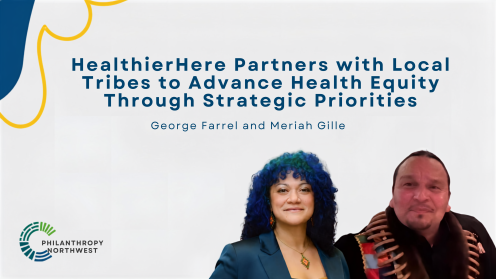
HealthierHere Partners with Local Tribes to Advance Health Equity Through Strategic Priorities

HealthierHere is a nonprofit collaborative in Washington state that works to advance health equity in King County through collective action. The organization started as an initiative of King County’s Accountable Community of Health (ACH) and first operated under Seattle Foundation through a fiscal sponsorship. Since their launch, they have partnered with more than 100 organizations, providing them with funding opportunities including some that extend beyond direct medical care. George Farrel, the engagement and program manager at HealthierHere, and Meriah Gille, chief operating officer of the Seattle Indian Health Board shared insight with us into how their new strategic priorities support the tribal and Indigenous communities who have always been at the center of their work.
“One main goal we have is to change systems, while still supporting direct service. This isn’t to say that direct health and medical support aren’t important. Of course, they are,” says Meriah. “But we’re thinking bigger, we’re thinking about how we can change the status quo. If we only fund direct service work, we’re just maintaining that status. If we want things to change, we need to focus on things like access, innovation and technology in the health field. We need to advocate for funding in these areas.”
Recently, in collaboration with the Muckleshoot, Snoqualmie and Cowlitz tribes, and the Seattle Indian Health Board and HealthierHere implemented three new strategic priorities. The purpose of these priorities is to further center Native voices in advancing health equity and to foster tribal-driven solutions.
“When forming partnerships, one of the harder parts is the nuances around trust and reliability in different communities and understanding these communities,” says George. “There’s always a learning curve when teaching education organizations and people about tribal protocols and the importance of that to deliver and access health and wellness options. That’s one reason our first priority is to design and implement a system of classes and training for non-native organizations. Our second priority is to develop an accurate resource directory for tribal and native-led native serving resources. We have other directories but they’re not the best and aren’t well informed or updated with the correct information and with culturally appropriate context. Our third priority is to advocate for medical reimbursement of traditional Indian medicine.”
When forming partnerships, one of the harder parts is the nuances around trust and reliability in different communities and understanding these communities.

George
As implementation continues, HealthierHere anticipates several interconnected challenges. “Ensuring tribal data sovereignty remains central to all data collection, sharing and reporting. Tight processes are essential to protecting tribal ownership, governance and trust. In partnership with the American Indian Health Commission, HealthierHere is developing a comprehensive tribal data sovereignty data sharing agreement to guide this work,” says Meriah.
Equally important is developing effective tools, classes and trainings that equip non-native organizations and institutions to provide culturally responsive care, while building lasting understanding, respect and meaningful partnerships with tribal and urban Indian communities.

Meriah
“Additional challenges include maintaining a stewardship model resource directory that contains accurate, up-to-date and culturally relevant information reflecting tribal protocols and community-specific services. Equally important is developing effective tools, classes and trainings that equip non-native organizations and institutions to provide culturally responsive care, while building lasting understanding, respect and meaningful partnerships with tribal and urban Indian communities.”
HealthierHere envisions making a lasting community impact by supporting equitable system design that honors the unique strengths, traditions and priorities of tribal and urban native communities. “An immediate goal is to create a culturally informed resource directory that reflects tribal protocols, community knowledge and culturally specific services, making it easier for individuals and organizations to access trusted resources. Over time, these efforts will strengthen care coordination, improve access to whole-person care and build sustainable training models that prepare healthcare organizations to deliver culturally responsive services,” says George. “The effort to advance advocacy for Washington state's Section 1115 Traditional Health Care Practices Demonstration is equally transformative, recognizing traditional Indian medicine as an essential component of health and wellness. Expanding access to reimbursement for traditional healing practices affirms Indigenous knowledge, supports culturally meaningful care and advances a more equitable healthcare system for future generations.”
The past year has been a time of significant change for HealthierHere, including moving forward as an independent 501(c)3. “Leaving our fiscal sponsorship with the Seattle Foundation is recent and it’s pushed us to diversify our funding. When we first started in 2017, there was a lot of flexibility and we were able to bring in many organizations to support,” says George. “We even had a road show and did a meet and greet with organizations in the county. The goal was to really meet people on a personal level, attend the local events and to just connect.”
When asked what HealthierHere is looking forward to with Philanthropy Northwest, Meriah shared this: “Being a part of an organization like Philanthropy Northwest is new to me but what I’m looking forward to is the opportunity to learn from and engage with the community. Taking what I learn and putting it to work with HealthierHere.”
Learn more on HealthierHere’s work on their website.