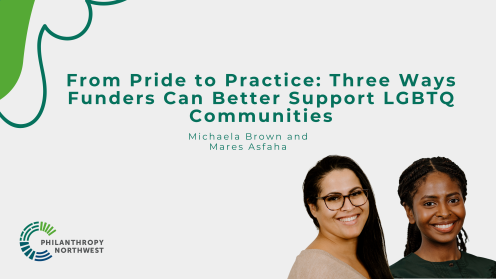
From Pride to Practice: Three Ways Funders Can Better Support LGBTQ Communities


In collaboration with our members from Pride Foundation, Inatai Foundation and Satterberg Foundation, we recently supported the Funders for LGBTQ Issues’ membership tour in Seattle.
Throughout the gathering, we heard from LGBTQ movement leaders and sector champions, asking us to hold many tensions like resistance with pride and disenchantment with inspiration. Saida Agostini-Bostic, president of Funders for LGBTQ Issues, quoted the most brilliant and queer James Baldwin: “Our survival is inextricably bound up in each other,” and asked us to consider this most timely question: what would this look like embodied in our grantmaking?

To help us move closer to an answer and inform how we move more money to LGBTQ organizations doing lifesaving work despite ongoing philanthropic neglect, we offer three ways funders can better support LGBTQ communities inspired by this event.
“Every Issue is a Queer Issue”
What do funders need to understand? KJ January, with Spectrum Center, declared “Every issue is a queer issue.” LGBTQ folks are impacted, and leading across all issues whether it be housing, criminal justice, health access, workers’ rights, violence prevention, education, environmental justice and more. Philanthropy often pigeon-holes LGBTQ leadership into specific issue funding and erases their full spectrum of expertise. In this moment, we are seeing the closure of organizations that once served entire populations, causing the few surviving LGBTQ-led organizations to overextend themselves to provide additional cover.
If you are an issue-based funder, we encourage you to look at your work with a new or renewed LGBTQ-intersectional lens. There is queer-led work happening in your issue area.
Rural-Focused Giving, A Model for Centralized Impact
It is important to counter the narrative that rural communities don’t include queer and trans folks. In fact, in many “safe states” like Washington, we are finding that smaller cities and rural towns are seeing growing numbers of “trans refugees” looking for safety and support. Funding and supporting trust and community building are key in rural communities, and it is especially true for our rural LGBTQ community. As M Eliatamby-O’Brien with Trans Rural Lives noted, supporting community gathering spots like parks and even tattoo parlors, where queer people convene in rural places, is upholding queer well-being, intergenerational connections and relationship-building. Funders must keep several things in mind when supporting queer communities. Rural areas move at a different pace, what may look like a silly party or a random expense request is connected to a deeper organizing strategy, and consider the ways your grant reporting requirement may unintentionally put community at risk by asking folks to provide publicly identifiable information or out themselves.
If you are a community foundation or place-based funder, we encourage you to find the LGBTQ groups and organizations building community in place and fund their work.
Finding Hope, Despite the Odds
In the face of this violent reality and the coordinated attack against trans and gender non-conforming folks, we see organized and sophisticated efforts to resist, survive and dream. Jaelynn Scott, executive director of Lavender Rights Project, reflected on the transformational role philanthropy can play in investing in queer intersectional power building, which includes supporting spaces for dreaming, “help us dream bigger!” . . . “We don’t always want to be on the defensive, we want to introduce our own ballot measures . . . in 10 years, we will be unstoppable!”

In closing, we echo Saida’s profound and clear message to the philanthropic community:
"Philanthropy’s role in this time remains the same: to resource our movements fully, abundantly and like we believe winning is possible." Despite the enormous odds facing their movements, queer and trans organizers on the frontlines continue to win important victories against bills seeking to restrict their rights and existence.
"Movement is doing their work. It’s time for philanthropy to do ours."
Additional Resources: