Maya:
How do you want to be remembered in your own leadership? If somebody was telling a story about your life, would you feel good about how you showed up either in this last next few years or historically over your career? And are you actually walking and practicing in your values?
Nancy:
From Philanthropy Northwest, this is Can We Talk About...? A project to normalize the messiness of leading for racial equity in philanthropy and reflect on what it takes to create lasting transformation? In Season 3, we're sharing stories inspired by our newest guide, Toward Transformation, on how a cohort of 20 community philanthropy organizations spent over a decade together working to advance racial equity. We're asking guests to practice vulnerability, explore sticky topics, and look for learning. And what we ask of you is to do the same.
Mares:
Hello everyone, and welcome to our final episode of our third season of Can We Talk About...? Philanthropy Northwest Podcast on leading for racial equity in philanthropy. I'm Mares Asfaha, and I'm an Associate Director of Programs at Philanthropy Northwest. I've been the host for this season, and it's been so great to talk with so many amazing community philanthropy leaders and really do a deep dive into how can community philanthropy organizations deepen their racial equity work.
I almost want to call myself a podcast host, but then I look at the other podcast hosts in the world and I'm like, "I don't want to be associated with 95% of those people." But I am very happy to have been able to have conversations with you all over the season. And as we've mentioned before, Season 3's topics have been based on our guide, Toward Transformation. And if you haven't checked it out yet, it is on our website, philanthropynw.org.
And I'm really excited today to have two fantastic folks. We have Maya Thornell-Sandifor, Managing Director of Programs at Kataly Foundation, and Valériana Chikoti-Bandua Estes, Executive Director at Social Justice Fund Northwest. Welcome to you both. Can you each give a short introduction about yourselves, your name, your role, a little bit about your communities that you serve? So let's start with Valériana and then go to you, Maya.
Valériana:
Okay, awesome. First of all, thank you so much for having us. My name is pronounced in the event somebody's trying to spell this out, write this out, this is exactly how it's pronounced. Valériana Chikoti-Bandua Estes, but if you can't roll your Rs, you can say Valériana. Pronouns are she and her, and I serve as the Executive Director of the Social Justice Fund, Northwest. We are a member-funded foundation. We support the creation of a just society through fundraising and grant-making, and we primarily serve grantees in Idaho, Montana, Oregon, Washington, and Wyoming, specifically grantees who are strengthening the way forward in terms of grassroots-led efforts and specifically around broad-based movement work that is progressive and a part of the broader spectrum or ecosystem of systematic social change.
Mares:
Thank you. Maya?
Maya:
Hi, thanks Mares for having us. Excited to be here and do this podcast. Maya Sandifor, she/her/hers. I am the Managing Director at the Kataly Foundation, which is a private foundation that's also in Spend Out. So we are a 10-year experiment. We will be ending around 2030. We fund nationally, primarily wealth building strategies for Black indigenous and people of color communities in the areas of mindfulness and healing justice, environmental justice, restorative economies, which is also our integrated capital fund and capacity building. I'm based in Oakland, California. In a previous life, I also worked in community philanthropy and intermediary foundations, so very familiar with that side of the sector. Excited to be here.
Mares:
Thank you both again. And part of the reason why we were so excited about you both joining is you represent different perspectives within the community philanthropy space. Valériana, like you said, SJF is not "traditional community foundation," but you are getting resources from your community. You have a donor base, you have tight relationships with your grantees, you work across several states and are place-based as well.
And Maya, you've worked in a couple of different types of community philanthropy orgs. And you didn't say this, but I wanted to mention that Maya also worked with our building community philanthropy partners as part of the cohort that we did for 12 years. So have a lot of insights into what it looks like for community philanthropy works to do this work.
So we wanted, as usual, to start with a quote from the guide, and we want to start the conversation talking about power to influence change, and this is the quote. "So as I look toward the future of community philanthropy, especially in the context of a world where it's becoming easier to back away from equity values, I see that we as a sector have become much more comfortable using our power to maintain the status quo than using it to change things for the better, and we must break out of that mindset."
So that is a quote from myself in the letter that I wrote at the end of the guide. And I don't want to quote myself, but we wanted to bring this into the conversation. So pitchfork's down. Okay, I'm sorry, please. Okay. But having said that, I want to focus on power. And one of the things that, Maya, I'll start with you. One of the things you had brought up was really seeing organizations underutilize their power. Can you say a little bit more about that?
Maya:
Yeah, I'll start by saying the sort of status quo, also complying in advanced stuff I think I see as a failure in leadership, particularly for community philanthropy where your whole reason for existing is to be in service to community. So now is not the time to retreat, it's actually the time to double down on your moving in solidarity with being in deep relationship with community in this work.
And I think the underutilization piece is both exercising, leveraging all of the types of capital that community philanthropies have. So it's not just the resource, grant capital, but it's also the social capital, the relational capital, the community, cultural wisdom as capital, the donors, whether they're DAF holders or independent donors to your philanthropy, leveraging them as influencers, the community relationships that folks have, both in the political arena, the organizing space, the community leadership space, the indigenous communities as well, just not really tapping into that source of power in your work.
And then the last thing I'll say is not underestimating the power of your investment portfolio as well for a lot of, I'll say, community foundations that have endowments because of their DAFs, not really thinking about how they're using those assets for community good, for social change, for social impact. So I think there's an over-indexing on protection as it relates to folks moving at this status quo pace, moving in fear. And I think that's a false dichotomy, I actually think it's a choice to move in status quo to comply in advance. And as it relates to equity, if you're making that choice, then to me, that just means you never were actually for values of equity and justice because you were just waiting for somebody to give you permission to not do a thing.
And so if folks are really going to walk in line with their mission as community philanthropy, the folks that they're obligated to take direction from is community, not somebody in a pulpit crowning themselves king, but folks that they are actually accountable and responsible to in their communities.
Mares:
Thank you, Maya. You said so many things that we will definitely come back around and definitely want to, later in the conversation, dig into the compliant in advanced component, because I think some folks are compliant in advance, but don't even realize that they're compliant in advance. It's a really weird thing happening, but would love to go to you, Valériana, in terms of how you see this playing out.
Valériana:
Yeah, I think that's honestly actually quite similar to what Maya just named is I actually think that history is gifting us in this chapter to examine who we are as philanthropists. There was definitely a time not too long ago in 2020 when a lot of audacious things were named out loud. And I would say post-2020 to date, I think again, history continues to invite us in and actually say, "Hey, are you good on your word?"
And I named this because the Social Justice Fund, one of the things that my staff and even as our board has been deeply thinking about has been what our role actually is as fundraisers and also grant makers and the power that we hold. There is privilege, but also how that also deeply makes us think about how we can utilize our power in a way that is a pivotal force. And I say this because oftentimes in moments of history when there are chapters that hold difficulties, whether it be social, economical, political elements that are impacting how resources are moved into community, I actually think it's an invitation when something is actually tough, hard, difficult, and it may bring a variety of nuances and challenges for us to actually go back and lean deeply into our values and recognize this is the power we hold and here's how we can move it forward.
And I know at SJF, we're often thinking about just the ways in which we do participatory budgeting, participatory grant making, participatory planning. All of those things speak to our ethos so that when the chapter or the tide shifts, it doesn't necessarily shift our strategy. We are still thinking more deeply about who we are, where our North Star is and how we are recognizing specifically as funders.
There's an opportunity here for us to be thinking actually more intentionally about our stewardship and similar to what Maya had just shared, that certain inclinations maybe to retreat are actually also founded in choices. And I think again, this invitation is just, again, asking us which road or which pathway are we all going to travel on? And that invitation forward, I think is actually a time for us to actually go, "Yeah, let's actually be even more audacious than we initially thought that we could even be." And I think that is the evolution of what we can actually do in this industry.
Mares:
Oh my God, I love that, Valériana. And one thing that is coming up for me from what you both said is this myth/dominant narrative that folks tell themselves, which is, and I would say some folks, not all of them, some folks in community philanthropy feel like, "My organization doesn't have the power to do X, Y, Z. We don't have the power to be audacious. We don't have the power to show up for community."
So what would you all say to folks who are really struggling to see what their organizational power is and where they can push? And how do we push more folks to recognize their own power and to act on ... Maya, what you said also is the different lovers of change that are actually out here. Let's start with you, Valériana first, and then we'll go to Maya.
Valériana:
Yeah, I think what this actually speaks to, I often think that piece you asked organizationally, I also think that to even get to thinking organizationally, we also have to look at this individually and the roles that we all play or function, I would say, how we all function. But that being said, I often think of the fact that the gift, or I would say the privilege to be an executive director for me at SJF, I'm often compelled to think about what our North Star is in our decision-making processes, but also how that's also deeply connected to change to the piece that you named earlier in our podcast about transformation.
When I go back just thinking about, let's say our org's values, our mission statement, whether it's even our internally, we have community agreements, I can't help but think, "Wait, this is the role that I'm holding. This is also the functionality of how I'm supposed to steward my leadership." But also the effects of that is that it has a ripple tide and a wave to also change the trajectory of how my organization does move internally, but also externally.
And I think, again, I'm just as somebody who loves history, I often just keep thinking about the tides, the moments, the waves that our ancestors, particularly as an Angolan immigrant and more recently and classifying myself as an Angolan American because I recently got my citizenship in almost two years now, I'm struck by thinking about all of the different things that my own ancestors were up against, whether it be existing during a time of war, still managing to organize, but also having these wild dreams about what's possible for generations to come.
So when I think of just organizationally, what's also possible is every time something in history comes to, whether it's rattle, the framework of what we're all actually building, again, it just continues to remind me back to it's actually an invitation for us to build. It's an invitation for us to organize. It's an invitation for us to be strategic. It's an invitation for us to be thinking, "What is one of the highest forms of freedoms? What is the highest forms of us actually practicing or moving in a trajectory where our power can also be felt in community in a way that actually uplifts the most vulnerable folks that we are also doing life with to a level where we haven't seen?"
And so I feel like those building blocks continue to build the next momentum for, again, for the next 5 to 10 years that come, that again, needs to continue to build, evolve, move. And I think in any movement, there are always these pillars like so and-so came and set the strategy for how we organize. Okay, but then so and-so who came next also set the strategy for how we actually think about how we want to collectively move also as to create more humane conditions in whether it be in a workplace. So I often just think about it as where we are in this moment or this chapter as an organization is just also thinking about what is it that is echoing through time that our ancestors have also tasked us with, that we are actually uplifting and making sure it's felt also in community.
Mares:
And that makes me think about what are we setting some of our ancestors, not everyone's ancestors.
Valériana:
I see what you did there. I see what you did there.
Mares:
Building something that we can build off of. So how are we organizationally in our individual roles, what are we leaving in terms of what can folks in the future building on? Are they building on a solid foundation of equity work? Are they building on mud, just not that sinking, something that's sinking? So Maya, what would you add?
Maya:
On folks walking and practicing their values and not having those be just words on a page. And then I would invite folks also to think about how are they becoming organizers in this work? I need folks in philanthropy, whether you are the program officer or the board member to actually put on your organizing hat because it's true. We can't individually or even singular institutions solve some of these very extractive problems that we are faced with right now in this social and political context.
And so it takes all of us and that means we need to be organizers. We need to find our people within the institutions we operate in. Who are your allies? Who are the people that are willing to go to bat with you on a thing externally? Who in the community are you partnering with to both tell the story of what's needed, but also to organize other peers and philanthropy, other institutions that exist in your community? How are you mobilizing folks and gathering folks to move a thing?
Instead of just relying on your one little niche of responsibility, how are you expanding your aperture to bring other folks along, but also to work in partnership and solidarity with other folks to move the needle on stuff? Because it's going to take all of us. It's not just one institution's responsibility. And I think about some of the work happening here in the Bay Area around housing justice and how one community foundation was like, "Hey, this is the X amount of dollars and we need to actually make a difference on this issue. We're willing to put in this much. What are you other community foundation across the bay going to put in? What is the state of California going to put in? What is Alameda County going to put in? What are the private philanthropies?" So they essentially identified the issue and they went around and just organized the ecosystem to address the issue and it's moving a thing, it's shifting a thing. And so that's how we need to act. That's how we need to leverage our individual power in partnership and in solidarity with other folks.
Valériana:
Not to go off track because Maya, you got me fired up over here, but just so happens at SJF, we are doing a housing and tenant fund justice giving project right now. And for folks who aren't aware of what a giving project is, similar to what you're naming, it's an opportunity for folks from different spheres of life, cross class, multiracial, and a variety of different backgrounds, ages who come together basically to do some deep political organizing for a particular social justice issue. They will actually, the goal of it is to fundraise for that specific social justice issue.
And I've been able to pop into a couple of different sessions that my team has been holding down the fort. Shout out to Emily Nadiza because I hope they listen to this podcast. But that being said, I think to your point, Maya, it is really pivotal that when we recognize the role of how organizing can change the trajectory of social justice issues that X, Y, Z communities are facing, because there's so many intersectionalities, what we actually find is that there's shared camaraderie. Because to some points that you named a little bit before, I think it's easier to put something on a website that speaks to equity, but the praxis of it, the North Star piece of it is actually actualizing it. And my hope is, and to your point as well is that when we organize, we think across the board, who's left out? They might not organize exactly in the ways that we do, but what's a way that they can be a part of this conversation so we can keep the momentum moving forward? So just hearing that, I got excited. Sorry, Mares, but-
Mares:
No, do not apologize.
Valériana:
... to not to go off track.
Mares:
I think that's great, because you have me thinking about organizing within philanthropy and how the term organizing, some folks have a very specific idea of what it is. It's marching down the street and that's it. And I remember, I don't know if this was a call or Twitter back in the day, but a local organizer said, "A lot of people think organizing is marching down the street and that's 90% of what we do." Actually, 90% of what I do is spreadsheets and documents and all the background work that actually goes into that. It's really not this scary image. "Scary" depending on who you are and how you define fear, but it's really a lot of me in front of a screen trying to figure out how to get this thing done.
I don't know if I have an exact question around this, more like wanting to encourage folks to reframe how they think about organizing and reframe how they think about their own role and how they can become organizers. Because even the examples that you both have given in terms of, Maya, that project in the Bay Area around housing and then, Valériana, the way that you all do your giving projects, many community philanthropy orgs are actually doing organizing in some type of way. So it's not that foreign of a concept. You don't think of it as organizing. So how to leverage more of that organizing to really zero in on equity. Yeah. So thank you all for sharing that.
One thing I do want to talk about is the boundaries and the imaginary boundaries and the limits that people put on themselves and put on their organizations of what they can and can't do. And Maya, one thing you had talked about in our prep call was kind of a lack of creativity in terms of how people think about where they can leverage their work. And you mentioned it at the beginning of the call. So I do want to circle back into that point around how to leverage each of your resources and thinking more creatively about how to show up.
Maya:
Yeah. I am a fan of both the future casting of using your imagination and the historical, back to mentioning of ancestry, like the historical look back at what's possible, because I think both of those directions give us instruction about how to do a thing and how to be creative. And so for example, I think about freedom towns that existed pre-philanthropy where folks were self-funded, self-governed, building whole cities and infrastructure with their own resources and their own will and their own wisdom. And that didn't require an institution coming in and saving them. It didn't require a board of directors. It didn't require major donors or wealthy folks coming to the table.
So I think if folks can do it without philanthropy, they can do it with philanthropy exponentially. And so taking the time to really think about, create some spaciousness around what is the problem we're trying to solve, and then what are all the creative ways in? Who are all the people we need at the table to make a thing happen?
And to the point of equity, if you identify the key problem that exists in your community, and then you drill down on that problem in terms of who is most impacted, almost always it's going to be women and women of color and queer folks. And so if you are about solving the problem as a community philanthropy, but you don't have an equity lens about the solution to that problem, again, failure of leadership, you're not actually doing what you are set up to do as a community philanthropy.
So I would say the creativity piece comes in with, one, the historical look back, the future casting. So thinking about what's possible given all the assets we have, again, creative capital, relational capital, and then getting folks around the table in your community to build out some creative solutions and not just being dependent on the staff having the answers or your donors having the answers or your trustees having the answers, like expanding the table to include folks who are most impacted by that issue.
Mares:
I was going to say something, I don't know if I should say it, but now I feel like I have to say it.
Maya:
Say it.
Mares:
Because you were like, "Don't depend on the trustees having the answers."
Maya:
You can always edit it out.
Mares:
And I'm like ... Yeah, you can edit it out, because you're like, "Don't depend on trustees having the answer." And I'm like, "For most folks, in what world did the trustees have the answer? In what world? In what world?"
Maya:
In the world, if our boards and trustees are actually reflective of the community we serve, then yes. But if your board is made up and trustees are made up of folks just because of positional power or financial power or class power, then probably not.
Mares:
Yeah. And the great news is our first two episodes, we talk about leadership and board and staff and all of that, so we'd invite people to listen to the first two episodes of the season to hear more about how folks have done some good work around adjusting their boards.
I do want to move into, because we've touched on it a little bit, but what the idea of being a leader in this moment and beyond, I have to say, I get a little annoyed when people are like, "This moment." Because I'm like, "You guys, this moment is bad, but we've had so many bad moments, so many bad moments."
Maya:
We're here because of all the other bad moments.
Valériana:
Yeah, that's it. That's it.
Mares:
And people are like, "How do we need to show up in this moment?" We're here because y'all weren't showing up in the other moments. But anyway, people are struggling with how do they show up on an individual level in their roles to support equity work, really feeling pressured by the outside narrative, really being led by fear, which I get it. Would love for you all to share a little bit of advice on how can leaders navigate in this time? And I don't want to just say leaders, I'm putting that in quote, leaders as in CEOs, but really anyone in an organization has something that they are leading no matter how small or big. Maya, maybe we can start with you this time and then go to you, Valériana, around navigating.
Maya:
Yeah. I'm going to double down on something I said earlier and also pick up on something Valériana said about how do you want to be remembered in your own leadership? If somebody was telling a story about your life, would you feel good about how you showed up either in this last next few years or historically over your career? And are you actually walking and practicing in your values? What are the ways you can, in the things that you have responsibility, accountability before, whether that's in your role as a leader or in your job description or how you are in community, what things can you push and be risk forward with instead of thinking about self-protection? Because the truth is, nobody's coming for you. The people who are being come for have already experienced that. They're the people who are most at risk in this moment.
Philanthropy and people who work in philanthropy, nobody's coming for you. So you have the privilege and the power to just lay it all on the table. The only thing you could possibly risk is your job. And if somebody is coming for you for your job because you did a thing, I have some lawyers for you.
But I just think everything that folks were fearful of, we're already seeing this big reversal, right? All of the educational institutions that laid down because folks were coming after them for their DEI initiatives and their enrollment practices, that's already been ruled unconstitutional. And so you're actually taking an action that is actually, there's no compliance or legal reason for you to do that, which is back to what I was saying earlier about folks complying in advance and operating from a status quo.
If you are doing that, it's because you always wanted to do that and you just feel I feel like you now have permission to do it, and so just be real about that. If you don't believe in equity, you didn't believe in equity before, DEI became the thing not to do. If you didn't believe in equity for queer and trans folks, you believe that before it became this lightning rod, dog whistling.
So I just think folks need to do some self-interrogation about how do they actually want to show up in this time? What can they do to actually step into their power, be risk forward? What's the story if they have children or grandchildren or niece or nephews that they would want those folks to remember them for when it's all said and done?
Mares:
Thanks, Maya. And I want to add quickly before going to Valériana for you to add to this question as well. You mentioned courage. And I just want to say courage is really hard to have in isolation. It's really hard to have when you feel like you're the only one in your org, when you're the only one in your community. So I want to go back to a point that we were making around organizing and the importance of finding your people. If those people aren't in your org, think who are other people outside of your organization who you can have other folks around you so that you can have more courage in this work. Valériana, I would love to go to you on how we're at the individual level and navigating right now.
Valériana:
When I think of even just courage and what it symbolizes on an individual level, I actually often think courage is opportunity for us collectively or even individually to be thinking thoroughly through a framework of what's actually possible. I look at it also from the trajectory of, again, I can't help but go back to thinking about a gift. A gift that's purely been given to us to walk in the most ... And my favorite word is actually audacious. My staff will say this. Again, audacious ways possible.
And I grew up in Papua New Guinea and I've seen political instability, but I've also seen the resiliency of people who've been like, in spite of what is happening politically, we will still gather, we will still laugh, we will still eat, we will still organize, we will still build, we will still carry forward. And when I think of that, I am looking at those moments and times in the '90s seeing that and then I migrated to the United States in 2007. And over time being a millennial, I've seen these different shifts and waves and changes, particularly that have taken place in American society.
And I think for me, it's such a huge gift that coming from anti-violence work into, and really direct service work and coming into the world of philanthropy, I see this as like, for me, one of the highest forms or the wildest dreams of my ancestors. Being born into this world as a refugee, never in my wildest dreams when my ... Just knowing the story of my family and what they had to flee so early on in life and seeing this point of where I am, did I think in my wildest dreams that I would be holding this kind of position and being able to be a decision maker and be really thinking thoughtfully with a team on how do we move dollars in a way to community that doesn't even seem transactional, but it's relational.
Mares:
So thank you, Valériana and Maya. We are going to move into our soapbox snack break and give you all a break. And it's funny because I feel like I'm going to bring it back around. I feel like the snack break is connected to what you all were talking about.
So as folks may or may not know, I'm hosting my soapbox snack break segments to give our guests a couple of minutes to chill. And I want to hop on my soapbox about really nothing of importance to philanthropy. This is just something fun to include within the episode. So you all can chill and sit back where you can join me in talking about this nonsense that I'm talking about today.
So this is probably the most random one we've had the whole season, but I had a text message from my friend the other day and she sent me a picture of, or a video of an erasable pen and I said to myself, "There's someone driving forward the scam around erasable pens and the scam stops here." I know that as a country, we can't come together around anything, but I said, "Who's buying erase ..." Let me calm down. Let me calm down. "Who is buying erasable pens? Who is producing erasable pens? Why? How much money are you making? Why has this scam been allowed to scam for so long? They're not good pens. They don't erase and yet they're still being produced. People are still buying them."
I'm like, "Consumers, please, we need to want better for ourselves." Especially in this economy. Whoa, I need to calm down. I said, "In this economy, y'all are making a profit from erasable pens." And the reason I'm frustrated is because we keep getting scammed and the scams keep going, they keep going. And I'm like, "I need one scam to stop. I need one scam to stop." And this is the one.
And when we talk about what's possible and what's not possible, I need everyone to know there was someone out there in 2026 making money off of erasable pens and you're sitting here thinking, "I can't move equity forward." Anything is possible because someone is making erasable pens in 2026, they're making money off of this idea, something that we all know doesn't work, but you're sitting here thinking, "I can't move equity work forward." We can't let the erasable pens win. I just feel like we can't. We can't.
Maya:
Facts. Also, there's so many scams in capitalism.
Valériana:
There are.
Maya:
That make people money that, to your point, illustrate anything is possible.
Valériana:
Anything is possible.
Maya:
If you can make money off of something as asinine as an erasable pen. Also, you're giving me flashbacks because I haven't seen erasable pen since I was in junior high and not to date myself, but that was a long time ago. So the fact that they still exist, I'm like, really?
Mares:
And she got that at a hotel, so someone is buying that in bulk. There is a decision maker who in their budget, they said, "We're spending money on erasable pens, but you can't in your budget say we're going to spend this money on equity?" Huh? Come on people. Okay. Okay, sorry. Let me stop.
And the funny thing is, I was trying to think of a soapbox snack break topic and I was like, I surely don't have a lot to say about erasable pens. Clearly I do. Anyway, I think this kind of goes well into our piece around collective liberation and what's possible.
Maya:
Oh, gosh.
Mares:
Yeah. Having said that, we do want to move into collective liberation and what we see as being possible for our communities. And we'd love for you all to share what ways do you imagine community philanthropy? And in some ways community philanthropy orgs are already doing this, but what ways can they engage in solidarity and advanced collective liberation and push the boundaries of community philanthropy even further? And Valériana, I'd love to go to you first on this topic.
Valériana:
Yeah. What I probably will say is I'll speak to what I think that really defines collective liberation. And then I'm sure based off of what Maya's going to say, I'm going to say something after that. But anyway, when I think of collective liberation, I am drawn to think about the highest forms of justice freedom or freedoms in plural, existing on the praxis or the basis that groups of community members in our society, when I think of folks with disabilities, folks, particularly Black trans women, undocumented folks, when folks who society often has forgotten when they are uplifted in a way where they're experiencing the highest forms of freedom, then collective liberation can actually exist in the room because it seeps through to a trajectory or plethora of other communities.
And I think that sometimes, it's easier to just say the words like collective liberation and just go about your day. But I think that when we are thinking about collective liberation, it's again, another opportunity packaged in a way for us to be thinking, "Who has been left out of the room? Who is it that maybe we haven't defaulted to? Who would be the most impacted by a decision that we make?"
And I'm reminded, I know for the work that we hold at Social Justice Fund is this is why our grant making process is participatory on purpose because we want community members to also have a stake at being decision makers in a room when we're discussing grant applications because their insight, their perspective holds a level of depth that we otherwise wouldn't necessarily hold because we are part of an institution.
And I think that those are ways, just like that example alone, is just a way in which for us in the world of philanthropy to be thinking about when we do our, or when we are going to go about making our decisions, how often are we actually engaging, inviting, including, and being intentional about having folks who otherwise may not even have a mainstream name, but they are effectively over in time, always at the front lines or experiencing the brunt of oppressive decisions that are having lasting effects?
So I think it's just important for us, if we hold that framework, I think that there's always room for us to even be more audacious into thinking what's possible when we think of collective liberation. But I have a sneaky feeling, Maya, you're about to say something that's about to make me excited to say something back to you.
Maya:
I'll do my best.
Valériana:
No pressure.
Maya:
I'm thinking about how every egregious, most inhumane act in this country and globally is first tested out on the folks who historically have been disenfranchised or oppressed. And so if we don't show up for those folks and the test works, who do you think they're coming for next? We saw this and what happened in Minneapolis. They said we're going after the most dangerous immigrants and migrants. And then the two people who got murdered were a white nurse and a white mother. And it was an awakening, I think, for some folks who maybe weren't paying attention.
But the thing to note is that the reason why we move and collective liberation is understanding that everybody is going to be at risk. But the first folks, the canary in the coal mine are folks who historically have been disenfranchised and oppressed, and those tend to be Black folks, indigenous folks, and queer folks. And so if you are not standing up for those folks and working for their freedom, your freedoms are coming next.
Valériana:
That's it.
Maya:
They're coming for you next. And so even if you just want to take the most selfish, individualistic view of a thing around collective liberation, understanding that it's going to be you and your family, if you don't show up for the folks who are the testing ground. And to be clear, community, particularly communities is where folks test out like policy, they test out legal. And we are seeing right now all kinds of beautiful organizing happening, particularly in South and in rural areas where folks are the testing ground and they're organizing and fighting back in a collective liberation stance and winning. And therefore, the rest of us will not have to suffer for it because those folks are fighting those fights.
And so we need to be showing up in philanthropy and solidarity with movement folks. As community philanthropy, we need to be very visible in showing up when community needs to organize around a thing for mutual aid, for safety and security, for resilience, for safe space, safe harbor. We need to be also showing up in those spaces and offering whatever it is we have to offer. And that's what collective liberation looks like in action versus I think someone was saying, or maybe it was Mares as you were saying earlier, that folks think about organizing as protest.
And for me, that's like the most performative of organizing. If you really want to walk in values around what organizing looks like as it relates to collective liberation, that means what are the things you activating, resources, capital, space, technical support, in times when the testing is happening, when communities are under assault, what is it that your philanthropy and/or your leadership is activating in that moment to walk in solidarity with folks who are under attack?
Valériana:
And I think to that point, Maya, I told you you would do something to me here. I think to that point, this is also this piece where what you touched on is what we're also doing externally is also a symptom to what's happening internally. So within one's respective organization, if as an org you haven't reviewed your values, this is a great time to be re-reviewing those values. This is actually a great time to be at recognizing what's your work culture look like? What's the relationship to labor? Is there an expectation where folks are expected to work to the bone? And there also isn't also that conversation around improving, whether it be internal benefits and things.
The reason I name that is in the last couple of years, those are the conversations we've been holding internally also at SJF, that when that can actually be actualized internally, the way that we also show up externally, you move with a different kind of sound because I think one of the valid criticisms that we can hear in community can be around, "Hey, this might come across in the world of philanthropy for institutions that, hey, some things can come across as performative, but what happens when we, let's say, move the performativeness away, and that means it's a lovely to have an equity statement, but internally, is that being felt by the collective and the organization? Are there ways that there can be transparent conversations to improve that, because that tug and pool also has these lasting effects externally?"
And I think that when we do hear community feedback, I think instead of maybe the narrative of maybe feeling, "Oof, fingers are pointing in this direction." I actually see this as it's actually an invitation for us to go, "Hey, this is actually a gift. People are naming something that maybe because we hold power, they're naming something and they're hoping that we will take this and make some adjustments and some tweaks."
And again, I say this not because no institution is perfect, but I also think that there is a way that we can move with momentum, evolve, make changes internally so that externally, the way that we move in a way where that audacity is felt across the board, that folks know, "Hey, when such institution is in the room?" While they are an institution and they have to operate through the frameworks of a 501(c)(3), we actually can see that there is an area of or level of trust based philanthropy that they're enacting in the way that they're moving. Yeah.
Mares:
Thank you for that point, Valériana, because people I think are more, actually weirdly more comfortable in some ways doing the external work, which is the grant making. They're more comfortable doing statements versus doing the really hard internal work that you're talking about versus thinking about how to adjust culture, how to think about internal processes. And if you don't do that internal work, you will have no momentum to actually even do the work that collective liberation requires. So, yeah, please don't put more work into your equity statements than you do into your internal processes and policies people. Please, we're begging. We're begging.
Maya:
Absolutely.
Mares:
So unfortunately, we do have to end episode, but we are ending the episode with starts and stops. And so when we think about, or when you think about community philanthropy and the future of community philanthropy, how to get to a future of collective liberation, what's one thing that you think community philanthropy needs to start doing or one thing community philanthropy needs to stop doing?
Valériana:
Okay. I would say the piece on start, start recognizing that fear is actually being disguised as a vehicle to avoid discomfort and recognize that in this moment, what we can actually do is lean into the belief that there's an opportunity being presented to us to actually be good ancestors. And that means the way that we organize, the way that we have conversations about resource and community to the way that we meet with each other on the peer level to connecting with our grantees.
Let's move with the audacity, the highest level of audacity from the framework of the wildest dreams of our ancestors, because to this point that was said earlier, history will have a lot to say with how and what we did with this time and how amazing will it be for the story to be that in light of all the things that happened, here's how we still audaciously decided to show up, to not just shake the table, not just turn the table over, but to build something that we haven't actually seen in our time of life.
I keep thinking again, and if there's one thing that people can walk away with what I've said is there's a piece here on framework and the way that we're moving, and that is seeing this as a disguise of an opportunity, not necessarily seeing this for all the things that it's packaged because that piece on fear by design, when that has been fueled out in such a way where you might even feel so overwhelmed within your body, you might actually end up moving away from the why of what brought you to even doing this work. And there's an opportunity here for you to lean into your North Star, into your values, into your mission, and move in a way that is so audacious that even if your voice is shaking even while you're doing it, you're still doing it, you're still doing it. And that to me is being a great ancestor.
Mares:
Thank you, Valériana. That was beautiful.
Maya:
I apologize. I have a stop and a start, stop being a political. Everything is political even in philanthropy. And I'll use the example of, because I know a lot of your listeners operate in the rural context. All of the hospitals that are going away in your community are a result of a political act. Health, wellness, the future of folks' livelihood is the result of a political decision.
So we don't have the luxury of pretending like we aren't touched by politics. And we also have access to folks who have resource that can move to support folks who are organizing the political arena, whether that's elected officials, whether it's political education, whatever the what is around creating a counter vision that is in benefit of our community. So just stop pretending that we exist in a political ecosystem.
I want folks to start moving in more relational philanthropy. Trust-based philanthropy is great and it also is very one directional. Relational philanthropy is an opportunity for us to actually get to know the people that we are resourcing, the communities and the issues that they are impacted by, inviting them into the conversation around the solution, not thinking we have all the answers. You can do that if you are operating from a relational stance where you see somebody as human and have an extended level of empathy even if it's outside of your lived experience.
So I want folks to start being in deeper relationship, particularly in community philanthropy with your neighbors in your community. It does not limiting yourself to who are your staff holders and who's on your board, but who's the pastor down the street? Who are the teachers in your community? Who works at the local businesses? Who are the healthcare workers and the healers? Who are the Native indigenous folks in your community? Do you have a relationship with them? That to me is the antidote to the fear part because you become less individualistic and feeling like you're operating by yourself because you have now built community around you and folks that you care about have relationship with.
And that's going to completely shift your level of willingness to take risk to Valériana's point, be audacious because you actually have people at your back. Yes, please do that. Take bigger bets, make bigger investments, definitely continue to do the GenOp unrestricted thing, but also take even bigger leaps in terms of your commitment to community. And you can do that if you have people in your corner.
Mares:
Thank you both so much. I feel like you shared so many different nuggets of wisdom and I hope that people walk away from this episode really thinking deeply about the questions that you pose, the mindset shifts that you pose and how to implement that into their work and into conversations with your own staff members and board members.
Yeah, this is the last episode of the season. And as you all were talking, one thing kept coming to my mind, which is that phrase the arc of the universe bends toward justice that Martin Luther King would always say. And sometimes I think people rest on this idea of, "Let's all going towards justice anyway, so what do we need to do?" And so I really want to encourage folks coming off of what Valériana and Maya have said, it bends toward justice if we make it bend toward justice. It takes people and organizing and work and resources to do that.
So really, again, thank you Valériana and Maya, and I want to end the episodes with letting folks know, yes, this season of the podcast is over. This is the last episode, but Philanthropy Northwest has more support for community philanthropy orgs. We have our learning library on the website, philanthropynw.org, and you can filter resources by community foundation. And we also have our regional community philanthropy group programming where we have programming, we have our listserv, and really the goal is to support our members in doing equity work, especially now. So that's the end of the episode in the season. Thank you both again.
Maya:
Thank you, Mares. Thank you, Valériana.
Valériana:
Thank you so much. Thank y'all. Really appreciate it.
Nancy:
Can We Talk About...? is a podcast by Philanthropy Northwest, written and produced by Aya Tsuruta and Emily Daman, with production support by Podfly and graphic design by Asha Hossain. Our episodes this season are hosted by Philanthropy Northwest Associate Director of Programs, Mares Asfaha. You can find more information on this episode, including guest bios and show notes at philanthropynw.org. A special thank you to Philanthropy Northwest Building Community Philanthropy cohort for their partnership on this project. I'm Nancy Sanabria, and we'll see you next time.
Season 3 episodes are inspired by our guide, Toward Transformation: A collection of lessons from 20 community philanthropies working to advance equitable philanthropy
Overview
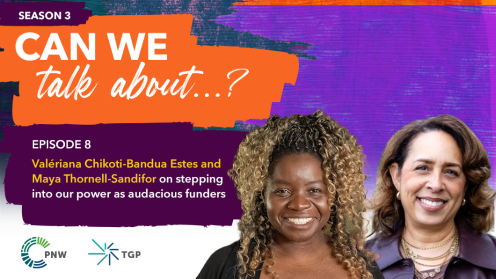
Valériana Chikoti-Bandua Estes, executive director of Social Justice Fund Northwest and Maya Thornell Sandifor, managing director of the Kataly Foundation, join Mares for the final episode of season 3 focused on community philanthropy and equity.
The episode begins with a conversation on power, and how community philanthropy typically underutilizes the power and influence they have. Together they share the need to move against the status quo for greater justice for their communities.
They also discuss the necessity of overcoming fear, being politically active and building deep relationships with the community to move philanthropy toward equity and justice through collective liberation.

Valériana Chikoti-Bandua Estes
Valériana is executive director of Social Justice Fund Northwest. A former refugee from Angola and a member of the Bantu Ovimbundu peoples of southern Angola, she comes from a family of freedom fighters, disruptors and organizers who shaped her commitment to social justice from an early age.
At age three, Valériana's family fled Angola due to Portuguese colonization and civil war, seeking refuge in Papua New Guinea. She later moved to the United States in 2007 to pursue her education, earning a bachelor’s in management information systems and a master’s in global governance.
Valériana is a multilingual public speaker with a diverse career spanning diplomacy, community organizing in Black immigrant communities and advocacy for survivors of violence. She is also the founder of Necessary Interruptions, a consultancy that supports nonprofits, educational institutions and small businesses through leadership and management services.

Maya Thornell-Sandifor
As the Kataly Foundation's managing director of programs, Maya leads efforts to support collaboration across program teams and in alignment with the organization-wide strategic goals. Maya also brings her deep experience working across the philanthropy sector to elevate community and movement centered strategies for a more just and restorative approach.
Maya brings 25 years of experience in philanthropy, organizational development, program strategy and change management. Before joining Kataly, Maya was the principal of Mandala Change Group where she consulted leadership at philanthropic and nonprofit organizations on strategy development while centering racial equity and justice.
Before Mandala Change Group, she was the director of racial equity initiatives at Borealis Philanthropy. In her role at Borealis she helped launch and scale several pooled funds including the Disability Justice Fund, the Racial Equity to Accelerate Change Fund and the Racial Equity in Journalism Fund. She also managed the Racial Equity in Philanthropy Fund to support philanthropic support organizations advancing their membership's commitment to practicing racial equity in the approach to grantmaking and institutional culture.
Maya is a certified coach through Coaching for Healing, Justice and Liberation and holds a master's in organizational development. Maya chairs the board of New Left Accelerator and The Capacity Shop to support progressive power building for mult-entity organizations. She lives in Oakland with her two teen boys, husband and dog Zora. Maya loves to paint, is a voracious reader and enjoys diversifying the sport of sailing by exploring the San Francisco Bay and Caribbean waters with her family.
Headshot photo by Bethanie Hines.
Key Lessons & Insights
- It’s Time to Think Like an Organizer
Maya and Valériana explore how organizing within philanthropy can shift the course of social justice work — whether that means leveraging individual influence or finding allies inside and outside your organization. Mares adds an important reminder: most organizing doesn't happen in the streets. It happens through funding decisions and the behind-the-scenes work that moves justice forward.
- What is Your Legacy?
Maya asks listeners to reflect on the legacy they want to leave behind, arguing that this moment in history calls us to act on our values and build a better future for generations to come. Both guests then discuss how to use the power of philanthropy intentionally — by leaning in, organizing and taking a strategic approach.
- Collective Liberation and Solidarity in Philanthropy
Valériana describes collective liberation as the highest form of justice and freedom — a framework that centers two key questions: who has been left out of the room, and who is most impacted? Building on this, Maya emphasizes that while oppressive systems and policies put everyone at risk, those who have been most marginalized serve as a canary in the coal mine. We must stand up for the most vulnerable, she argues, because their struggle is a preview of what's coming for the rest of us.
- Walk and Practice Your Values
Both guests stress that how an organization shows up externally must be rooted in what it practices internally. They encourage listeners to use their mission, values and vision as a north star — but to go beyond public statements by also examining and adjusting internal culture and processes to reflect those same commitments.
References & Resources
- Philanthropy Northwest’s Learning Library
- Regional Community Philanthropy Group
- SJF’s Housing and Tenant Fund Justice Giving Project
- All In On Housing Initiative: Maya shares an example from the Bay Area of a community foundation that identified an issue and leveraged their power to build solidarity and a cross-sector collaboration in the region.
Starts & Stops
This season, we’re asking all guests what philanthropy ought to stop doing and what philanthropy needs to start doing. Here’s what Valériana and Maya shared:
Start:
- Valériana: Start recognizing that fear is actually being disguised as a vehicle to avoid discomfort, and recognizing that we are being presented an opportunity to actually be good ancestors.
- Maya: Start moving in more relational philanthropy — it is an opportunity for us to actually get to know the people that we are resourcing, the communities and the issues that are impacted, by inviting them into the conversation around the solution, not thinking we have all the answers.
Stop:
- Maya: Stop being apolitical. Everything is political, even in philanthropy.
Credits
This episode of Can we talk about…? was produced by Aya Tsuruta, Emily Daman, Mares Asfaha, and our audio engineer Josh Suhy, with editing support from Karalyn Jenkins. Special thanks to Asha Hossain (Graphic Design), Nancy Sanabria (Intro/Outro Host), Komiku (Music) and to our Building Community Philanthropy partners for their thought partnership and support.