Gloria:
I think now more than ever, nonprofits need partners to not just give, but give longer. Give larger amounts.
Nancy:
From The Giving Practice at Philanthropy Northwest, this is, Can we talk about...? A project to normalize the messiness of leading for racial equity in philanthropy, and reflect on what it takes to create lasting transformation. In season two, our hosts explore what it looks like for philanthropy to advance racial equity on the ground, where the work can look quite different depending on the context. Whether it's place, issue area, or community served, and in a world where our contexts are constantly shifting. We're asking guests to practice vulnerability, explore sticky topics, and look for learning. And what we ask of you is to do the same.
Katie:
Hello, everyone. And welcome to Can we talk about...? A project to normalize the messiness of leading for racial equity in philanthropy. I'm Katie Hong, and I'm a senior advisor with The Giving Practice at Philanthropy Northwest, and your host for this episode.
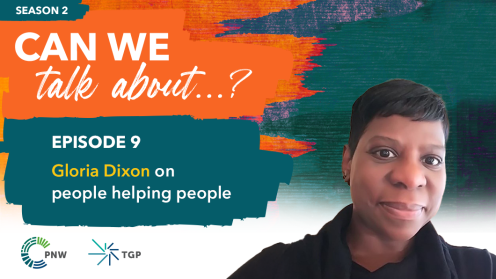
For this episode, I'm joined by Gloria Dixon, the Director of Philanthropy at BECU, and the Executive Director of BECU Foundation. Based in Seattle, BECU is one of the top five largest credit unions in the country, and their goals include helping individuals to access and complete post-secondary degrees, build relevant skills for today's workforce, and to encourage and expand entrepreneurism.
So I just want to say a warm welcome to Gloria, and to thank you so much for your time. And I would love to start this episode by having you introduce yourself. So can you tell our audience who you are, what brought you here today, and how has your personal experience shaped your approach to philanthropy?
Gloria:
Hi, Katie. Thank you for having me. My name is Gloria Dixon. I'm the Director of Philanthropy, and the Executive Director of the BECU Foundation. I was brought to this work because this work I've always done. So I've been doing work in nonprofit organizations for most of my professional career, so definitely well over 25 years. Pretty much, you name it, I've done it in nonprofit work. Whether it's been food insecurity, after school learning programs for young people, working at faith-based organizations, grassroots community organizing. I've done so much work in the nonprofit space.
But it's even deeper than that, for me. I grew up in Milwaukee, Wisconsin. We have a very high concentration of poverty in Milwaukee, and I grew up in a household where my mom was a single parent household, and there was times we struggled. And my mother needed access to other assistance, whether it was through nonprofit organizations, or through any city, state related programs. And that really, living in that atmosphere and seeing my mom work very hard to make sure we'd stay afloat, but at the same time, she required us to give back and be part of our community. So I remember times where we were volunteering at food kitchens, where maybe we needed a meal that night. So those things stuck with me, and I carry them throughout my lifetime. And then, too, my college journey, and now into my professional career. So I always like to say that it's come full circle for me, that I'm giving back to the community that gave to me when I needed help.
Katie:
Thank you so much for sharing that. Well, I'd love to hear more about BECU, and how equity in particular shows up in your work. And maybe before you talk about that, could you define, what does equity mean to you? And what does it mean to the organization?
Gloria:
When you think about equity, there's a really popular picture that shows what's the difference between equity, what's equal, and what's equity. So equal is, everyone is able to stand on a box to be able to see over a fence, to watch the game. Equity is when you look at the differences of the social dynamics of each of those individuals, where some people are starting at a higher place than other folks. So in order to make it equitable and fair for everyone, you have to give a little bit of a higher stand for those folks who have more challenges to get to the equal footing, as another counterpart. So that picture sticks with me, when I think about what is considered equity in our work. So for me, that is a perfect description of what it is.
But when I think about BECU, it goes deeper than that, because BECU doesn't just look at equity from the lens of just one particular vantage point for us, because we are a member-owned credit union, we are a cooperative, we look at how is that affecting all of the spaces where BECU has membership, or our service areas. And so for us, equity is not just based on cultural or racial dynamics, it's also based on regional, it's based on financial. What's the difference in someone's financial? It's based on our employees, and what's the different ways that our employees have come to BECU?
So we have so many different ways that we look at what we consider equity, and we're always challenging ourselves to be fair and equitable to all those systems. And so we're constantly re-evaluating, "What does that look like for us?" And in our work, in philanthropy, that means that our network of partners, community partners we work with, are so vast and so very different because we have to meet all of those different challenges, on making sure we're providing access to quality programs for everyone.
Katie:
And can you say more about why that's important to your organization?
Gloria:
It's important to us because that's the credit union philosophy, people helping people. We truly believe that, for each of us to be successful, we have to help each other. It is not just BECU's model, it's every credit union's model. As a cooperative, we were built out of the community. BECU was birthed because seven Boeing employees came together to help buy tools, so they can actually start their jobs at Boeing. And for us, that mandate and that start stays true, right now. That it's very important to us to continue to make sure that we're looking at what are the needs of our members, what are the needs of our community, what are the needs of our employees? And again, like I said, challenging us to meet that need to be there, and help each other.
Katie:
Well, I'd love to hear more about concrete examples of how this shows up in your philanthropic efforts. And I know one of the efforts we talked about was, in 2020, you created the Black Community Development Project. So can you tell us more about that project, and what were some of the more powerful lessons you've learned from that experience?
Gloria:
The Black Community Development Project was birthed out of the death of George Floyd, and a lot of the racial and social unrest that surrounded that. BECU, like many large organizations, took a stand and stood with the community to enact change. And so, one of the things that we thought we talked about was, "How do we make sure that not only internally are we doing the work, but also, we're showing up in our communities?" And so my boss at the time came to me and said, "Hey, we want to put together something to give back to the community, use some of our philanthropic dollars to do that." And so, I put together the Black Community Development Project grant, not just to support the overall wellness of the Black community, but also to look at what are the inequities that are around financial health for the Black community? The black community continues to be behind white counterparts when it comes to wealth building and wealth attainment.
And so, the grant was put together basically to, one, solve for some of those discrepancies through partnerships with non-profit organizations that are working to provide solutions. But then also, we were partnering with our credit union associations. What is the work that's happening across our credit union to do the real work of supporting Black employees, supporting Black employee growth and development? We looked at internally, how are we allowing our employees to support organizations they care about that's doing work in communities of color? And then, finally, we really wanted to look at, how are we supporting nonprofits that are led by predominantly Black staff, and or board members? And so those were the pillars that we stood upon when we wrote the grant.
And I'm happy to say that we ran the grant from 2020 to 2024, in total we gave $5 million back to the Black community. But what was surprising about it, and I think this is very true of any community of color, that normally when you go into the Black community, that is not the only community that's there. There are a lot of other cultures within that community. A lot of different diverse communities usually are situated right next to each other. So because of that adjacent-ness, any funding that we gave to a nonprofit that primarily worked in Black communities, was also serving very high percentages of populations in the Asian community, in the Hispanic community, in poor communities that identify as white. So there was a lot of raising all boats that happened when we decided to give those dollars. So even though the fund was named and designed to support the Black community, it really did support many communities across many different cultures and regions.
Katie:
Yeah, I'm so glad you mentioned that, because I know oftentimes when we talk about equity, sometimes there is a perception that it's just giving almost preferential treatment to a particular group. And I think that the way that John Powell talks about equity is, "Who's the least served well, and how do we differentiate the way we do our work, or our programs and services, to meet the needs of those who are the least well-served?" And then what you find.
Gloria:
Yep, and with those communities.
Katie:
... is that you actually raise all boats, for everybody. So yeah, I'm just curious how that experience is staying with you, how is it influencing the way you are currently doing your philanthropy, and maybe the way you're thinking about future efforts?
Gloria:
You know, it's interesting when we talk to our nonprofits that we funded and ask them, "What do you think is important to you? What should we do?" And by the way, I would say that BECU does model trust-based philanthropy. And for us, we don't go in as a funder and say, "Oh, this is what we're going to do, because we have the dollars and this is how we want you to use our dollars to provide support to the community." We listen to the community, we allow them to tell us what needs to be funded, and what is the right way to do this work. So that's the same thing we did with nonprofits, we do that on the regular, with the 200 plus nonprofits that we work with. We truly believe they're more relationships than they are these transactional partnerships. They're very much relationships.
So we listened to our partners and we asked them, "What do you think is needed? What do you need?" And it wasn't so much that the nonprofits that I identified as Black were saying to us, "We need you to give more back to the Black community," that's just not the only thing. For them, it was the same thing that everyone else needs. "We need more investment in our small businesses. We need more investment to grow more housing, more homeownership." So many of the things that they needed and wanted was not just only for their community, but for the larger picture of what they need to be, or become, financially secure.
And so, one of the grants we launched, one of the first grants we've ever launched at the BECU Foundation, was the Housing Stability Grant. That grant was focused on eviction and foreclosure prevention. And Black communities, particularly Black single mothers, tend to be one of the highest groups that face eviction. And so, as we were talking to one of our partners about it, they were like, "That's where we need more support and investment, around making sure people can stay housed, stabilize housing." Because if they lose their housing, then so many other things happen. It's like this ripple effect of, if they lose housing, then their kids aren't getting access to school, they're not eating proper meals, they can't pay for adequate transportation. And so, hearing that spurred another grant, the Housing Stability Grant, that was very successful. And right now we're working on an even bigger strategy around housing, because we realize we need to invest more and do more work in that space.
Katie:
Yeah, that's great. That's a really great example. And I know you have been, BECU has been, such a local leader in advancing trust-based philanthropy. And can you tell us more about, I think you had a summit a couple of years ago on trust-based philanthropy. What spurred that, and what did you learn from that?
Gloria:
So honestly, my learning from trust-based philanthropy came from the Giving Practice, out of Philanthropy Northwest. And really, what I think I, as a person, I think I already knew, having been on the receiving end of services I now support. That it's more important for the community to be part of the design and execution of what they need to be successful. I don't want to say that everyone has the ability to pull themselves up by their bootstrap, when that's not true. Everyone needs help, or sometimes some people need more help than others, but that's really what they need. They just need you to give them opportunity to help themselves, and make space for them to help themselves, so then they will do that work. So what I learned is not only just listen to them, but once you give them the resources to do that, step back and let them do the work. They're capable of taking care of it, and supporting their community, and building their own individual families up. They don't need to be handheld or micromanaged to do that.
Katie:
And in terms of your relationship with your grantee partners, how does trust-based philanthropy actually show up in terms of your practices? If other people wanted to do more of that, what would they do?
Gloria:
First, you got to take the time to listen, and truly listen. Provide opportunity for your partners to feel comfortable coming with you to share their successes and their losses, and not say that because you failed, we're not going to do that again. "We tried that. It didn't work." There was a partnership we had a couple of years ago, before we were modeling trust-based philanthropy, where we were going to go in and we were going to partner with this organization. And while they were providing workforce development with these individuals, they would also provide some financial literacy training. Because, one, maybe they've never had a financial account, or maybe they've had trouble with it in the past. Or they just needed to really understand how to balance their checkbook, how to read a credit score, or eventually buy a house or buy a car.
And so one of the things we realized, as we went into it, as we were coming back with some of the reports, is that for a lot of the people, it was more of those small successes. Like for someone, it helped them stop smoking, because they needed to save. So they were able to reduce how much they smoked in order to save money, because they realized that's where they were putting a lot of their dollars. Or for someone, they realized, "I'm close enough that I don't need to drive my car every day. I can get on the rail and come into my job, rather than that," and that saved them money on gas. So there was all these little small, incremental changes that people were making, whereas our initial outcomes that we set up with the partner was very huge. They were going to open an account, they were going to have $500 saved by such and such date, and that was challenging for the people.
And the reality is, that we didn't ask them first. We made outcomes and decisions on what we thought would happen without asking and listening, and talking to them. And that really kind of was the precursor to why we realized, "Okay, maybe we need to do something different." And at the same time, we were thinking about that, here comes Philanthropy Northwest and the Giving Practice. "Oh, we're going to do this new thing called trust-based philanthropy." And I'm like, "Oh, that's what it is."
So it was like the same time that happened, that we realized that for anyone that's looking to get in this work, you really need, one, first. Get some training. Understand exactly what it is first, because it's not an easy adoption, and I don't want to say you could just start doing it out of the blue. So there's training to understand it, and then, start practicing it. Start with a few partners and see how it's working for you, how you need to adjust it based on your particular organization. For us, I've been very fortunate to work at an organization that, because we're a credit union, because we're a cooperative, we're different than most philanthropic organizations. We already are owned by our community, so we're making decisions about our products and services based on the needs of our members. So it was a little bit easier for us to do the same thing with our philanthropy, because we already listen to our members. So we're like, "Okay, well, now let's listen to our community."
Katie:
And I'm curious, as you look to your other peers in corporate philanthropy, what are you seeing as their adoption of trust-based philanthropy? What's your sense of the ecosystem of other peer funders? Do you think they're adopting it, or if they're not, then what are you seeing as potential hurdles or challenges?
Gloria:
Yeah, I would say adoption rate maybe has been 50/50. Some of them, like me, work in an organization that was already there. They were already, I guess you could say, a kinder and gentler corporation. So maybe it was a little bit easier for them. But I do understand for some, it is harder. When you work in a corporation that is shareholder-based versus, like we are, we're much more, we're a community credit union, we're community-based. But you have to level up to the needs of that corporation. So it's a little bit harder. I think a lot of them are modeling it, in the best way that they can, within the confines of their structure.
Katie:
And it sounds for you, getting the framework of trust-based philanthropy was really important, as well as being supported by leaders inside your organization. So do you have any other advice for other funders who are interested in learning more about this approach?
Gloria:
One of the things we're really good about, BECU, and it's not just for other corporations, also other credit unions. We share. If anyone wants to reach out, wants to learn how we're doing it at BECU, happy to be that resource. Happy to be that confidant, if you want to share how it's difficult, and things I could share to help you. We are always talking to other funders or other credit unions about how we do our work. And the other thing is, like I said, to really reach out to the team at Philanthropy Northwest and learn how it's really done.
Katie:
Well, I'd love to just get a better sense of what you're scanning as current opportunities or challenges, as you think about your philanthropic work. What's going on now, and how are you thinking about efforts to continue to support equity, especially in this current moment?
Gloria:
Yeah, so now, my view on equity, because I really think we do a really good job of being equitable across different communities. But now we're looking at, more so, equity on how much we give. And I think now, more than ever, nonprofits need partners to not just give but give longer. Give larger amounts. And so we're looking at, one, we have a number of partners on the book and they're all amazing, but maybe it's time to decrease the number of partners we have, and give more to specific partners. And then, over multiple years. We'll always have a lot of partners, because BECU has a large territory we have to cover. We have Washington State, part of Idaho, Oregon, as well as a small pocket in South Carolina, where there's a Boeing plant. So we'll always have a number of partners for that reason, because we want to make sure that we're representative of all the different communities we give to.
The needs in Spokane are not the needs in Seattle, are not the needs in South Carolina, so we have to show up in those spaces. But we also understand that the importance of a nonprofit, having a partner that won't walk away after a year, that they can count on that will be there for the next three, five years, or potentially more. And so we're looking at, right now, developing a plan on partnering in that capacity. We do have some multi-year that we give to, but that'll probably increase over the next year, with different partners. And what we're thinking about more so is, obviously housing is really important to us, and small business growth and development are really important to us. So those are areas that we're looking at, and how we're thinking about doing the work.
Katie:
What are you seeing in the current environment now, given everything that's going on? And just what are your thoughts on, how you do that when the need only seems to be increasing? How do you think about that?
Gloria:
Honestly, that is challenging. It really is, because like I said, I can't think of one of our partners that I would not give to more, if I had my way to give more to them. They are amazing at what they do, and they truly care. That's something we're figuring out. So much is happening in real time, and unfortunately we're hearing about it very regularly. A lot of nonprofits are struggling, a lot of them are losing access to some of those federal dollars that they counted on. And I think they're doing the work themselves. They're not just relying on funders to figure it out. They're aware that we only have so much ability to give to them. So a lot of them are looking at what can they do first, before they come to us and ask for additional dollars. Honestly, I think it's going to be a collaboration between us and the nonprofit community. How can we support each other more? How can we be there for each other more?
And then also, I think it's going to be funders coming together to do more co-funding of projects and initiatives, so we can get bigger impact. I know that BECU can't do this work all alone. We are always interested in being in partnership with other like-minded funders, to do important work. We give to an organization, a lot of times, they also get funding from many other different funders. And I think it's just time for us to all come together, support each other, lift each other up.
Katie:
Well, as we discussed in our planning session, in some of our earlier discussions, really the whole purpose of this podcast is about the normalizing, the messiness of leading for racial equity, as well as just offering some practical advice to others who are interested in this work, on how do you do this? How do you continue to sustain this work? What is it that you need to do for yourself, at the personal level? And then, really lead at the organizational level. And so I'm curious if you have thoughts about that. What do you do to continue to really keep on going, and to support this work?
Gloria Dixon:
I say it all the time, and I mean it. I have the best job at BECU. I truly do. I truly feel I'm walking in my purpose. I absolutely love the work that I do, and giving back to the community. So it's very easy for me, because I get up every day knowing that I'm doing something important, something vital to support our community. And I hope that individuals doing this work see that, and know that. It can be, it's tireless work. You're not going to get a pat on the back. You're not going to have people singing your praises. You can't go into this work thinking that's what's going to happen, because it's not. And you need to be okay with that, that you're going into this work doing really hard work, and the success and the joy you should get out of is seeing others succeed and grow in whatever you're supporting. Whether it's, for us, it's financial health or whether it's education, or whatever those areas are.
So I would encourage people every day, one, get your rest. But two, just really center yourself on the fact that you're doing good, ultimately, for our communities.
Katie:
And I hear that you work at a values-aligned organization, where making the case for-
Gloria Dixon:
I do.
Katie:
... equity, and really thinking about, do all of our populations regardless of race, or geography, or zip code, do they have access to equitable services? And I'm curious if you have colleagues who work in other corporate philanthropy, in particular, or corporate organizations. Who, they haven't been as successful in making that case. I wonder if you have any advice for what they could do?
Gloria:
To be perfectly honest and completely transparent, if you're working in an organization that doesn't see the big picture and the power of what you're doing, they're already divesting in the work. And maybe that's not the space to do the best work you feel you can do. It's also really personal journeys and personal choices, on where you align yourself, and where you work. I work at BECU because I, 100%, believe in BECU's mission and the work that we're doing. I'm very fortunate to work at a company that feels that way, that we are all united to support our members and our community. It shows in how much you see us out volunteering. It's real authentic.
We just had a partnership we launched in Spokane with The Scale House Market, and not only was my team engaged, but also other teams at BECU was engaged. And they were like, the people running it were like, "Oh my God, there are like a hundred BECU people I'm getting emails from." She was like, "You guys really care. You guys are serious about doing good." It's not just from me, it's across the org with all the employees.
And it's easy for me to say to someone who doesn't have the support, "You just got to keep going. You got to keep pushing," because I'm in an environment that lets me do that. I work with colleagues-
Katie:
Mainstream, yeah.
Gloria:
... that get up every day and feel the same way I do. But for someone who is in that environment, I can understand, I've been there before. I worked in organizations, that wasn't it. The best thing you can do is keep doing the challenging work of giving back and doing good, putting proposals and work in front of the folks that prove what you're trying to achieve. Data, the numbers, all of that will continue to help possibly influence their decision-making on how they're going to support, or how they're going to show up and do this important work.
Katie:
And how much of your effort is in influencing other funders? Will you say more about that, how you cultivate relationship with other funders to support efforts?
Gloria:
I've always heard that the best influence is, people see you doing, and that's what I found. When I get emails from other funders, or other credit unions, they're reaching out because they either heard or they saw something and they were like, "That's what I want. Can you explain to me what you're doing, and how you're doing it?" And so for me, really, it's not me doing anything to convince anyone. I'm just doing the work that's in front of me, and doing it to the best of my ability. And if folks are reaching out, it's because they saw or heard something that really sparked their curiosity, and they want to know. How do they find that joy in what they're doing?
Katie:
Yeah, yeah. Okay. So Gloria, I know that you shared that BECU works across different geographies. So in Idaho, Oregon, Washington, I think even in South Carolina. What are the different needs that you are seeing in those different communities, and then also, what's connecting them?
Gloria:
Yeah, so one of the first thing I did when I moved to Washington and I started working at BECU is, I just spent time in the community. I'm from, like I said, Milwaukee, Wisconsin. Completely different time zone, and completely different needs, completely different people, completely different way of doing things. And so, I spent time in Washington understanding, what is Washington? What are the needs? What do people want? And so that way, I could be a better funder, a better voice for the work.
But I'm aware that I can't show up in every community that BECU is at, neither can my team. We are a small team of just three people doing this work on a regular basis, so we leverage other BECU employees who live in those communities to tell us, "What's happening in your community? What do you need? Is this a nonprofit you would encourage us to support?" So we leverage our team. We don't do this in a vacuum, and siloed, as if we're the only ones that can make decisions on how BECU responds in the community. Our employees are an incredible voice. They are all individually very involved in their respective community.
So if we're giving to South Carolina, I reach out to the branch manager down there and I'm like, "Jamie, what do you know about this, and what's happening in your community? What is the greatest need?" And that way, when we make funding decisions, we're still holding true to our belief of listening to the needs of the community first.
Katie:
Yeah. And are you finding that the needs are different in those different communities?
Gloria:
Oh, yes.
Katie:
Yeah.
Gloria:
Absolutely, absolutely. I mean, case in point with South Carolina, that is in the South. And we're up in the Pacific Northwest. That is a vastly different space, and different climate. And so when I asked Jamie, what's happening in South Carolina, and she was like, "Kids are struggling with graduating high school. That's really important." And not that it's not happening here, but it's just different there. And so we give to organizations that are supporting youth education, youth mentorship, youth workforce development, more so than we would here, because that's primarily what they need. So those are the things that we think about.
And even in Spokane, the needs of Spokane can be vastly different than the needs in Seattle. So we tailor our funding to meet the needs of the community, rather than us saying, "We're just going to do blanket education, and you just have to align with our funding." We align to what the community needs.
Katie:
That's so great that you leverage your membership in that way, because especially, again, given how small your team is, that makes a lot of sense.
Gloria:
It's a lot of work.
Katie:
Yeah. What's a surprising thing you've learned, through your time? What's a couple of things that you've learned that you were like, "Wow"? Yeah, that has surprised you?
Gloria:
I've been in this work so long, I don't know What surprises me anymore. Let me think. I think what really surprised me, when I came here to Washington State, one, it's different culturally. And people would be surprised at how non-diverse the Midwest can be, and it's very much still, the pockets of communities stick with their pockets of community. Whereas here in Washington, it is very much woven of different communities living amongst each other, which I absolutely love. I love that. And coming here and seeing how extremely diverse it is, in comparison to the Midwest, but still understanding that the needs are different.
Case in point, I joined the board of the Asian Pacific Cultural Center, because as a Black person, I didn't have a lot of Asian people that I knew, growing up. And coming here to the Pacific Northwest, where there are vast numbers of different cultures, Asian cultures, here. I wanted to make sure I'm respectful, and I do my own work, my own learning, to understand the needs of the community, or to be sensitive to the community. And so that was a learning curve for me that I took head on.
Katie:
Yeah, that's beautiful. Thank you so much for sharing that. I want to ask you a couple more questions around, what are some of the more... Not your favorite, but what are some examples of other impactful efforts that your organization has made, that you want to really highlight?
Gloria:
Oh, wow. That is a hard one, because there are so many. We have a partnership with an organization who provides small business growth and development up in Skagit, Whatcom Counties, the island counties. So theirs is a little bit different than your traditional small business support, where they're supporting small businesses that primarily work in agriculture or manufacturing. They're inventors, they have a maker space up there. That's one that I really love the uniqueness of it.
We also have a partnership with an organization here, Refugee Women Association, that is helping women of different, immigrant or refugee, and they are helping them actually create items out of reusable waste items, which I absolutely love. And some of the items they created was like a coat- tent-backpack for homeless individuals, that they created out of a Starbucks coffee bags. Absolutely amazing.
Our partnership with the Family First Community Center in Renton, that is just a gem of a organization for an area where there are a high concentration of young people that have no place to go. But now they have not just recreation, but a place to do some afterschool learning, health clinic on site, mental, medical, and dental care. And it provides support not just for young people, but also for children, as well as seniors.
The partnership we just started in Spokane, with The Scale House Market, Spokane's first ever indoor-outdoor marketplace, that will not only provide a place for the households around it who were living in a food desert, now they have some place to go to buy some groceries. Not everything they need, but a lot. It also is incubator space of growth and development for small businesses, including farmers, rural farmers, and fisheries.
Those are just a few that I'm just naming off the top of my head, that I absolutely love, and really am proud to be partners with. But I can't think of, I could keep going on and on and on, a list of partners that I really am proud to say that we are in support of their work.
Katie:
Well, I just want to lift up some of the things I feel like you've just been saying throughout our conversation, that I think are great practical advice for other funders who really want to do this work well.
One is, really build and lean in on relationships, and listen to the partners. It's really leveraging all of your assets inside your organization, using the many staff members at BECU, and really listening to their wisdom about what their community needs.
And then really differentiating what the different kind of services are, and just paying attention, again, to local differences in community. And I think your advice to other funders is, do that, and give more multi-year general operating support. And continue to support differentiated supports, and to make sure that all communities' needs are met. But what else would you add to that? What are other advice that you have for, especially corporate funders? Again, in this environment where there seems to be kind of, equity is in the news. And people are like... And you're seeing a lot of retreats. What other advice would you give?
Gloria:
Talk to your peers. Reach out and talk to your peers. It's challenging work, and it can feel very lonely doing this work. Usually, we all are small teams, inside of a larger organization. So reach out and talk to your peers for support. I think that, before we started this, we were having a chat about a recent corporate funders meeting that we had. And philanthropists, we love getting together, we love seeing each other. But we don't get the opportunity to do it much, because we're all in our respective places working, heads down, or out in the community. So it's important to reach out and have peer lunches, to have coffee with other folks, to learn from one another. So, reach out, because sometimes that's all you need is that little bit of rejuvenation to keep on going.
Katie:
That's such a good advice. Good advice. And I hope that we'll maybe link in our notes your information, if you're willing to be a resource for others.
Thank you for all of this. I'm wondering if there's anything that I haven't yet asked you, that you feel like is really important for the audience to know?
Gloria:
The one thing I want to leave with, and I've said it earlier, the power in people being people. I can't express that enough, how vital, important that is right now. That we are helping each other, that we are supporting each other, and that we engage in this work together.
Katie:
I think that's really true. And I again, love, as a BECU member myself, it just makes me so happy to hear that.
Gloria:
Yay.
Katie:
Oh, Gloria, you've done so much, and I just feel like you are like the role model. I love all the work that you are all doing at BECU.
Gloria:
Thank you.
Nancy:
Can we talk about..? is a podcast by Philanthropy Northwest, written and produced by Aya Tsuruta and Emily Daman, with production support by Podfly and graphic design by Asha Hossain. Our episodes this season are hosted by TGP Senior Advisors, Katie Hong, Robin Martin, and Abby Sarmac. You can find more information on this episode, including guest bios and show notes, at thegivingpractice.org.
And if you have a topic that you think philanthropy should be talking about more, let us know by emailing hello@thegivingpractice.org.
A special thanks to our Philanthropy Northwest and Giving Practice teams for their thought partnership, and the Ford Foundation for making this project possible. I'm Nancy Sanabria, and we'll see you next time.
Overview
Gloria Dixon, the director of philanthropy at BECU and the executive director of BECU Foundation, joins Katie for a discussion on how corporate funders can show up for communities using trust-based practices.
In this episode, Gloria shares how the credit union philosophy of ‘people helping people’ is aligned with BECU’s philanthropic work. BECU takes an equity and community-based approach to supporting 200+ nonprofit partners that are working to improve financial health and well-being. She also discusses the importance of trust-based philanthropy as a model for other corporations to put people and communities first.

Gloria Dixon
Gloria Dixon began her career with BECU in 2017 when she became the credit union’s first employee dedicated to philanthropy. While BECU is known for giving back, Gloria’s strategic focus on financial health and economic resilience has helped grow the credit union’s impact. With her leadership, BECU’s donations totaled nearly $9.2 million in 2024. Gloria has a passion for grassroots community work. Under her leadership, the BECU Foundation worked with the Washington Department of Commerce and Small Business Resiliency Network to give $2 million to entrepreneurs in urban and rural areas during the pandemic. She also launched the first-ever BECU Foundation grants focused on housing stability and green energy. In 2020, Gloria created the Black Community Development Project, a five-year, $5 million commitment to improve the financial health and well-being of the Black community. Gloria serves on boards for Philanthropy Northwest, Renton Regional Community Foundation and Asia Pacific Cultural Center.
Key Lessons & Insights
- Gloria shares some of what she is hearing from the credit union’s grantee partners in this current climate. Specifically, funders need to step up and give more and give long-term to their communities. She shares that it is important for “nonprofit(s) to have partners that won't walk away after a year. [Partners] that they can count on that will be there for the next three, five years or potentially more.”
- When BECU began its work in trust-based philanthropy, it took time to listen to the communities it serves. As Gloria shares, foundations need to “take the time to listen and truly listen, provide opportunity for your partners to feel comfortable coming with you, to share their successes and their losses.”
This approach has helped BECU navigate and align their giving with the different needs of the various communities they serve across Washington, Oregon, Idaho and South Carolina.
References & Resources
- Gloria shares that single Black mothers have the highest rates of eviction, and that BECU is working to address this through its grantmaking. For more information, read the Center for American Progress (CAP) report: The Disproportionate Burden of Eviction on Black Women.
- Katie mentions john a. powell, director of the Othering & Belonging Institute at University of California, Berkely, and how he talks about equity not as preferential treatment, but as ensuring we serve those who are least served well, and seeing how that raises all boats.
Ongoing Reflections
Gloria reflects on the power of working in a values-aligned space, acknowledging the challenges of working within systems that don’t support equitable change.
What are some ways you can harness your power, no matter what environment you are in?
Credits
This episode of Can we talk about…? was produced by Aya Tsuruta, Emily Daman and our audio engineer Josh Suhy, with editing support from Karalyn Jenkins. Special thanks to Asha Hossain (Graphic Design), Nancy Sanabria (Intro/Outro Host), Komiku (Music). Thank you to the Ford Foundation for making this project possible.