Strategic Directions: The End Product of Equity-Centered Strategy



In 2024, we set out to learn how our sector is centering equity in strategic planning. As part of this journey, we’re lifting up lessons and tools emerging from the field. You can read more about why we were interested in this topic and overall what we learned about equity-centered strategy in Part 1: Meeting the Moment with an Equity-Centered Approach to Strategy Development.
We invite you to explore the rest of our series as well including:
- Part 2: Priming Our Organizations and Ourselves: Readiness for Equity-Centered Strategy
- Part 3: Equity-Centered Strategy: The Process is the Work
- Part 4: Who Belongs at the Table? Rethinking Role and Participation in Equity-Centered Strategy
In this post, we share examples of what final products in the equity-centered planning process can look like and ways this work can help organizations actualize their values.
Landing on a Strategic Direction Rather Than a Strategic Plan
At GEO’s annual conference just a few weeks ago, we heard from Ruth Anne Norton of the Healthy Homes Initiative, who shared, “If we can’t walk in our values, what is the point?”
Traditional strategic plans, inspired by for-profit strategy development processes and widely used across our sector today, generally don’t set foundations up to lead with their values. They tend to be time-bound products that attempt to achieve a particular set of outcomes or results on discrete, specific issues — a deterministic approach that loses sight of what is happening in the community in real time and narrows the foundation’s vision.
In equity-centered strategy development processes, the end result is not the end of the process, but the beginning of living out a foundation’s values.
This is because equity-centered strategy processes lead to strategic directions, not plans. Strategic directions focus on supporting communities in an ongoing way, rooted in the foundation’s values. Ultimately, the impact is not on specific issues that the community is accountable for achieving, but instead on the foundation’s values and how they show up and are in community with their grantees and partners.
Example #1: Sewall Foundation
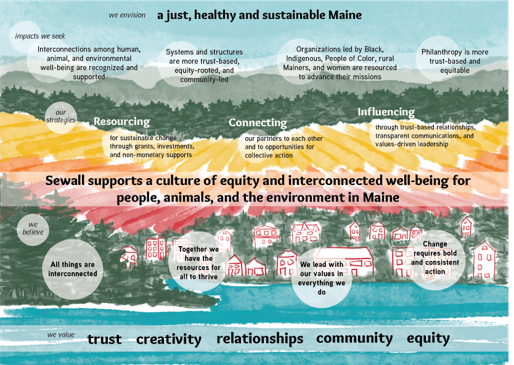
The Sewall Foundation's strategic direction is one page, rooted in their values of trust, creativity, relationships, community and equity. Impacts that the foundation seeks are focused on interconnectedness, shifting systems and structures to be equity-rooted and community-led, resourcing BIPOC, rural and women-led organizations and shifting philanthropic practices that are more equitable and trust-based.
Example #2: Waters Meet Foundation
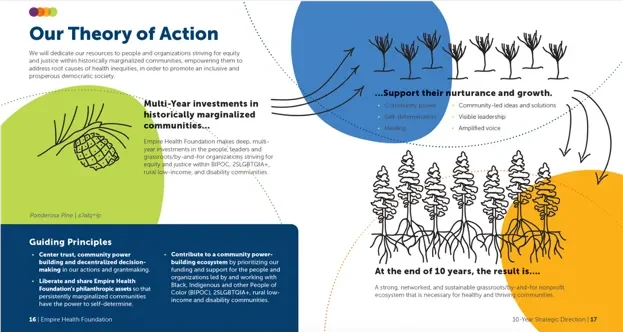
Waters Meet Foundation's 10-year strategic direction focuses on multi-year investments for BIPOC, LGBTQIA+, rural, low-income and disability communities — those most affected by health inequities.
There are ample benefits to strategic directions, but one that has surfaced regularly, especially in today’s context, is that this approach allows funders to be adaptive and responsive to the community’s emerging needs, especially in times of crisis. This was evident during COVID and again in the current era of federal funding cuts and attacks to racial equity, where best laid strategic plans have been scrapped due to the rapidly shifting context. Equity-centered strategy is designed to support work that is adaptive and responsive to grantees and the broader community.
Implementing a Strategic Direction
How does a foundation implement a long-term strategic direction? We have found that the most successful way to operationalize a strategic direction is as simple as using annual workplans. These workplans are developed and informed by conversations with grantees and other foundation partners.
Waters Meet Foundation actualizes its strategic direction through a grantee cohort that will meet for at least five years and receive annual general operating support. This cohort is forming committees based on community needs, such as policy and advocacy, healing, and operational efficiency. The community of grassroots nonprofits engaged in this initiative drive Waters Meet’s program creation and funding strategy on behalf of their organizations and the communities they serve.
The Sewall Foundation uses rapid grantee surveys and community conversations to make small adjustments to their grantmaking rubric and criteria, which they share on their website for all to access. The foundation has also worked to shift its investment portfolio to be 100% values-aligned, and is currently 70% of the way there. This example showcases how foundations are implementing an equity-centered strategy in all aspects of the organization, with greater emphasis on alignment of values.
When foundations develop an equity-centered strategy that is directional and values-aligned, they are better able to adapt and respond to the changing tides of the world, supporting grantees, partners and the broader community where it is most needed.
Now, you might be wondering — and others have asked us this same question — how the heck do we measure a direction? Stay tuned for our final post of the series, where we share how foundations can embed measurement, learning and evaluation into this process in ways that are not extractive to grantees.
To meet with one of our senior advisors and learn more about equity-centered strategy, reach out to us.
Find our previous posts where we offer an overview of equity-centered strategy, discuss the importance of ensuring our organizations are ready to begin this work and how the process is the work on our resource library here.
More from TGP
Subscribe to our newsletter to stay up to date on our latest reflections, insights, interviews and more.