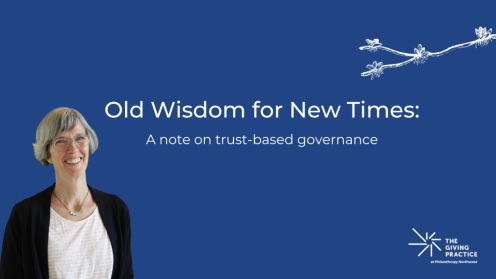
Old Wisdom for New Times: A Note on Trust-Based Governance

A foundation CEO called The Giving Practice recently, with a surprising issue.
“We have fully embraced trust-based grantmaking,” the exec said. “Now we need a trust-based board!” We discussed issues the trustees were having: lack of candor, backdoor communications and second-guessing staff. How could we help this board understand that trust begins at home?
Despite being on the cutting edge of grantmaking practices, this board was suffering from very common problems with its board dynamics. To address them, and to tie trust-based grantmaking to board operations, we decided to dust off one of the oldest “trust” frameworks in the world: fiduciary duty.
We met with the board in person to discuss Fiduciary Duty 101, i.e., the duties and obligations that legally bind people who oversee someone else’s assets. As we talked, I think we were all surprised at the beauty of timeworn concepts like the “the duty of care” or “the duty of loyalty.” We probably expected legalistic formulations - or wagging fingers! - behind these old-fashioned words. Instead, we found simple and clear standards for board behavior. We have to be candid, and we have to show our cards. We have to prepare well, and listen carefully. We have to put self-interest away. We have to act in good faith – not just externally in the communities we serve, but also internally, in our dealings with one another.
The board really resonated with the fiduciary standard for being a “prudent” person, which is basically to do the best that you reasonably can, given your own background and skills, to see into the future and make decisions that further the foundation’s core function in society. The prudent person standard gives every board member a unique value and a useful role, Each trustee has a clear mandate to look ahead (that is the root meaning of prudent) for the best way the foundation can create charitable benefit. We even unpacked the meaning of charity, and found its root meaning of love of humanity – quite a north star for the prudent foundation trustee.
Duties of Foundation Trustees
Duty of Care / Prudence
Apply your unique combination of skills and experience, and your full attention, to the best course of action for your charitable organization.
Duty of Loyalty
Your first loyalty is to the organization, not personal self-interest or even other constituencies you may represent.
Duty of Obedience
Obedience is not rote; it requires deep attention to the core.
Of course, the root of the word fiduciary is trust – and the framework of laws and case law that define fiduciary duty tell a long, ever-evolving story, of how people can come together to work in trust. It was inspiring to see a group of trustees rediscover the beauty and the utility of the fiduciary duty framework – and we look forward to watching them adapt the concepts in a trust-based philanthropy setting.
Rosalie Sheehy Cates is a senior advisor at The Giving Practice at Philanthropy Northwest. Learn more about Rosalie here.
Looking for support on your trust-based philanthropy journey? Email us at hello@thegivingpractice.org
You can find additional resources on trust-based boards from our partners at The Trust-Based Philanthropy Project below: