Themes from Season 2 of Can we talk about...? on Advancing Racial Equity Across Contexts
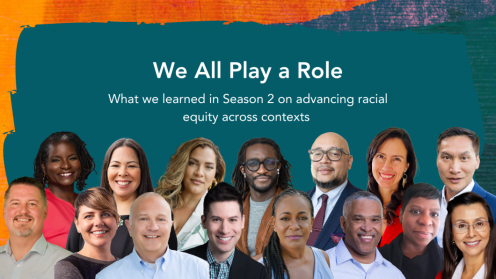
And just like that, Season 2 of Can we talk about…? is a wrap! In our show, we explore what it takes to lead for racial equity in philanthropy, and this season we set out to uplift the nuances of operationalizing equity commitments across a diversity of contexts.
We heard from a community foundation in Birmingham, Alabama, working within one of the Southeast’s most fragmented communities; a capital fund investing in Black Portland’s future; and a community-led public foundation partnering with grassroots nonprofits serving Asian American, Native Hawaiian, and Pacific Islander communities. Our guests represented a wide range of geographies, communities served and philanthropic models, each with a unique story and strategy for change.
Five episodes into the season, a new administration came into office, adding yet another layer of complexity to an already shifting landscape. The urgency of equity work deepened, and so did our conversations.
So, what does it take to push this work forward in today’s landscape? Here’s what we learned from our guests:
1. Starting Anew
In a field where transformation often means slowly unraveling decades of ingrained culture and practice, some are taking a bold step, beginning fresh with a commitment to equity from the outset. Our guests included New Breath Foundation (est. 2017), Women’s Foundation of the South (est. 2021), Indigenous Women’s Flow Fund (est. 2020) and 1803 Fund (est. 2023), all of whom started their foundations from the ground up, centering lived experience and community-led solutions.
Others like Waters Meet Foundation (formerly Empire Health Foundation) and Seeding Justice (formerly McKenzie River Group), have reinvented themselves, inviting new leadership and staff to start fresh while honoring their history.
2. Deep Listening
Whether working to center community, collaborate with other funders, or bring peers along on your organizational equity journey, deep listening is a critical skill that nearly every guest highlighted. While listening may sound like a simple act, our guests acknowledge that it doesn’t always come naturally. In a fast-paced world, it takes intention, practice and patience. But when we slow down and truly listen, we begin to build the deep, trusting relationships that are essential for lasting change.
3. Working Intergenerationally
This season, our guests modeled the power of taking an intergenerational approach to advancing equity, reminding us that lasting change is rooted in both legacy and innovation. They shared stories of learning from elders — those who’ve paved the way with hard-earned lessons — and embracing the energy and ideas of emerging leaders shaping what’s possible today. At the heart of it all is the understanding that this work is never just for now. As our elders know well, every action taken is a seed planted for generations to come.
4. Celebrating a Spectrum of Roles
Our guests represented a wide range of strategies and approaches to advance equity, each calling for distinct roles and contributions. From bridgers who cultivate connection to activators who challenge the status quo to elders who pass on their wisdom, transforming systems and cultures takes all of us. Across episodes we were reminded that advancing equity can take many different forms – some bold and visible, others quiet and behind the scenes – and that every step towards progress matters.
5. Finding Your People
Peer support, learning and action have always been centerpieces of the philanthropic sector, and in today’s context – with rising attacks on DEI, sustained uncertainty and increased demands on funders – coming together as a sector has never been more critical. Guests across our season have leaned into structured spaces like communities of practices, infrastructure groups like Philanthropy Serving Organizations, and 1:1 relationships with mentors. Many underscored the importance of finding values-aligned people and workspaces to make this challenging work joyful and sustainable.
A huge thank you to the leaders who came on to our show this season to reflect so candidly on their work and lessons learned, and to our hosts, Katie Hong, Robin Martin and Abby Sarmac. You can hear Katie and Abby share their takeaways from the season in our Season 2 recap episode.
We are thrilled to share that as we close out season 2, we are rolling right into season 3, hosted by Philanthropy Northwest Associate Director Mares Asfaha. In Season 3, we’ll be doing a deep dive into community philanthropy organizations, based on our work outlined in our latest guide, Toward Transformation: A collection of lessons from 20 community philanthropies working to advance racial equity. Listen to our trailer here!
You can find all episodes with accompanying episode guides (including references, resources, reflection questions and exercises) here.
If you are looking for support in leadership and governance, please reach out to us at hello@thegivingpractice.org.
Aya Tsuruta is the Associate Director of Marketing and Communications at Philanthropy Northwest and The Giving Practice and Executive Producer of Can we talk about...? Thank you to TGP Senior Analyst and Can we talk about...? Producer Emily Daman for her editorial support on this post. You can learn more about our team here.