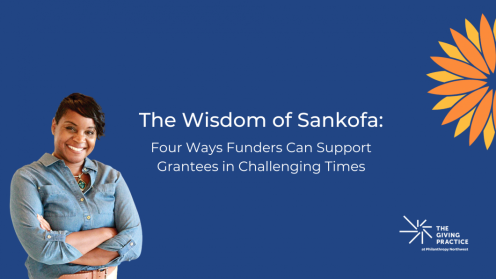
The Wisdom of Sankofa: Four Ways Funders Can Support Grantees in Challenging Times


When I was younger, I was mesmerized by the image of Sankofa as a symbol for how I wanted to live my life. A church pastor introduced me to its loose meaning of connecting the past to the future. I later learned (probably through a Google search) that it is an Adinkra symbol from the Akan people of Ghana, meaning “go back and get it.” It’s a reminder that progress requires reflection, that we can’t move forward wisely without reaching back to retrieve what’s been forgotten or overlooked.
In a sector that often rushes, I try to carry the message of Sankofa into my work as a philanthropy consultant as well. Sankofa calls us to pause, learn from the past and ground our next steps in enduring wisdom.
As I've supported philanthropy’s leaders through a year of feeling overwhelmed yet resolved to show up for the social sector, the following four strategies, inspired by my understanding of Sankofa, seem to resonate with clients the most:
1. Respond with Intention, Not Reflex
Every week in 2025 seems to bring a new crisis or headline. The instinct is often to respond immediately, usually with a public statement. But as we learned in 2020, not every statement adds value. In fact, many funders are still carrying the weight of having made statements they weren’t ready to act on.
The lesson isn’t to respond faster next time, but to respond with true, actionable intent. I tell clients this: you don’t have to show up everywhere. What matters is showing up authentically, where you have the capacity, influence and expertise to make a difference. Sometimes that’s a statement. Other times, it’s simply being present with your nonprofits, offering stability - and yes, resources! - while the noise swirls around them.
I point my clients to How We Respond Matters by Dr. Tiffany Manuel, which highlights three critical questions you can pose to your leadership about when and whether you need to respond with a public statement at all. Doing the work well is a statement, too.
2. Step Outside the Echo Chamber
We are living in an intensely polarized environment. But history reminds us that communities have always found ways to bridge differences. One of my favorite movies, The Best of Enemies (2019), dramatizes a real-life charrette where community members on opposite sides came together to find solutions in Durham North Carolina. It reminds me that communities can work through difference, and philanthropy can play a role in helping create the conditions for that kind of dialogue. (A great example is On The Table in the Chicago metropolitan area, hosted by The Chicago Community Trust.)
The point is, step outside your algorithm – and help your stakeholders step out of theirs. Seek out diverse perspectives and opposing viewpoints to widen your understanding.
Funders are most effective when they can hold complexity without retreating into comfort zones.
One tool I use myself is Ground News, which lets you see how the same story is covered by media outlets on the left, right and center. It helps me consider how others are experiencing the same information.
3. Don’t Shy Away from a Focus on Equitable Outcomes
I believe that philanthropy’s call for equity is not going to disappear, irrespective of today's political headwinds and shifting grantmaking priorities among some funders.
However, I would love for us to better connect our equity journeys in philanthropy with the need to be laser-focused on advancing equitable outcomes for people on the ground and in communities.
To do that, we need quantitative data and qualitative data. The numbers tell one story and people tell a story that’s just as important. Nonprofits often see trends long before they appear in reports. Listen deeply to those closest to the work and integrate their insights into your evaluations and decisions. Calibrating to this moment requires all of the above.
And let me add one caveat here: don’t start making plans without checking in with your nonprofits. The people closest to the work will always know what’s needed most, and listening first is one of the most powerful strategies funders can employ.
I find myself pointing equity-focused grantmakers to one of my favorite, old-school guides that seems to stand the test of time, Racial Equity and Inclusion Action Guide (2015) from The Annie E. Casey Foundation. It provides a steady framework focused on outcomes, data and community involvement to drive equitable change. Plus, when I think of Sankofa, it serves as a reminder that tools from our past can be resources for our future work.
4. Anchor in Place for Long-Term Impact
Finally, I can’t stress enough the importance of place! While disruption feels global and national, so much of the real work happens locally.
The very first community foundation, the Cleveland Foundation, founded in 1914, was rooted in the belief that philanthropy should be anchored in place, accountable to community and designed to grow stronger over time. Place-based approaches plant the seeds that can amplify impact far beyond their original boundaries.
When funders ground themselves in place, they create ripples that extend outward. Today, community foundations, local grantmakers, and philanthropy infrastructure organizations such as Philanthropy Northwest provide the connective tissue our sector needs to activate place-based strategies. These are the spaces where stakeholders from different backgrounds can come together, hash things out and synthesize examples of what’s working. A local collaboration coming out of these spaces can inform state policy or local and regional strategies, which in turn can influence national conversations.
Moving Forward
Disruption is not going away, but it can be our teacher. Sankofa reminds us that wisdom isn’t found by racing ahead, but by pausing to retrieve the lessons and truths that have carried communities through challenge after challenge.
For funders power lies not only in resources, but also in the ability to rebuild with greater clarity and care. If we can embrace that rhythm of looking back to move forward, philanthropy can do more than respond to change, it can drive more equitable and enduring impact.
The Giving Practice (TGP) is the national consultancy of Philanthropy Northwest. Learn more here.
Subscribe
Sign up for our quarterly newsletters to get the latest TGP reflections and resources right in your inbox.