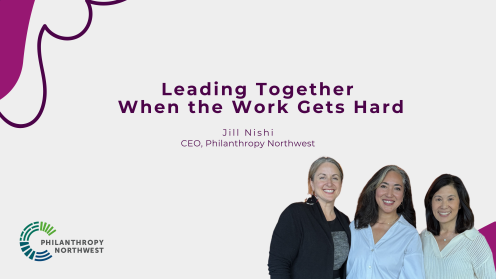

As 2025 draws to a close, I’ve been reflecting on what this year has taught me as a leader, as a listener and as part of our incredible network of peers who care deeply about the health and well-being of our communities in the Northwest.
It is an understatement to say that this has been a challenging season for our communities. Across the country, we’ve watched public funding streams stall or vanish, and our nonprofit partners scramble to adapt and philanthropy itself become a target of growing scrutiny. At the same time, we see the distortion of efforts to advance diversity, equity and inclusion misrepresented as unlawful and the human rights and dignity of immigrant, LGBTQ+ and trans individuals increasingly under threat. For many of us, the past several months have tested not just our resources, but our resolve.
I’ve come to see that leadership in moments like this requires re-grounding ourselves in our core values and staying present in the tension between challenge and possibility. It’s about holding fast to the belief that how we show up matters, especially when the ground beneath us feels unstable.
When our own federal grant from the EPA was terminated earlier this year, we had a choice to make. The path of least resistance would have us step back, accept losing this funding and focus inward. Instead, we acted. Not because it was easy, but because it was essential in this moment. Filing a lawsuit against the federal government wasn’t just about protecting congressionally authorized funding for the communities those dollars were meant to reach. Equally important was asserting our legal rights and upholding the system of checks and balances that underpins our democracy.
As previously shared, my family history includes the incarceration of Japanese Americans during World War II. Nearly all 120,000 people who lost their homes, and livelihoods as a result of President Roosevelt’s signing of Executive Order 9066 dutifully obeyed the government’s order. Their acquiescence was grounded in survival and deep fear. But three young Japanese-American men – Gordon Hirabayashi, Fred Korematsu and Min Yasui – resisted and asserted the government had violated their constitutional right to due process. In 1943, the U.S. Supreme Court ruled against them, upholding the legality of the incarceration under the guise of national security. Nearly 40 years later, the convictions of all three men were reversed after evidence came to light that the incarceration was a grave injustice.
As we moved through our lawsuit this spring, I often thought of what it took for these three young men barely into their adulthood, to stand up and defend the promise of our democracy. Their experience reshaped my understanding of courage. It’s often not loud or performative - it’s steady, collective and deeply grounded in purpose.
In conversations with members across Alaska, Idaho, Montana, Oregon, Washington and Wyoming, I’ve heard encouraging stories of how funders are standing with and supporting communities most under threat and most vulnerable. Many of you are navigating unprecedented pressures balancing board concerns, compliance fears and the moral imperative to stay true to your missions.
Here’s what I’ve learned from this year and from many of you:
- Courage is collective. None of us leads alone. The strength of our network lies in how we stand together through uncertainty.
- Trust takes consistency. In times of instability, our partners and grantees look to us not for perfection, but for reliability and to do what we say we’ll do.
- Leadership is deeply human work. When we lead with empathy, transparency and humility, we make room for others to lead alongside us.
We are entering a period where philanthropy’s role will be tested in new ways. The loss of federal funding is reshaping the nonprofit landscape. The Center for Effective Philanthropy recently reported that one of three nonprofits experienced a loss of funding this past year. Communities are increasingly vulnerable and we need our sector to lean-in with them more than ever. Deepak Bhargava, the President of the Freedom Together Foundation recently shared with a group of our colleagues, ‘we must challenge our cultural habits.' In this spirit, many funders are increasing their payout, adopting new models of collaboration and providing more flexible and longer-term funding for our nonprofit partners, particularly those serving and advocating for our most vulnerable communities. We need all of us to do more of the same.
This moment demands leadership from philanthropy rooted in equity and justice, centered in community, and guided by hope. At Philanthropy Northwest, we stand with you and your nonprofit partners. I invite you to participate in our upcoming programs, inspire your colleagues through our network and lend your voice and advocacy that is essential to our democracy. The challenges ahead are real but so is our collective capacity to lead through them with courage and conviction.