International Funders for Indigenous Peoples (IFIP) is a global community of funders dedicated to Indigenous Peoples worldwide.
This past spring, through a process led by Executive Director Lourdes Inga with support from TGP Senior Advisors Lisa Fisher and Mark Sedway, IFIP staff and board members unveiled an exciting new strategic framework to their members at their annual conference.
As the team moves forward with this framework they’re continuing to center Indigenous Peoples in their work with funders, leaning deeper into an advocacy role, shifting narratives around funding Indigenous Peoples and building their capacity to support their great work, amongst other priorities.
We sat down with Lourdes and Lisa to reflect on the end-to-end strategy process.
Thank you, Lourdes and Lisa, for your perspectives and insights.
Can you provide a brief overview of the strategy process?
This strategy process came after we did a mid-term review of our 2017 strategic framework in 2020. And it was a process of not only reflection, but also listening and responding to all of the wonderful and beautiful input from our membership and Indigenous partners on what IFIP could be – their dreams, aspirations and asks of us and of philanthropy.
Lourdes
Tell us more about the dreams and aspirations.
It started with what we heard from our members through our 2020 and 2021 virtual convenings. There were all of these things that people imagined IFIP could be doing like working more regionally, being a resource hub and center of excellence, leveraging funding, managing pooled funds and advocating for direct access of funding.
So the strategy process that we went through with TGP was to answer questions like…How do we imagine we can do all of this? What are some of the things that we can move forward with? What are others that we just have to sit with because we either aren’t ready or they’ll come, but at a later time?
We had months of conversations, interviews and surveys where Lisa and Mark invited us into a bottom up process working closely with staff and synthesizing what we were seeing first hand while also facilitating similar conversations with our board. And where we landed together was a clear understanding and articulation of both the ways IFIP was evolving and what we wanted to see happen for IFIP in the coming years.
This included the evolution of our advocacy role, which we had been being called to do more of, and our role in changing narratives around funding Indigenous Peoples. It also included the evolution of our geographic scope as well as our capacity to sustain this work.
Lourdes
As you were getting to clarity on your evolutions and strategic priorities, did anything surprise you?
Yes. When we were exploring the advocacy piece, we did the Sort and Share exercise with the stars and hearts*. What surprised me was where the board landed on that. They were all in. All the way to the right. Even further than where the staff landed. So it was very clear to us as an organization that that’s the direction we needed to go in.
And that leads me to the next piece I want to share which is how fortunate we are to have a board that is deeply committed to our mission and that continues to work really well with the staff. During these critical moments of organizational change and growth, it’s so important to have a board that is aligned and understands both what is happening on the ground and what needs to happen.
Lourdes
What do you think is important to fostering board alignment?
You know, I can’t say what the formula is for board alignment. I can only tell you the way that I’ve worked with my board – and that’s always been very open and very transparent. I’m clear on where we are going with our organization but also some of the struggles that we are having. And when I’ve had these types of open conversations with my board, they’ve come back with really thoughtful questions that have helped me as an ED move into that next step.
It also helps that many of our directors are IFIP members who talk with other members, and that we have Indigenous Peoples on our board who understand the realities of Indigenous organizations. The majority of the board actually attended our last conference where we announced our strategy framework together. They got to see the excitement and energy from other members which was great to see.
Lourdes
What piece of the framework did you feel conference attendees were most excited about?
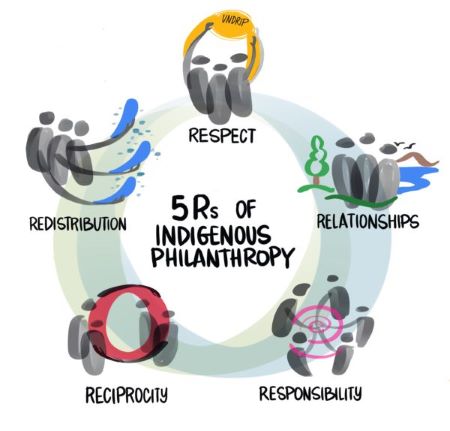
I think people loved all the values, and especially the new value of redistribution. We spent a lot of time thinking about what redistribution means in the context of some of the recent conversations that were happening across different social movements around the world. In the US, we see redistribution more tied to money, but it was important for us to reflect on how this sits with the global movement. How does it sit in Asia? Does the term work well in Africa or in the Pacific? And the way we think about it now with our global lens is redistribution of wealth in all its forms – yes money, but also knowledge and access.
Lourdes