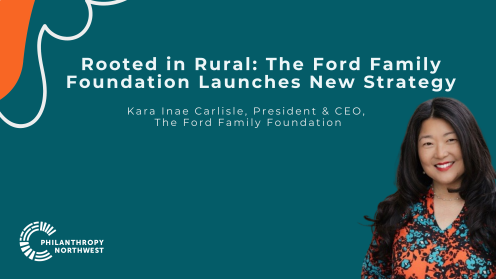

The Ford Family Foundation (TFFF) is making significant strides in their rural community. Founded nearly 30 years ago, TFFF primarily operates in rural areas, including rural Oregon and Siskiyou County, California, through grants, scholarships and community development. Recently, the foundation has launched a new strategy that is “rooted in rural” and centers youth.
“Our foundation isn’t quite 30 years old. I’m only the third president and CEO of the foundation,” says Kara Inae Carlisle, The Ford Family Foundation’s current president and CEO. “When we started, Oregon philanthropy was pretty young. Our main community work was TFFF’s scholarship program and our community building leadership program, in addition to our grantmaking. Then we started a visual arts fellowship to honor Hallie Ford, the Ford matriarch — she was a visual artist. When the second CEO stepped in, we deepened our community building work with the addition of field staff, launched our community economic development and K-12 efforts, and went even deeper in the early childhood and abuse prevention spaces. Now, with me, I am thinking a lot about the founder who wanted to give back to the region that supported his company. In these rural places there are many barriers for children to thrive and succeed. Poverty, family instability, etc. Our new approach focuses on tackling these systemic issues for the youth in these counties.”
“After years of work with partners on the ground, we realized we need to focus efforts on systems change, because none of us can grant-make our way out of the most pressing issues these families face. To realize our mission fully, we have to build our capacity to influence state and regional systems as a ‘neutral’ partner. Our board fully supports this next step, and it's a natural next direction for us to move, especially because we want to give back to the communities that helped generate the wealth that birthed the foundation. Doing this has meant meeting people where they are and having vulnerable conversations, especially with parents who are trying to be better for their kids,” Kara says.
After years of work with partners on the ground, we realized we need to focus efforts on systems change, because none of us can grant-make our way out of the most pressing issues these families face.

Kara
“For example, access to early care that meets the needs of families not only helps parents work but helps kids be ready for school. This sets them up for success by third grade and across K-12. For some families, with additional stressors in that zero to five age range, some of who were already in the child welfare system, or perhaps engaging with our incredible system of relief nurseries — these families need added supports to make sure kids are ready for school. And yet, parents are kids’ best teachers — and many of these parents in our home county know their own trauma is impacting their ability to parent, so they seek out help. Now, these same parents have their kids back and are working with Douglas County to train the county how to better support them, how the system can see them with compassion and how parents can shape the system.”
I’m looking at how we step into our unique superpowers and how we use our voice. I’m thinking a lot about how some funders may not understand rural life in Oregon and the issues people face on a daily basis and how we can bridge that experience gap.
Kara
In addition to refocusing on children and youth, TFFF has made internal shifts to better execute the foundation’s mission and vision. “We’ve hired a communications director and a policy director to help bring together research, data and storytelling,” Kara says. “I’m looking at how we step into our unique superpowers and how we use our voice. I’m thinking a lot about how some funders may not understand rural life in Oregon and the issues people face on a daily basis and how we can bridge that experience gap.”
From planning to development, TFFF has taken roughly two years to execute this new strategy and are still refining minor details to ensure the approach is having the intended impact. “Because we want what we’re doing to be long-term, we’re thinking about the strong relationships we have in these counties and how we can make them stronger. These connections are vital if we want to make a real change in kids’ lives, and in the counties where they live,” Kara says. “The community leaders, the pragmatic decision-makers in these areas, are some of the people we really want to talk with because they can help us move our region forward. Simultaneously, part of my job is keeping our values in mind: Respect, Stewardship, Independence, Community and Integrity. How do we ensure that our values serve communities? Because, what people don’t realize is rural is its own inequity, meaning that while opportunity gaps are often visible in high population areas, the same conditions are often overlooked or invisible. We have to help raise awareness in order to lessen the opportunity gap for our rural families.”
The Ford Family Foundation is rooted in rural communities and determined to see youth in their communities thrive by working at the systemic level to dismantle the barriers to them living a happy, healthy and joyful life. The easiest way to describe this new approach in a few words: “Amplify the power and promise of rural,” Kara says. “Helping people embrace and understand that there is power in our rural communities. Our job is to support the innovation, capacity and influence within that power and create the conditions that help rural kids thrive and succeed.
Learn more about TFFF’s work on their website.