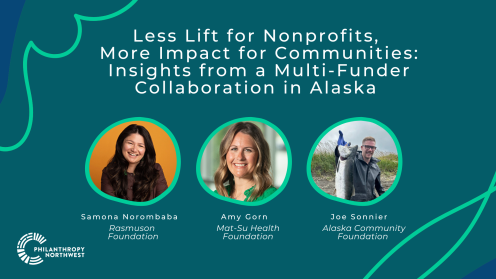
Right now, federal funding freezes are prompting worries across the philanthropic sector about how cuts will impact the communities we serve. As funders, two things we can do during this time are 1) try our best to reduce the burden on nonprofits that are already spread thin and 2) collaborate to maximize our collective impact. The Camp Initiative in Alaska is a great example of how some of our members are doing just that.
The Camp Initiative is a collaborative effort between Philanthropy Northwest members Alaska Community Foundation, Rasmuson Foundation and Mat-Su Health Foundation as well as the George and Stephanie Suddock Foundation and other Alaskan donors. The initiative supports summer enrichment programming for Alaskan youth, including overnight and day camps.
“Summer camps are a rite of passage for many Alaskan youth, and essential childcare infrastructure for their families,” says Samona Norombaba, program officer at Rasmuson Foundation.
In 2020, the COVID-19 pandemic forced camps to operate at either significantly reduced capacity or to cancel their seasons altogether. This led to staff layoffs, lower revenues and scaled-back offerings for kids…Rasmuson Foundation partnered with the Alaska Community Foundation on a grant program to support these camps.

Samona
Since then, more partners have been brought into the program and it has become a state-wide initiative, giving thousands of Alaskan youth full or partial scholarships to camp and increasing the quality and capacity of the programs the camps offer.
This year, the initiative was a collaborative effort between Rasmuson Foundation, Alaska Community Foundation (ACF) and Mat-Su Health Foundation (MSHF). Rasmuson Foundation provided a significant grant to ACF for the initiative with minimal reporting requirements or other stipulations. Since MSHF specifically serves the Mat-Su borough of Alaska, ACF’s partnership with them strengthened the initiative by giving them the ability to work with a local funder that has established relationships in the community and a deep understanding of local needs. However, this partnership also raised important questions about how the three foundations could align their grantmaking processes in a way that eases the administrative burden for potential grantees.
Amy Gorn, program officer at MSHF, said that MSHF and ACF came together to sort this out.
How can we align our processes? You have an application, we have our standard applications. What does that look like to come together?

Amy
And we literally started to look at some application material side by side, and ACF was incredibly open to say: ‘What do you need, Mat-Su Health Foundation? Is there anything missing that we could build into our template?’” Amy says. “I really appreciated their openness.”
“We also worked through what our values were in wanting to be partners in this, and one of them is to reduce grantee burden” Amy continues. “We might have some Mat-Su entities applying to us for summer programming, and then they might go to ACF for the statewide initiative…We wanted to streamline as best as we can in communicating out: go to the initiative and whatever you complete in an application there will be shared with the Mat-Su Health Foundation, so you don't have to apply twice.”
With this joint application came the task of managing the mechanics around bringing information from one funder’s system to another. “We retained quite actively within the whole initiative, and that meant that whatever applications came into ACF, the materials would get shared in Mat-Su, and the actual grants to the Mat-Su camp recipients came from the Health Foundation with very clear and helpful communication from both entities” Amy shares.
The organizations continued this collaboration through the grant decision process as well. “ACF follows a fully participatory grantmaking approach, so all of our grantmaking decisions are made by volunteer committees,” says Joe Sonnier, director of programs and grant operations at ACF. “You know, we did kind of bend that a little bit to give Mat-Su Health Foundation preference to what they wanted to fund. So there's that, you know, give and give collaborative piece. At the end of the day, even if it wasn't the committee as a whole's favorite proposal, but Mat-Su Health Foundation is able to fund it, that means more kids are being served.”
To inform the awardees located in or serving the Mat-Su region, ACF and MSHF created a process. “I had my list of the projects that Amy and Mat-Su Health Foundation we're going to fund,” Joe says. “So in the closeout letter that's automatically generated from the system, I was able to announce: you did receive the award, I'm copying Amy on this email, she's the program officer with Mat-Su Health Foundation who will be fully funding the award, so all of your reporting will be through their portal. Here's how to get a hold of her, and she'll be in touch with the actual details. It was a pretty easy handoff and was transparent for the applicant.”
Where can we be more flexible as we all are evolving practices and learning what we can do more in philanthropy?
Amy
Both MSHF and ACF say that they learned a lot through this collaboration. “It’s allowed us to see how other grantmakers operate, and I've so enjoyed learning ACF's participatory process,” Amy says. “Where can we be more flexible as we all are evolving practices and learning what we can do more in philanthropy? I think that's jump-started some good possibilities that we'd like to explore additionally beyond this initiative.”
For other grantmakers who are considering collaborating on an initiative, Amy says the key is “being involved, having transparency and finding alignment.”
We believe that the community as a whole knows best what the community needs are.
Joe
“I view my role as really being a steward of the public trust, and that's something that I take very seriously and very much to heart" Joe says. "And so, as a steward of the public trust, I need to be collaborative. I need to be present and engaged within the community. I need to be looking for connections that maybe I didn't realize were there, or helping facilitate those connections between donors and grantees or between other funders. It requires me to be open and willing to learn from everyone at the table, and also being willing to be flexible with our own processes.”
Ultimately, these three funders’ shared purpose of increasing accessibility of camps for Alaskan youth has enabled them to form a true collaboration and maximize their impact for the communities they serve. This year, the Camp Initiative funded 40 proposals totaling around $750,000 in requests to camps that serve over 13,000 youth across Alaska.
To learn more about the Camp Initiative, please visit ACF’s website.