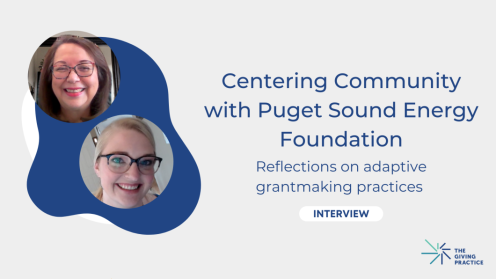
Centering Community with Puget Sound Energy Foundation: Reflections on Adaptive Grantmaking Practices
 Aya Tsuruta and Leslie Silverman
In 2020, in an effort to better center community, the Puget Sound Energy (PSE) Foundation piloted a new grantmaking program that engages local PSE employees across their 10 counties in the grant review and decision making processes. Two years later, the relationships between PSE and the communities they support continue to deepen and strengthen, going beyond funding and nurturing long-term partnerships. Community organizations are being recognized and valued for their work and expertise, and PSE employees are building new professional and interpersonal skills - including a deeper understanding of social issues in their communities as well as skills around board engagement.
We sat down with Nina Odell, director of local government affairs and community engagement, and Rachel Benner, community engagement representative, who led this effort with support by TGP Senior Advisor, Leslie Silverman, to reflect on the work and what they learned.
Thank you, Nina and Rachel, for sharing your perspectives with us!
What inspired you to engage PSE employees in the foundation’s grantmaking work?
When Rachel and I assumed management of the PSE Foundation it was the eye of the pandemic and the eye of the awakening of our communities to be more inclusive and to intentionally address social justice issues. And what this new dawn in philanthropy was signaling to us is that it wasn’t just important what you did, but also how you were doing it.
We wanted to make this the start of a non-transactional relationship with our community based organizations that we were meeting through this process. And by non-transactional I mean not having the relationship start and end with this grant. At the same time, PSE (corporate) was starting a renewed focus on becoming hyperlocal and taking everything to the local level and less at the corporate level. We were also seeing more attention being paid to employee engagement for retention, job satisfaction and quality of life. So Rachel and I went back to the drawing board and thought about how we could reintroduce the foundation’s programs with this new context and world we’re living in. And it was helpful that being new to the role meant that we didn’t have the historical burden of carrying on tradition.
Nina
What are some examples of some of the shifts in the how of your grantmaking?
One of the biggest shifts was that instead of grant applications being reviewed by the PSE Foundation team we recruited PSE employees across our 10 counties so that they could review grants that came from their own communities where they work, live and raise their families.
To address the taxing burden of grant applications for organizations applying, we simplified the process by asking what is it that we actually need? What is required by regulation? Then we collapsed the rest into one-on-one interviews between the employee evaluators - who we call the Grant Selection Circle - and the applicants. The interviews gave employees a chance to meet the organizations from their community while providing equal footing to those community-based organizations that simply don’t have a professional grantmaker or maybe the time to put into a robust grant.
We also had employees working in teams with others in their county. Each county team was provided a budget allocation to work with and this made it very competitive in some areas where the aggregate request amount of applications far exceeded the available dollars to award for that region. After the county teams came together as one large group on a zoom call to present their recommendations and rationale, they had the opportunity to contribute their dollars to an area where the need was greater. This allowed them to apply the training Leslie did with the Grant Selection Circle members around diversity, equity and inclusion.
All Grant Selection Circle members run something at PSE. So part of the goal is how they bring that thinking and training around diversity, equity and inclusion to the service work that they do as a utility provider. We’re proud to have graduating Grant Selection Circle members who are coming back into the organization with this training embedded into how they show up every day.
Nina
Let’s explore more about the why behind these shifts in grantmaking practices. What do they mean for the work and for our communities?
It’s really about recognizing the value of the lived experiences and changing the narrative internally to recognize lived experience as evidence and as the highest expertise. There is a Mackenzie Scott quote, ‘people struggling against inequities deserve center stage in the stories about the change they’re creating for their lives.’ The pandemic highlighted a lot of racial injustices that are baked into our systems and society, as well as the necessity of lifting community voices. And what better way to do it than to have people who are passionate about their local communities and the work of PSE and the PSE Foundation, bringing their insights forward and engaging in conversation to learn. It’s been a powerful experience and I want to underscore that shifting power has been the internal and external driver here.
Rachel
What are some of your biggest lessons learned from piloting this program? Were there any unforeseen challenges that you would share with others who might be testing similar approaches?
This will continue to evolve because one of our values is to continuously look at what we do and find ways to refine, improve, take insights from what we learn and incorporate that going forward.
Some of the areas we found were challenging included making sure that our Grant Selection Circle members were prepared for the comparisons of grant applications that were not necessarily apples to apples. It can get really overwhelming to look at mental health needs, childcare needs, food needs and then try to determine where the funding flows. I don’t know how many calls I got where people said, ‘I have to choose between whether people can eat or whether there is stable childcare.’ So that in itself is hard, but for us it was really about ensuring that we were continuously realigning to our community goals and values.
The other area is continuously underscoring that this is not just work for the volunteer opportunity or foundation. It’s your role as an ambassador of the PSE Foundation to take this lesson into the work that you do for PSE, the communities where you go home, and to make sure that we are together, creating a more equitable future. This is a starting point for how we’re shifting that narrative. We’re giving them tools and a specific assignment, but the goal is critical thinking around this effort and developing a refined way of thinking in the community. Mary Kipp, our CEO, says ‘There’s no end to diversity, equity and inclusion. In a similar vein, progress does not rest on select groups of leaders or teams. It takes all of us, it has to be internal and external.’
Rachel
It has really been empowering and I’ll just say two things. One, I love that I could definitely feel the shift from transactional to relational in your work. To sit in on the review team calls, after having led the orientation workshop and DEI calls several weeks preceding, I could feel a different energy. Employees feeling more engaged and knowledgeable about the heart of this work. The Grant Selection Circle participants were so committed to a fair process, working together and learning from one another. Second, I think the participatory grantmaking component of the interview call made a real difference for both the PSE employees and the non-profits. In most circumstances, there was a shared familiarity of place and need, and this practice of a real-time conversation (as part of the grant review) was the personal element we need to see more of.
Leslie
To that point, I want to reiterate that the interview call is to lessen the burden on the nonprofit, so we advise our Grant Selection Circle members that the conversation should not ever require applicants to turn on their computer. The conversation should be what they have - their experiences, what their barriers are. Just that lighthearted conversation that you have with a friend. That’s what we’re looking for.
Rachel
Three years from now, what would you like the program to look like? And do you have any questions for other funders out there?
The future is more intentional. It’s more responsive. It’s adaptive. It also elevates all the voices in our community so that we have a melting pot of solutions that we can build upon. It’s eliminating barriers as we learn about them and understanding that some barriers may be invisible to us, but we still continue to break them down.
It’s having a solidified and common understanding of what our commitment is to community engagement amongst our stakeholders and partners. It’s building these relationships to share ownership and decision making in philanthropy for our community’s sake, not for our own corporate sake. Importantly, it’s evolving the relationships to be long term and mutually beneficial for each other in the communities at large. This thinking will take us to the vision: empower community resiliency.
Rachel
I’ll also add that some corporate foundations like ours have a unique opportunity. I have the fiduciary responsibility of making sure that the foundation exists tomorrow but not necessarily to grow it larger. We are able to make our grants non-discretionary dollars and only insist on reporting what is required by regulation removing unnecessary barriers or process. This flexibility that corporate boards have, to grant in a very nimble way, is part of the conversation for the future of philanthropy.
Nina
You can learn more about PSE Foundation’s work here.
More from TGP
Subscribe to our newsletter to stay up to date on our latest reflections, insights, interviews and more.