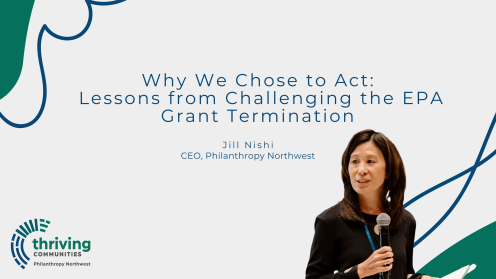
Why We Chose to Act: Reflections from Challenging Our EPA Grant Termination

“Do not obey in advance” was advice I heard from a colleague as we all experienced the seemingly unrelenting number and overwhelming scope of executive orders issued in the early weeks of this administration. The phrase is the title of the opening chapter of "On Tyranny" by historian and author Timothy Snyder. At the time, I did not fully appreciate how prescient these words would be.
In December 2023, the Environmental Protection Agency (EPA) selected Philanthropy Northwest to serve as a regional grantmaker for its Thriving Communities Grantmaking Program following a competitive RFP process. This program was part of a historic congressionally authorized investment in community-led climate and environmental protection solutions. Over the next three years, Philanthropy Northwest would serve as an intermediary to disburse $48 million to communities and federally recognized tribes in Alaska, Idaho, Oregon and Washington. Our role reflected a new approach by the EPA, partnering for the first time with intermediary organizations like ours to reduce barriers and expand access to federal funding. Throughout 2024, our team worked tirelessly to design a community-centered grantmaking process, seek advice from subject-matter experts, hire new colleagues and stand up the systems and policies to issue our first call for proposals in December of this same year.
And then, like so many nonprofit organizations, we started experiencing the unpredictability that has characterized the last few months. In late January, our funds were unexpectedly frozen with no clear explanation. Weeks later, the EPA terminated both our administrative grant and pass-through funds intended for community disbursement, citing a new priority on “merit, fairness and excellence” over prior commitments to equity and environmental justice.
By early March, we found ourselves in a tenuous position that sadly, many nonprofits across the country have become familiar with, facing mounting costs with no federal funds reimbursement and no ability to deliver long-promised resources to communities. The sudden termination of federal funding has forced many organizations to scale back, pause critical programs or in some cases, close entirely. At Philanthropy Northwest, we knew that while we weren’t immune to those same pressures, we were in a position to push back. We ultimately decided to file a lawsuit against the EPA to reinstate our Thriving Communities grants intended to support communities with historically little or no access to federal funding.
So, what does it take to not obey in advance? A lot and then some. Our experience over the last few months has shown us that it takes an unwavering commitment to organizational values, nimbleness to counter unpredictability, courage to take on a high degree of risk, optimism grounded in stark reality, and finally, an entire village willing to stand alongside you.
Our Values. The decision to take legal action was both informed and driven by a staunch commitment to our organizational values of equity, justice and courage, as well as a mission that ultimately seeks to serve historically underinvested communities. Here, our board was unequivocal in their support while fully recognizing the real risks associated with taking legal action. In the face of adversity, our values served as the ultimate arbiter of our decision to fight back.
Risk Tolerance. History has shown us that the greatest advances in social justice have come with great sacrifice and risk. For many organizations who have opted to push back, the financial burden of absorbing expenses that might never be recaptured, not to mention the costs of litigation, can be and are often overwhelming. The experiences of others also made us fully aware of the potential organizational risks of retaliation. And yet, the choice to absorb these risks seemed acceptable in service of defending our democracy and system of governance.
Nimbleness and Adaptation. Navigating the unpredictability of the current environment necessitated a high degree of agility, as we encountered new challenges on an almost weekly basis. Scrapping best laid plans to constantly consider new factors is now our norm. The process of adapting our plans, while considering the impacts on colleagues, partners and grant seekers, emphasized the critical role of clear, frequent communication and a realistic yet cautiously hopeful outlook in the face of increasingly strong headwinds.
It Takes A Village. Throughout this lawsuit, I have often said that it is a privilege for Philanthropy Northwest to stand up and fight back. This privilege was made possible by many:
- Our co-plaintiffs – Green & Healthy Homes Initiative and the Minneapolis Foundation – who became great allies and thought partners, and shared in the costs of taking collective action;
- Our legal counsel, Jonathan DeMella and his colleagues at Davis Wright Tremaine, who from the onset believed in our case and shared our pursuit to preserve our nation’s systems of checks and balances;
- Funders in our network – Inatai Foundation, Meyer Memorial Trust, Stolte Family Foundation, Russell Family Foundation, Ellen Ferguson and College Spark Washington – who committed and moved funding for us in record speed to mount and sustain our legal action;
- The hundreds of community-based organizations and tribal nations throughout Alaska, Idaho, Oregon and Washington who applied for Thriving Communities funding and who have exhibited tremendous patience and grace throughout and;
- Multiple colleagues and partners whose affirmation of our actions became a source of resilience to keep moving forward.
And finally, I am eternally grateful to my colleagues at Philanthropy Northwest and in particular, our Thriving Communities team who in the face of so much adversity have kept pushing through with their sharp thinking, creativity and persistence to preserve these federal resources for our Northwest communities.
On June 17, a federal judge ruled in our favor, finding the EPA’s actions illegal and invalidating the terminations of our grants. This decision affirms what we and our partners have known all along: communities most impacted by environmental harm deserve access to the resources committed to them by federal law. While we celebrate this important step toward justice – there remain hurdles to ensuring these funds reach the communities they were meant to serve. Here, we remain steadfast in our commitment and are deeply proud to stand with our colleagues, board and the many partners who will continue to help us do our part to not obey in advance.