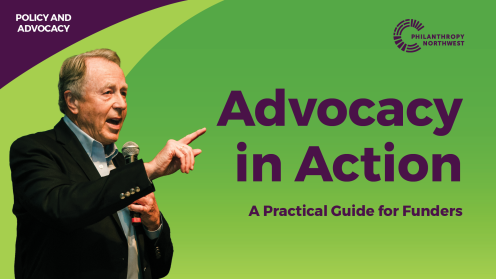
Using Philanthropy’s Voice for Change: A Decade of Learning That Shaped the Advocacy in Action Guide

When I moved from running a policy advocacy organization to working with Philanthropy Northwest over a decade ago to encourage funders to do and fund advocacy, I wasn’t surprised by the reluctance I found. I had experienced it firsthand as a grant seeker: general operating grants with overly restrictive language, confusion between advocacy and politics, and misunderstandings of what funders and nonprofits can legally do.
Part of my role was to help shepherd the newly launched Democracy Northwest initiative. Democracy Northwest laid down a challenge to philanthropy: in the words of former PNW board member Dan Kemmis, it was time for philanthropy to “step up its game” to rebuild (or reimagine) democracy. Central to “stepping up” is the need for philanthropy to use its voice in advocating for change. PNW embraced its leadership role, more aggressively centering the need for racial justice in our democratic systems and by embracing policy advocacy.
I found that, over time, for more hesitant funders, inserting “advocacy” into a patriotic form of democratic expression was an easier way to get over discomfort. By identifying ways funders are already engaging in advocacy — using their voice to shape the debate of public policy issues — they could move to additional ways to advocate. If a funder was already convening actors to discuss the lack of affordable child care, or water rights, what else could they do as an institution to mobilize change? Could they fund policy research? Could they make sure their grant agreements weren’t restricting advocacy? Could they engage in direct lobbying, or fund allowable projects to empower grantees to do so?
Helping funders imagine these possibilities and shepherd them along the way is my favorite role at Philanthropy Northwest.
Over my time working with members, I have concluded that funders can best support advocacy by: 1) creating a culture of advocacy that builds power in grantees by focusing on giving general operating support and tools to do advocacy, and 2) organizing other funders to fund and do advocacy.
The most powerful support funders can offer grantees is the freedom to lead, and to follow their lead. That’s ever more important now.
“We the People” began as a declaration of who should hold power. As we mark our 250th year of independence, does “we the people” ring true in our actions? Most Americans don’t feel that way. Trust in institutions is eroding, and in some cases has disappeared altogether. Philanthropy’s very nature as unelected decision-makers, managing the resources of powerful and privileged people, must do more to relinquish control.
Philanthropy’s very nature as unelected decision-makers, managing the resources of powerful and privileged people, must do more to relinquish control.

Remy
Effective advocacy asks: Do we have a vision for communities where everyone feels they belong, has some control over their lives and has the agency to lift their voices in shaping the direction?
Remy
That’s the beauty of embracing advocacy. It’s about money and resources and civil society. It’s how we build the public structures that allow us to live together in harmony. Effective advocacy asks: Do we have a vision for communities where everyone feels they belong, has some control over their lives and has the agency to lift their voices in shaping the direction? For democracy, it is important to think about how Americans — the people in a funder’s community — feel about their own voices being heard. It requires asking whether your approach to advocacy empowers this sense of agency in shaping one’s community, or reinforces the sense that most people are subjects of powerful and wealthy elites.
My hope is that this guide will spark more curiosity about advocacy. I hope to hear from many of you as you consider your next step on the advocacy journey, whether you are unsure where to start, if you need help convincing your trustees or are considering a new initiative.
Philanthropy Northwest member organizations can receive an hour of advocacy consultation each year. Please reach out to our policy team at policy@philanthropynw.org to take advantage of this member benefit!