Carmen:
This is a moment of crisis for our sector and for our community. And these are existential issues that are facing us in terms of how do we do the work that we say we value? How do we live our values in this moment, clear and unapologetically? And how do we support it?
Nancy:
From the giving practice at Philanthropy Northwest, this is, Can we talk about...? A project to normalize the messiness of leading for racial equity and philanthropy and reflect on what it takes to create lasting transformation. In season two, our hosts explore what it looks like for philanthropy to advance racial equity on the ground, where the work can look quite different depending on the context, whether it's place, issue, area, or community served. And in a world where our contexts are constantly shifting. We're asking guests to practice vulnerability, explore sticky topics, and look for learning. And what we ask of you is to do the same.
Abby:
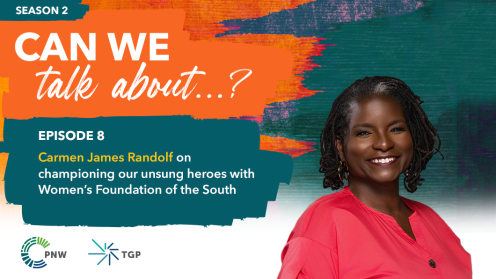
Hey there everyone, and welcome to, Can we talk about...? A project to normalize the messiness of leading for racial equity and philanthropy. I'm Abby Sarmac and I'm a senior advisor with the Giving Practice at Philanthropy Northwest. And I'm your host for this episode. I am so incredibly privileged today to be joined by Carmen James Randolph from the Women's Foundation of the South, which is a place-based community centered funder whose work centers on health, wealth, and power of women and girls of color in the US South. Welcome, Carmen. I'm so excited to be with you today.
Carmen:
Thank you, Abby. I am incredibly excited to be here with you as well.
Abby:
We actually have these questions here in front of us, but actually Carmen, I would actually love to hear before we got started with the formal questions. How did you even come to be on this podcast with us? What was the path for you to get in front of the mic with us today?
Carmen:
Oh, my goodness.
Abby:
How did that happen?
Carmen:
I worked with an incredible team for our strategic communications and we are a relatively new public foundation, so we are in our fourth year of development. So my board chair likes to remind me, we are a toddler [inaudible 00:02:27]. But one of the things that has helped us punch above our weight, so to speak, is that we have grounded strategic communications from the very beginning. So we work with a fabulous communications firm, a strut agency, and they make sure that we are getting the message about the Women's Foundation of the South out far and wide. And I think that is how we got connected.
Abby:
Nice. I love it. I love it. That makes a lot of sense. We're all in this for systems change. We're changing systems and one of the key pieces is-
Carmen:
Absolutely.
Abby:
Changing the narrative. Tell them a story. Telling the story. Awesome. Thank you, Carmen. It's helpful to just know how we get here. So one of the key pieces that we always like to do on this podcast is story, speaking of story. So I'd love to start with your own personal story. What was your personal story? What brought you to this work and the connection with the foundation and what you all do?
Carmen:
My personal story in terms of my work in philanthropy started in the nonprofit sector. So I worked in a nonprofit. I was working for the Humanities Council of Washington, DC. I came out of college out of American University and I majored in American Studies. And at that time, my plan was to go to law school. So my parents and no one would've imagined I would've found a job working in the humanities, actually putting my major to work. And I loved arts and culture and history and anthropology and all that good stuff. And I was a very young woman doing public humanities programs in public housing communities in DC. And part of that work in my intro into the nonprofit sector was I soon learned you had to fundraise. And as I started fundraising from institutional partners in the DC metropolitan area, I soon came to realize how important it was to build relationships.
And it was through the process of building relationships, connecting funders to the work that we were doing at the Humanities Council. And as we were looking at embarking on a citywide initiative to lift the stories of neighborhoods in DC and embark on neighborhood cultural tourism, I got involved even more closely with foundations and was asked to participate in some community advisory capacities. And one such foundation that I worked with was the Eugene & Agnes E Meyer Foundation. And when I was looking to make a change, one of the women who had worked there who had been a program officer to me said, "I really think you should have a conversation with our president." And from there, I was recruited to work at the foundation.
And one thing that was interesting and really cool about Meyer is that all of the program officers there had run nonprofits before. So we all had the experience of raising money, managing teams, working with the board. Myself had served as interim director for some time at the Humanities Council, I had worked my way up in that organization. And at the time, the field of philanthropy, program officers, generally that was the role that people retired from. It wasn't your starting role. And I was told I was the youngest program officer they had ever hired at the time. So most of my colleagues were in their 40s and 50s, even 60s. And here I was coming in just turning 30. So don't mean to date myself, but it was my first role that I was... It was in my job description that I had to be a leader locally and nationally.
And that work exposed me to so many colleagues and I focused in youth and education and youth development. And really gained a national perspective on the work as well as a deeply local perspective that was also fueled and informed by the work that I did on the ground in community in my first role. So I would say working in public housing communities, I got a firsthand view of what injustice looks like. Especially injustice for people in education, for people, for families that are striving and living in poverty and how systems that are really not built for their success and for their wellbeing. And this really tapped into my desire for and push for social justice. I had been a leader on campus and so on and so forth. So it really helped bring all those things to bear. And I found in philanthropy that there were different roles that philanthropy could play.
It wasn't just about writing a check. Philanthropy could truly be a catalyst for changing systems, for changing hearts and minds. That there was a role that philanthropy could play in using its voice and being leader full in a particular space and advancing an issue. So all of that good and made good trouble with folks in DC raised a lot of money... Actually leveraged money for transformative programs that help transform schools that help transform the reality for young people. And I always had a passion for young people who their lives were off track for one reason or another. And my work eventually took me to the south. I came to New Orleans, continued my work in philanthropy. And I was excited, coming to New Orleans more than a decade ago, coming to a city that was still rebuilding itself after Hurricane Katrina.
And I was at a personal inflection point in my life where I was rebuilding my life and learned so much more about the city, about the region, about the state, working in philanthropy versus just when I had when I was visiting and staying with family. So I've made the reverse migration that my family has made from the south to the north. I've been working my way south and now here in New Orleans. And I would tell you just that understanding of just how far we had come and how far we have yet to go when it comes to securing the right and the ability for people to thrive. This is such an incredible community and incredible region and the will for people to preserve their culture, to preserve community, and to look at building very powerful and dignified lives for themselves and for their children and understanding what they're up against.
And what struck me very early in my work here in New Orleans was that the wellbeing of women and girls was not really on anyone's agenda. The community foundation did not have at that time a fund that was dedicated to the wellbeing of women and girls. The state of Louisiana didn't have a women's fund. So certain issues that I thought were just relevant in the nonprofit sector, like paid family leave, having a maternity leave policy or a family lead policy. As I became connected to leaders in Louisiana, I came to understand how those issues were also relevant in other sectors. And then as I started to learn about issues like maternal mortality and how you have black women in particular here dying more than four or five times the rate of white women in childbirth and up to a year after having a baby.
These issues for me were screaming and I'm like, "Why isn't this on anyone's platform? Why isn't anyone making this a funding priority?" So as I started talking to colleagues in the field of philanthropy, other black and brown and allies working in philanthropy, they were saying to me, "Carmen, unfortunately, this isn't just a Louisiana issue. This is true in Arkansas. This is true in South Carolina. This is true in North Carolina. These are issues that are relevant for the south." So as the vision began percolating to how could we, or is it possible, because I didn't know anything about building a foundation to create a foundation that would center the lives of women and girls of color? To address these issues and to change back to the storytelling, to change the narrative about who women and girls of color are in the south.
Could we do that and could we build that? And I was able to join forces with just a powerful group of women. One such woman was the late Gladys Washington who was formally with the Mary Reynolds Babcock Foundation. Gladys just passed away this past November. But Gladys said to me, "Carmen, speak life into this vision." Because truly dedicating work to southern women and girls, it's a calling. It's beyond a passion. This is a calling and this is something that must be done. So we came together first just five of us, and then later a kitchen cabinet of 25 women from across the south who were trans women, Latinas, African-Americans, Muslim women to just dream, to just dream together and say, "Okay, if we were to create something that was for us, by us, what would the values be? What would the mission be? How will we build this thing?"
And I would say we came together to dream and to do the serious work of building a strategic plan and then an operations plan. And eventually, we reached out to black women working in the field of philanthropy to say, "We have this vision to build the Women's Foundation of the South. Will you join us? Will you build this with us?" And that generated our first $100,000 and then leveraged larger gifts. And we were able to open our doors in August of 2021 with $1.3 million.
Abby:
Wow. Amazing. Amazing. What can happen when you get some good strong women in a room together. Love it. I love it. I'm so much a proponent of participatory philanthropy, community philanthropy, just... Right? It's what women know what to do, which is come together and take care of each other. Take care of each other and others. And what an inspiring, beautiful story. So tell me a little bit more about where you are now. So that was a little bit of the origin story, and that was how long ago? So 2021, now it's 2025. What's happened since?
Carmen:
Oh, my goodness. So in just short order, and I say short order because wow, this time has gone so fast. But 30 days after we opened our doors, our home state of Louisiana was hid by hurricane Ida. And that is significant because we had planned and game together and dreamt of the Women's Foundation of the South during the pandemic, at the height of the pandemic. And so then we're opening our doors and we had this elaborate plan for what we would do in our first year. And part of that was to do focus groups across the south. And we were going to start in Louisiana. So in the midst of saying, how do we begin rolling out this strategic plan when our home state is either... It was deeply in recovery from a tragic storm and damaging storm and COVID just exacerbated realities on the ground.
Hurricanes do the same thing. Natural disasters only exacerbate situations on the ground. Truthfully, I was checking in with women leaders that I knew in the state, having worked with quite a bit of them at the Greater New Orleans Foundation to see how they were doing, to see what they needed. And then I was hit with the reality like, oh, wow, I don't have the checkbook that I had behind me. Here, question was, what do we do in this moment? So we decided one, to use our voice and to make it clear that there is... To put a gender lens on disaster recovery and what that looks like when you are a woman, when you have just given birth, when you are pregnant, when you are taking care of elderly people, when you have so many grandchildren and children of so-and-so in them. And you have so many people who are reliant on you for your decisions as to if you can evacuate.
And evacuation is very expensive. It's costly. So we talked about those issues and checked in with groups and basically girl, learned that folks were tired. They had already been exhausted from the pandemic. Now they were either recovering, some of our executive directors had lost their roofs of their own homes, let alone their buildings were damaged and they're taking care of community. One woman moved into a school with a whole community of immigrants and was taking care of people in a school building. And the city of New Orleans in this region, we had no AC, no electricity for three weeks. So how could I ask these same leaders to just pull on them, give of their time so that we could learn? That's what foundations do, right? We want to bring you together so you can teach us and we can learn. Didn't seem appropriate.
So we said instead, "Can we mobilize the dollars that we had for re-granting?" It was just a tiny bit. And having work with larger portfolios, I'm like, okay, what can we do, possibly do that's meaningful with $200,000? And we said, "You know what? Why don't we give this to the leaders who are doing this work, who are standing up whole communities instead?" And that was the genesis of our WŌC @ Rest program. It's a play on words, WŌC @ Rest. And we gave these leaders a modest grant that we said, "Look, this is for your restoration and your leadership development in this moment. Use it how you need to."
Abby:
Oh, love it.
Carmen:
Understand if you use it for strictly personal reasons, it's taxable, otherwise, use it how you need to use it. And we made those grants to their organizations and they determined how they use those funds. And then we brought them together for a two-day retreat that we said, "These dollars or this retreat, we are inviting you to rest." And these women were like, "What is this?" I literally had a group of women-
Abby:
I love it.
Carmen:
That on the first day of the retreat, this woman came up to me and she said, "Carmen, I have to ask you why me?"
I said, "Excuse me."
She said, "Why me? Why did you choose me to come to this?"
And mind you, Abby, she leads a state wide family health organization. And have been doing the thing through a pandemic, through a natural disaster. And she's looking at me, "Why me? Why did you think I deserve this?"
And I said, "Why not you? Aren't you doing the work?"
And she said, "Yes."
And she said, "I have to tell you the truth."
She said, "All of the women at my table, we all thought this was a hoax."
Yeah. And she said, "When does philanthropy ever care about us and center us?"
Abby:
Oh, my gosh.
Oh, my gosh. That right there is the state of the field, right? What is it? That's gaslighting at its finest, right? Where somehow the folks that are literally doing the work are questioning why they're being recognized. Oh, my goodness.
Carmen:
And let me tell you before we... Our process in starting this, and I'll take a moment to share this, I haven't forgotten your question where we are now. But we started by taking love boxes to these leaders across the state. We traveled to the west of the state, we traveled to the bottom of the boot. We took these beautiful boxes that were filled with things to encourage these leaders to love on themselves. Whether it was beautiful Tees and hand creams and eye masks and candles and journals. They were filled with tools to help you just claim your time and your space for yourself. And so anyway, they had been loved on before they came to the retreat. They came to the retreat and we had a story sharing moment.
And it was through that storytelling, story sharing that we decided that's how we're going to learn from these women by listening, through their stories, by sharing their stories. So this was such a powerful way for us to enter community that we decided to make WŌC @ Rest our flagship program for how we enter states. This is not the end all be all for how we will do grant making in the future, but this certainly is our starting place. So we started in Louisiana, and today we are now in five states. We have supported 113 women in Louisiana, Mississippi, Texas, Georgia, and Arkansas. Our leaders are African-American, they're Latina, they're indigenous, they are immigrant, they are trans, they are other members of the LGBTQ community, they are Muslim.
And so we have supported this incredible array of hardworking, striving women who are doing all they can to not only hold up their communities, to do things like help bring healthy babies and help women live and thrive through the process of birth, but also fighting for everything from clean water in their communities to affordable housing, to looking at the impact of climate change, to voting rights. And so we support women in these three pillars of health, building, wealth and thriving, and also power. And that can be leadership development and power building.
And here we are in our fourth year, and we're not only building relationships with these women within their states, but we're bringing them together across states. So we have a monthly program for which they can check in with one another, which has been an incredible fertile ground. Especially in these times for sharing resources with one another for... We call it grapple and grow. They talk about what they're grappling with, they help each other as well as we might include a learning agenda where we are bringing resources to them. And this has helped partnerships grow with leaders from Georgia and Mississippi working together and really finding new ways of connecting.
Abby:
Nice.
Carmen:
So that is the work we are this year. We're not expanding in this year. We're hopefully going to Alabama and Tennessee in 2026. But for this year, we are bringing those women from the first five states together in what we're calling a rooted retreat. And the theme... And really we had planned this before understanding the full impact of the repeal of affirmative action, the backlash against DEI and all the things. And really looking at this as an opportunity to bring these leaders together and to focus as a collective on their wellbeing and their strength as a community.
Abby:
Thank you so much, Carmen, for that intro. I feel like I have now had a masterclass in terms of how you support leaders on the ground and build a movement, because that is what you're doing. All of the work that's being done here is so incredibly inspiring and hopefully our listeners can take some of these pearls of wisdom and replicate work with support, the foundation, support your work is truly inspiring. I know. Put a pin in it. I want to talk with you later. I got a bunch of people, I'm like, okay. All right. But what you have mentioned here also brings me to a couple of questions that we also had that I feel like we could really learn from and I'd love to hear from about with you is equity, equity on the ground in the US south and risk. You began to touch on this already and your path. Obviously racial equity and as you were talking about earlier with Ida, is that crises just exacerbate what's already on the ground.
Carmen:
Absolutely.
Abby:
And I'm curious in linking that a bit to some of the racial equity questions that we have, equity on the ground that you were seeing in this work. What have you seen there? And then this whole question too around, it's very risky work now. It's being framed in many circles as risky work. And so just curious where you all are landing with the Women's Foundation of the South, the approach you're taking, what you're seeing on the ground and how you're managing risk if you even see it that way in continuing strengthening, growing this work that we're involved in.
Carmen:
I would say the answer to this question has multiple layers. One, it's important to note that when we launched, the Dobbs decision had not happened and the repeal of affirmative action had not happened. So if you can imagine, there was a time when both of those two things right there were considered foundational and core to our sense of rights as women, as people of color, as anyone different, so to speak. And each one of those decisions have been, or shall I say, the rollback of those policies have been incredibly impactful In the South. You had southern states that in anticipation of the Dobbs decision put together trigger laws that would go into effect once the Dobb decision happened.
I don't know if people understand that the same approach of anticipating this massively transformative policy states anticipating that and having trigger legislation ready to go also happened with the repeal of affirmative action. So I think it's to understand that things like... I remember, and you might also remember, Abby, just being in this field for so long, talking about equity, talking about justice, you would get into debates or have questions about, really, are we there? Is this so much... Do we really have to talk about equity? Aren't we in a post-racial America and so on and so forth? I think the murder of George Floyd shined a light on and just really put in our faces that, okay, maybe we are not as well as we hoped or thought we were.
I think that's true too when we think about our rights and when we think about what's at stake and who's at risk now. Whereas before, maybe even just two years ago talking about the need for Women's Foundation of the South, there were folks who questioned really patriarchy, really? Let's talk about the disparities. How much of this really exists and why is this important? But we are at a moment where these things are no longer in question. There's no question that there has been an attack levied against women, against immigrants, against people who, like I said, present differently. LGBTQ, Trans, it's no longer a question.
The conditions that make DEI necessary, no one is challenging that. Okay? No one's challenging the conditions that make policies that give people a level playing field. No one is challenging that. However, what's become risky is actually doing the work. And-
Abby:
That's true.
Carmen:
Making and putting a flag down and saying, "We're going to make things better for people who are suffering or for people who deserve an equal opportunity." I would say we had the benefit. I participated in a fellowship program with other CEOs who are committed to equity injustice about two years ago that was hosted by the Aspen Institute and the Neighborhood Funders Group. And at that time, we were talking about what would happen if affirmative action was repealed? And what would the impact be on philanthropy? What steps would we need to take?
And with this circle of what has become new friends and friends now, with this circle of leaders, we started talking and sharing, we're going to go through a legal review. I think it's important that you get a lawyer and look at all of your things. I also got the recommendation to contact the Lawyers' Committee for Civil Rights. So those two things prompted us to, one, me suggest to our board that we move from having pro bono legal counsel that helped us with all of our foundational things, getting started, to move to having general counsel, which was monumental for a very small organization just two years off the ground. And then we applied to become a client of the Lawyers Committee to have a legal review done. I had talked to some of my colleagues who paid upwards of 40 and $65,000 to have a legal review done.
We didn't have that kind of budget, but I knew it was important. And thanks to the Lawyers' Committee for Civil Rights, that took us on as a client, they assigned us to a firm, Crowell & Moring. And we had a wonderful team that took us through an in-depth process of doing a legal review. And what became clear to me in short order was it was important for us to not only secure the foundation, but also our grantees, right? So we've gone through this process of legal review. We've had some very clear recommendations of things that we could do too.
Abby:
Yeah.
Carmen:
Our level of risk and all of this was before this current administration and executive orders. So even before our board and our team had been wrestling with what changes we needed to make, and there was just some tweaks that we needed to make to some of our processes internally and then externally based to some of our written materials and in our public materials. As the election and all this happened, our grantees, because we bring them together monthly, said to us, "We'd like you to hold space for us after the election. We don't know how it would go. We might be celebrating. We might not, but we want to come together. Will you hold that space for us?" We booked it. We didn't know how we would be feeling, but we booked it to hold an hour the day after the election for our grantees. And in that moment... Let me back up.
Before we held that moment for them after the election, after our legal review was complete and our board had made some decisions, I brought that same team from Crowell & Moring to brief our grantees. So we had the lawyers brief, our grantees answer any questions that they might have for what they might need to do. We encouraged them as LCCR had some slots available still for legal review for nonprofits that if they wanted to apply to LCCR, they could. So we had started that dialogue. And then I would say since the executive orders, we then held another space for them.
How's this impacting you? We surveyed them. We asked them what concerns did they have, what kinds of things were happening on the ground in their communities? And then we talked about how do we protect ourselves? What kind of protection do you need? Do you have enough insurance? Do you have adequate insurance? And these were things also simultaneously WFS is looking at. We're looking at our cybersecurity, we're looking at cyber insurance. All of our policies, are we adequately insured? Can we withstand a legal challenge? Because we don't have a big legal, we don't have [inaudible 00:36:52]. We don't have a legal reserve fund period or a fund for that. And through partnerships with grant makers for immigrants and refugees, [inaudible 00:37:02] and others, any resources we can get, we're sharing it with our grantees. Know your rights.
Abby:
Amazing.
Carmen:
We've had groups who've asked, "What do we do if ICE comes to our office?" A counterpart of one of our grantees had ICE come and demand all of their W-9s of anyone they had worked with. And our grantees said... They gave them my W-9.
Abby:
Amazing.
Carmen:
And I'm fearful. And what do I do if they come to my office? Do I have to give this information? What do I need to provide? What are my rights? We've had groups talk about from Mississippi pending legislation like bounty legislation to pay people to turn in someone who's suspected of being here illegally and say, "How can we in this moment resist and inform people and support our communities in ways that we do not allow poor people to be pitted against poor people?" And in terms of protection, we have been for some time now trying to make sure our grantees have resources that they need to shore up their organizations to ask and get legal questions answered as well as take real tangible steps to understand their rights and know what they need to do at this time.
I would say the number one thing that our grantees are concerned about, it's twofold. One is fundraising, how to raise dollars in this climate. And then secondly is messaging. How do we do our work for our public health organizations? We can't talk about immunizations. We can't post public signs anymore about being vaccinated. So at the time, they're like, "We're in the height of flu season. We can't encourage people to get flu shots. What can we do?" So how do we message the importance of the work and how do we reach communities in this moment? So we have brought fundraising... We've used our elemental account to do research on funding opportunities.
We've put that out to each cohort by state as well as according to what it is that they... The areas in which they're working. And we're doing what we call intensives in each of our states, starting with Louisiana in just two weeks. Where we're bringing fundraising experts to them and doing some in-person workshops on looking at fundraising differently, building your base of individuals and how do you bring some innovation to how you fundraise and how do you message your work? And having those conversations about how do we do the things that need to be done in these times.
Abby:
Amazing. Amazing. Oh, my goodness, Carmen, the story that I'm getting here is an incredible story of resilience. And maybe this is coming to mind, is that what I'm learning here, what I'm hearing here is you're only as strong or as safe in your community.
Carmen:
Absolutely.
Abby:
Right? This is not about WFS or Carmen, right? Managing your own risk. It's on the one hand, yes, but on the other, my risk is my community's risk. So always pushing out those resources, you're only as strong as the community that you're with. And just congratulations again, such an inspiring story. And again, I think that our listeners, certainly I, am taking from this conversation a lot of just nuggets to apply in the work that I do and in the work that we do in our region. There's a lot in the Northwest. Amazing. Thank you so much for sharing some of that.
Carmen:
Often we'll say in philanthropy, we tend to silo ourselves so much. And our investments are only as strong as our nonprofit partners are. They are our partners. And as our partners are in the moment. And whether we understand it to be true or not, this is a moment of crisis for our sector and for our community. And these are existential issues that are facing us in terms of how do we do the work that we say we value? How do we live our values in this moment, clear and unapologetically, and how do we support it?
Abby:
I love that. Oh, beautiful words to close on. Carmen, I'd love to just pause at a last question here as we think about moving into the future. Because the stories that I'm hearing that you've told today really are pretty unique. You tell the stories and you're such a beautiful storyteller, and it feels well, of course. But then you look at our field, you look at philanthropy, and that is not typical traditional philanthropy at all. What is your wish for the field moving forward? What do you think that you'd like to normalize more? Obviously how WFS works. In a way, there is no difference between WFS as a funder and your grantees. It's like you are one, right? What helps you, helps them. What harms you, harms them in any way... I want that to be more normal. I want that to be more normal. I want that to be more the typical way in philanthropy. What do you think? What are you hoping for to normalize in philanthropy moving forward?
Carmen:
Well, your question makes me think of when we first went to Mississippi and when we gathered with a group of women leaders in Mississippi. And we introduced them to the Women's Foundation of the South and talked about our work and what we were looking to do. The look on their faces honestly was just one of such surprise. And we asked them what their experience has been with philanthropy. And these were the words that people were saying, "Trauma, traumatic, denigrating, hard, fruitless."
And I was like, "Okay, talk to us about this."
And they talked to us about having the experience of needing to be validated by or verify by a larger, more sustainable or just white institution in order to make the case for their work or why they were doing it. They talked about being used by organizations to say, "Oh, we're working in community and this is our partner." And that when the grant comes into the community, none of the resources flow to them. And just that whole experience of I need X, Y, Z leader who is white to make the case as to why I'm worthy to have a seat at the table, why I'm worthy to receive a grant. And it was hard to hear that, but the hardest thing was when we told them about WFS, one woman asked, "Who gave you permission to start the foundation?"
And that just went through me, and it has stayed with me. And we said we gave ourselves permission. And I say that because our collective power is so incredible. And as a field, we truly miss out. We miss out, and we miss the mark When we do not invest in leaders of color, when we make excuses. Oh, that organization might not have the capacity to handle a grant. Or, oh, that leader hasn't been in place long enough. Or, oh no, that board doesn't really have... Whatever it is, we make the rules and we have to be clear about that. We create the hurdles in the on-ramps into our field, right? To get the grants. And doing so and often in the ways that we do it, we make it tough. And we often trust some leaders and bless them. And we choose who we don't trust and who we don't bless.
And I will say one leader told me about work that they were doing to challenge a redistricting effort in their state, and they had raised $40,000 for strategic comms for this work. And they said, our opposition has come at us with a campaign that's $250,000. So we're talking about an effort that has got out tens of thousands of people. These women are working so hard in doing the work. We don't call them patriotic. We don't call them the sisters who are saving democracy, but that's what they're doing. And I think we have to look at our communities as a whole and truly give respect and open the door of possibility for these leaders to rise and be their full true selves. And that is what I would hope philanthropy would do. This is the field of loving humankind. And I think that we have to be and allow ourselves to be fully human in doing this work, invest in the full humanity of the leaders who are doing this work.
Abby:
I don't think I could say anything else to close out better. Let's normalize having philanthropy actually return to being the field of loving humankind fully.
Carmen:
Absolutely.
Abby:
And authentically unreal. Thank you so much, Carmen. I'm so incredibly inspired. I know our listeners will be too, to look at health, wealth and power of women and girls in the south. Let's connect to the Northwest and start that going, and then we've got all through. The US... Hey, let's go global. Let's just go global. I'm ready.
Carmen:
Yes. Oh, this has been my absolute delight. And I have to just ask your listeners, pay attention to what's happening in the South. It's so important. Many of us have ties to the south from all over this country, and it's so important to see and to watch what's happening politically, what's happening in state legislatures. And just now is a time more than ever to pay attention and also understand that there's hope. And often leading that hope, our women of color.
Abby:
Exactly.
Carmen:
Here in Louisiana, we just had a housing trust fund created.
Abby:
Amazing.
Carmen:
Our state defeated horrible changes to the state constitution. And both of those two efforts were led by women of color. And I thank you for this opportunity to connect with the Northwest. I hope folks will connect with us, visit our website in community with you.
Abby:
Love it. I've already put that in my next actions list. I'm signing up right after this. I love it. Carmen, this is amazing. It'd been truly inspirational. Thank you so much.
Carmen:
Thank you so much, Abby. This has been wonderful.
Nancy:
Can we talk about...? is a podcast by Philanthropy Northwest, written and produced by Aya Tsuruta and Emily Damen, with production support by Podfly. And graphic design by Asha Hossain. Our episodes this season are hosted by TGP Senior Advisors, Katie Hong, Robin Martin, and Abby Sarmac. You can find more information on this episode, including guest bios and show notes at thegivingpractice.org. And if you have a topic that you think philanthropy should be talking about more, let us know by emailing hello@thegivingpractice.org. A special thanks to our Philanthropy Northwest and Giving Practice teams for their thought partnership and the Ford Foundation for making this project possible. I'm Nancy Sanabria and we'll see you next time.
Overview
Carmen James Randolf, CEO of Women’s Foundation of the South (WFS) comes onto our show to introduce the four-year-old foundation and its vision of health, wealth and power for womxn of color in the South.
She outlines the various aspects of the foundation’s strategies, rooted in genuine care for women of color community leaders who tend to be under-recognized and underfunded. This care looks like listening, anticipating needs, protecting the community amid political threats and attacks, and giving community leaders opportunities to connect, learn and rest.
“We need to invest in the full humanity of leaders who are doing this work,” she says.
Finally, Carmen calls on philanthropy across the U.S. to “pay attention to what’s happening in the South,” and specifically the regressive policies that are being tested and exported to other states.
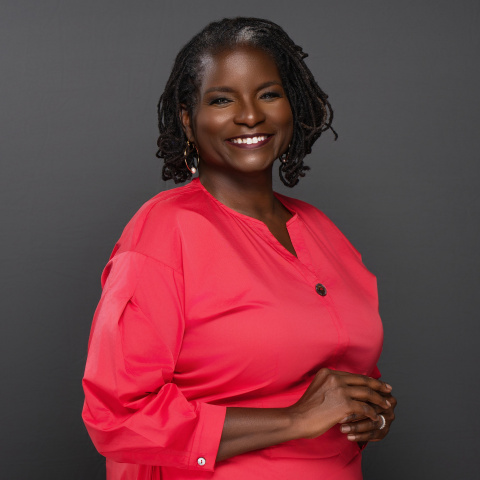
Carmen James Randolf
Over the course of her almost 30-year career in philanthropy, Carmen James Randolph has made her mark by galvanizing funders, donors, policymakers and grassroots activists to forever change lives, systems and communities for good. She is particularly passionate about building prosperity for women and girls of color. In August 2021, Carmen was named founding president and CEO of a ground-breaking new foundation, Women’s Foundation of the South (WFS). WFS centers women and girls from the beginning and shifts philanthropic resources to womxn of color-led organizations and businesses that often lack proper access to funding. She is boldly leading the foundation’s vision to expand grantmaking to all thirteen states within its footprint and become a permanent inheritance for women and girls of color in the South by raising $100M over the next five years; WFS will already be in seven states by 2025. Carmen launched her career at the Humanities Council of Washington D.C., then served as senior program officer at the Meyer for 16 years, supporting and transforming marginalized communities. Most recently, she served as vice president for programs at the Greater New Orleans Foundation, leveraging a team of twelve to hone programs in workforce development, environment, economic security and disaster grantmaking. Carmen was invited to join Fortune’s Most Powerful Women and named one of the Top Women Leaders for Louisiana in 2024. Carmen holds a bachelor's in American studies with a concentration in African American studies from American University.
Key Lessons & Insights
- From the beginning, WFS has prioritized the practice of listening to truly understand what their communities need most. Listening is how they learned that their grantee partners were seeking space to make sense of the 2024 elections – leading to a convening in which they then voiced concerns around legal risk. This concern then led WFS to bring legal professionals in to brief the group of grantees and answer any questions they had. Every decision that WFS makes is directed by what they hear from their communities.
- “We don’t call them patriotic. We don’t call them the sisters who are saving democracy but that’s what they are doing,” Carmen says about women of color. She emphasizes the ways that women of color work tirelessly to support their communities – most of which goes unrecognized. These leaders are so often unrecognized that even a grantee who had been leading a state-wide family health organization and supporting her communities through Hurricane Ida questioned why she was chosen to receive support from WFS. “Why me?” she asked. To which Carmen answered, “Why not you?”
- “Our investments are only as strong as our non-profit partners are,” Carmen shares, reminding us that community leaders are continuously navigating exhaustion and burnout while caring for their communities. Funders can support their grantees by inviting them to rest, and giving them the resources to do so. WFS models this through their flagship program, WŌC @ Rest.
References & Resources
- Carmen mentions the (Agnes E.) Meyer Foundation and Mary Reynolds Babcock Foundation when sharing her journey in philanthropy.
- The U.S. Supreme Court issued its ruling in Dobbs Decision on June 24, 2022, taking away the constitutional right to abortion, abandoning almost 50 years of precedent, and paving the way for states to ban abortions.
- The U.S. Supreme Court issued its ruling in Repeal of Affirmative Action on June 29, 2023 to end race-conscious admission programs at colleges and universities across the country.
- Trigger Laws are unenforceable laws put into place ahead of key Supreme Court decisions or laws that may become enforceable if legal situations change.
- The Lawyers Committee for Civil Rights (LCCR) is a nonprofit that facilitates pro-bono legal support to ensure Black people and other people of color have the voice, opportunity, and power to participate in a thriving, multi-racial democracy.
Ongoing Reflections
WFS started by asking 25 women across the South – women leaders who were transgender, Latina, African American, Muslim, etc. – to dream. “If we were to create something that was for us, by us, what would the values be? What would the mission be? How would we build it?,” they were asked.
What do you dream about implementing or changing at your foundation? What one step can you take towards that dream?
Credits
This episode of Can we talk about…? was produced by Aya Tsuruta, Emily Daman and our audio engineer Josh Suhy, with editing support from Karalyn Jenkins. Special thanks to Asha Hossain (Graphic Design), Nancy Sanabria (Intro/Outro Host), Komiku (Music). Thank you to the Ford Foundation for making this project possible.