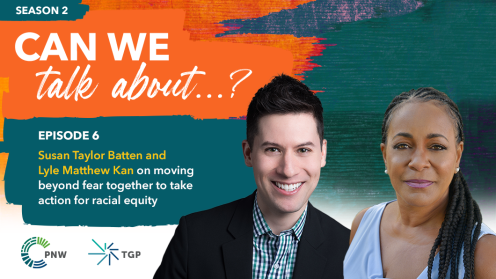
Susan
You know, one way to deal with fear is to focus on what you can control, and that's one thing that we can control, is to move dollars rapidly. And I would say that we think about civic engagement and organizing groups that build political power in communities of color, gay, lesbian, bi communities. That's what we need to be doing in this moment, is moving large amounts of money to those to those organizations.
Nancy
From The Giving Practice at Philanthropy Northwest, this is Can we talk about...? a project to normalize the messiness of leading for racial equity in philanthropy and reflect on what it takes to create lasting transformation. In season two, our hosts explore what it looks like for philanthropy to advance racial equity on the ground. Where the work can look quite different depending on the context, whether it's place issue, area or community served, and in a world where our contexts are constantly shifting. We're asking guests to practice vulnerability, explore sticky topics and look for learning. And what we ask of you is to do the same.
Katie (Host)
Hello everyone, and welcome to Can we talk about...? I'm Katie Hong, and I'm a senior advisor with The Giving Practice at Philanthropy Northwest and your host for this episode. For this episode, I'm so excited to be joined by Susan Taylor Batten, the president and CEO of ABFE, a philanthropic partnership for black communities, and Lyle Matthew Kan, the interim president and CEO of Asian Americans / Pacific Islanders in Philanthropy, also known as AAPIP. I'll pass the mic over to Susan and Lyle to introduce themselves and their work in this moment, but I want to acknowledge that we're having this conversation a month into the second Trump administration, where he has already taken so many significant actions to dismantle diversity, equity and inclusion efforts, both at the federal government, inside and outside of government, affecting organizations that receive federal dollars. I just want to acknowledge that we're in an environment of chaos, uncertainty and real fear in our country right now, with so many organizations reversing and dismantling their efforts on equity and inclusion. So more than ever, this conversation and the work that you're leading at ABFE and AAPIP seems so important. So Susan and Lyle, thank you so much for being here today and for this conversation. We're already where our audience can learn more about both of your organizations and the work that you're doing to support the philanthropic and nonprofit sector in continuing to advance this important work. But before we jump into this work, I'd love for our audience to get to know you better. So if each of you could share a little bit about yourself, what brought you into this work, maybe what continues to sustain you in this work, and a little synopsis of your organization, that would be wonderful. And maybe I will first ask Susan to start with the intros.
Susan
Sure, sure. Thanks. Katie, good to be here. Hey, my friend, Lyle, good to be in conversation with you. I'm Susan Taylor Batten, president and CEO of ABFE. I use she/her pronouns and a little bit about me. I am a native New Yorker. I am living in the DMV in this moment. I've been a resident of Maryland for about, gosh, 25 years now, and I've been the CEO of ABFE for the past 15 years and I'm in this work. You know, the road to philanthropy is an interesting road. But prior to ABFE, I worked at a pretty large foundation, the Annie E. Casey Foundation, and many years ago, helped that organization stand up its first portfolio on racial equity, diversity and inclusion, and that was really hard. That was hard to do, and I know that's a topic probably for another podcast at some point, how we stand up these organizations and foundations. But what helped me through that time I remember was my ABFE Fellowship. I was fortunate to be in the first class of ABFE fellows at the same time that I had the responsibility to help this very large institution so organize its resources around racial equity, diversity and inclusion, and that's how I got connected to ABFE. And when the position opened for president and CEO, I went for it. I thought this would be an opportunity to help many other foundations like I had. Did the Annie E. Casey Foundation get intentional and create its point of view and portfolio around racial equity, diversity and inclusion.
Katie (Host)
Wonderful. Yeah, thank you. And will you say one a couple sentences about ABFE and the work that you're doing?
Susan
Sure, so our mission at ABFE is to promote effective and responsive philanthropy in Black communities. Our work sort of falls into three buckets, if you will. One is philanthropic advising. We actually do have a philanthropic advising arm that provides consulting and technical assistance and training to foundation boards and staff. The second bucket is networks and partnerships. We organize funders by issue area, by role, to sort of help them think through how to, sort of, you know, better arm themselves to be strong advocates for Black people in the field of philanthropy. And then the third bucket is research and advocacy. We stay on the issues of the extent to which Black professionals get to lead, particularly in the c-suite in this field, and also we stay focused on the amount of money going to explicitly going to Black communities at the end of the day at ABFE, we're really trying to do three things with all the work that we do. One is to ensure that funders are armed with all the tools, resources and information they need to be the strongest advocates for Black people in the sector. The second is to ensure that ABFE members are parts of both public and private initiatives and collaborations to uplift Black communities. And the third is to ensure that ABFE members are networked, very tightly networked, so that we can leverage relationships and then money to sort of scale impact for our people.
Katie (Host)
Yeah, I love that. Thank you. Okay. Lyle.
Lyle
All right, here we go. Thank you again. Katie and Susan, it's always good to be with my dear friend, Susan, for folks who don't know Susan, I were actually Rockwood buddies, what feels like a million years ago and I actually love Susan that you'll tell people, oh, that was like five years ago, yeah, five times, like, maybe three or something. But, you know, but I love it, and I love being here with you all to answer the question, I think a little bit out of order, but I'll come back. You know, what sustains me is actually this community of folks here, you know, we're in a really challenging time. As I said, my name is Lyle Matthew Kan. I use he/him/his pronouns. I am currently the interim president and CEO of AAPIP, or Asian Americans and Pacific Islanders in Philanthropy. You know, I was coming into this year really trying to be very calm and focus, which, for folks who know me, I can be a bit energetic and talkative and frenetic, but really wanting to be very focused. And you know, since Susan said where she was born and raised, I can say, you know, I was born and mostly raised in the Los Angeles area. Is actually born in Huntington Memorial Hospital in Pasadena, right on the Pasadena Altadena border. And so the way that you started this podcast, Katie, just talking about this, the chaos that we're in right now. I mean, even before the start of this Trump term, the fires in LA with the world, literally and figuratively feeling like it is on fire and everything is under attack, everything we cherish, care about and hold dear, I think it's difficult. It's a difficult time for folks. So I want to acknowledge that as well. I am currently in New York City. I've been here for over 20 years now. I definitely consider myself a New Yorker. Susan, we must have done the switch swap trade. And you know, I love it here. I love the energy, the energy of people, helped sustain me. I actually got into philanthropy by accident. I think there's a lot of folks I know who kind of fell into this field, and it's interesting, since so many folks want to work in this field, I always say I'm someone who came into this work not because I wanted to work in philanthropy, quote, unquote, but because I was interested in making a difference in our communities. You know, I'm a biracial Asian American gay man. I felt like I spent a lot of my life struggling with different aspects of my identity, growing up, never feeling like I really belonged anywhere. And so for me, a huge part of my career has been on making sure that people feel like they belong, that they can bring their full selves to the world, and that they have the opportunity to flourish. I feel lucky, you know? I talk about it often. You know, I remember when I was a little kid in first grade, my best friend was Chinese, and my mom is the white one. I went to my mom and said, Why can't you be Chinese? Why do we have to be half white? And then, you know, I remember being a little bit older, right? And when I came out as gay, you know, at that point, it was fully acceptable in the gay community, saying, no fats, no femmes, no Asians. And I remember being like, Oh, I really want to be all white. And, you know, some with a fair amount of white passing privilege trying to lean into that for a while. And then, you know, I always say, as a gay man who was born and grew up during the AIDS epidemic like I didn't even know if there was going to be a life or acceptance for me. And we look at what's under attack right now, all the communities that are under attack, it's heartbreak. So I got into philanthropy. I got into this work because. I wanted to make a difference for the communities I care about. I started at Stonewall Community Foundation, which is New York City's LGBTQ public foundation. It was a great experience. Someone who's now worked at philanthropy serving organizations for nearly 15 years, I can tell you we did everything wrong at that foundation. Tell you firsthand the importance of the org, the importance of organizations like ABFE and AAPIP is making sure that you don't just do it alone, that you're connected to resources, to a community that can help you do your job more effectively and help you maximize your impact. Because we thought we had all the answers, but I can tell you we didn't. We definitely did not. I was there for a very chaotic two years where I think we had three or four different executive directors. My inaugural executive director, who I loved, Paul Edelburg, actually passed away on the job. It's a very chaotic time. And so I ended up, after two years, there at Funders for LGBTQ Issues, which is actually how Susan and I first met each other. I was the VP of research and communications there for quite some time. For the last few years, I've kind of bounced around between a bunch of different PSOs. AAPIP, I was previously their interim VP of programs here. Change Philanthropy and Philanthropic Initiative for Racial Equity. And what I can say about AAPIP and where we are right now, you know, we're a organization that's been around for 35 years now is we are really focused right now on two things. We're focused on providing community care for Asian American, Native Hawaiian and Pacific Islander people in philanthropy, and we are focused on philanthropic advocacy to increase foundation funding for Asian American, Native Hawaiian and Pacific Islander communities. You know, our we say community care, because it's not just professional development anymore. We do do leadership and professional development, but we also do healing. We organize people at all different parts of their career. We have, you know, 11 chapters across the country. We have support systems that we're constantly working on for folks that are newer to philanthropy. We have AAPIP affinity spaces, but we also have a CEO and Trustee track called Power in Practice. And then we talk about, you know, our philanthropic advocacy. We're always trying to make sure that we are focused on doing research that identifies trends, gaps and opportunities as they really as they relate to AANHPI funding. We are then trying to identify who is funding in our community and how we can help them organize and be more strategic, be more connected, and then identify also who's not funding us, right? Who should be funding us? Who says they have a racial justice portfolio, but they've not made a single AANHPI grant? We need to talk to those folks. So really, at the end of the day, what we are focused on here at AAPIP right now is being a home for AANHPI people in the sector, and being a catalyst that helps exponentially increase foundation funding for our communities.
Katie (Host)
Yeah. Thank you both so much for both your personal introductions as well as a little bit about your organization. I'm just want to lift up that really your life's work, the work that you're doing is about making sure that all of us, regardless of where we come from, what we look like, where we live, are just treated with dignity and respect. Are felt, is heard, is included, feel a sense of belonging, and that resources are going fairly to all communities, and that no community is being left behind. Sometimes I think when people hear the word equity, it just seems I don't know what people assume, but I just want to remind and I think your stories really lifted that up, that what we're talking about is that every person is included in the in our community of concern, and is really supported to to not just survive, but to thrive. So thank you for lifting both of that up. And I'd love to start, you know, we talked about kind of this current climate. That's how I started the podcast, by just referencing what's happening at the national level. But I'd love if one of you could start out by talking a little bit about what's happening in the philanthropic sector. How are found. I know it's early, it's and and at the same time, it's not just this last four weeks. I think we're feeling it really intensely because of the change in administration, but I think some of the backlash and some of the reversal we were already starting to talk about in our sector. So what are you hearing about what's happening in our sector? How are foundations reacting or responding to this current moment? Who would like to start?
Susan
I'll jump in Lyle and yeah, let's tag team on this. You know, there's so much confusion and lack of clarity, particularly around the legal landscape, vis a vi what is legal, what's not, in terms of explicit and we talk about race, explicit grantmaking, I would say, over the past couple of years, the field has, you know, been sort of reaching for answers and clarity about what's possible vis a vi, you know, funding around equity and justice for all people. People that lack of clarity, the confusion, also in an environment that, quite frankly, bullies are winning or leading, I would say, and so there's a lot of fear. There's a fear. There's fear about, you know, speaking truth, continuing to fund in ways in which, you know, we had made some progress in this field around funding to racial justice and social justice, and never enough money going to these issues, but, but there has been slow, I would say, steady progress. There's a lot of fear within the sector, again, I think mostly fear of the unknown, I would say, but also fear of being sued, or, sort of, you know, being attacked by folks who don't want to see opportunity and equity for all people, and so foundations are operating or responding in different ways. We've seen total loss of funding around racial equity and justice for some organizations, some nonprofits, and also just the muting of issues of race or gender or gender identity in this moment, as if not talking about the issues, actually is protection to continue to fund this work. I don't think that's the case. I think, you know, those that have different opinions, or what I call, generally, the opposition, it's one of their goals to get us to be quiet and not talk about issues of race and gender and identity and orientation. And so we're seeing that, I think, by foundations that have good intentions because they think they're protecting the work this way. But, you know, I always talk about the risk of muting the issues of equity and justice for all people. You know, I think there have been a few standouts in terms of folks being vocal in this moment. And so I just want to give all props and kudos to foundations that are making very clear and loud statements. Because, for the most part, Katie, I think the the sector's gotten very quiet, very quiet and and, you know, I believe, I think Lyle and I both agree that we have to continue to be loud on these issues. So I just want to, again, sort of give kudos to those foundations. I'm going to shout out Robert Wood Johnson, those foundations that are making very bold statements. In this moment, there is some funder organizing happening. I think more recently, you know, we we get the sense that foundations are meeting amongst themselves, particularly given the executive orders flying from this new administration, there's some funder organizing about how to protect and defend the sector, but for the most part, use of proxies rather than the real issues that we're talking about, clearly pulling back of funding, and all of that, I think, is driven by fear of the unknown, fear of the unknown. Yeah, I know Lyle.
Katie (Host)
Lyle, go ahead. Should I just say ditto? Should that just be I mean, seriously, I think it is such a rich question, right? And there's, I totally agree with everything that Susan said, and I think, you know, just to add to some of it, to start from the positive, I think at its best, philanthropy is innovative and impactful, and does work that takes risks, does work to make and inspire a more just society that government can't or won't do, that other private actors can't and won't do, and it's a real privilege that we have to work in the space. And I think we have to always acknowledge that we are in a privileged space right now. And I agree that people are running scared. I think people are running scared because things are unknown, because there's legal risks. I think also, as much as we don't want to admit it, there's a certain instinct to protect a certain amount of privilege that we have right now, right? So not really wanting to put that privilege on the line. And I think now is the time to put that privilege on the line. So much is at risk for so many of us. Yeah, right. I think now is the time to do that. I mean, I think that in many ways, as you said, Susan, you know, the field is often playing catch up. The field is often playing it safe, and I think too often self polices itself before it's necessary, right? We come in and we say, oh, we can't do that. Actually. No, we can do that.
Susan
We actually make up all the rules.
Lyle
We absolutely do. I mean, like, have you read the IRS code? It's not, I mean, there, there's some, there's some rules, but there's not that many. Yeah, and you build a lot of flexibility and leeway to make a really big difference in this world. I always say it's most important your grantmaking, obviously, but you also have a bully pulpit, you have power, you have access that a lot of people don't have, and I think now is the time to use that and to Susan's point. There certainly are folks that are doing but I think would like to see more. More of it, you know, more of it before it's too late. I was on a call recently with some CEOs, and I'm trying to remember who said this. But you know, there's the whole thing where they're coming for us right now, right? They're coming for our communities. They're starting to come for our organizations. They might not be coming for the private foundations yet. But you know, what's that old quote from? You know, the the Catholic, or was it the whatever priest in World War II, like they came for all this, I didn't speak up. What happens when they come for us? And I think we are potentially in a moment of existential crises right now for our sector, for a lot of things that we really deeply care about. Yeah, you know, I feel like we have made important progress in my lifetime. You know, when I started in philanthropy, I remember. I remember still when I made the decision to come as a gay man, I thought, oh, there's a good chance I get HIV and AIDS and die and there's I never thought that I'd see, you know, marriage equality in my lifetime. So I've I'm proof that you can see this progress in your lifetime. I'm also proof that it's not guaranteed, that it can slide backwards. Right? The number of countries I can visit as a gay man is far fewer now than it was when I first came out because of laws that ban gay people going there. So your world can also shrink. I think that, you know, after the racial justice uprisings of 2020 we saw certain progress, but we're already seeing that slide back. We're about to release a new report on AANHPI foundation funding. It did surge in 2020 and in 2021 after the Atlanta spa shootings and after the stop AAPI hate movement, but it already went back down in 2022 right? We need to sustain that work. We need to sustain that funding. We need to see the real gains. I mean, I think we are closer. I hope that we are closer than we think, and that this is, you know, a difficult moment that has a happy ending on the other side. But I think you're right. Katie, certain words just set people off. Yeah, you know, I was thinking we were talking about this equity. I think people, when they hear equity, have the powerful voices that have an vested interest in keeping us down. Just see us as trying to invert power dynamics. And I tell people, I'm here just to get rid of power dynamics to really make it a better world for all of us. So I'm starting to ramble. I'll let you interrupt.
Katie (Host)
Yeah, no, I'm just, I mean, both of you referenced this. I mean, clearly. So a couple of things that I'm really struck by your comments. First is this recognition that, in a way, we've been here before, maybe not the current context, but the history of our country is that you take a couple steps forward and then three steps backwards, like it is this continuing pendulum and and I was speaking with a friend of mine who was just reminding me, like this backlash, the the strength of this backlash, in some ways, is an indication of some of the progress we've made in this country. And you know that that it's important to kind of understand this context in the whole arc of our history, right? And that that we are, that there are parts of this movement that are winning, and so that we shouldn't give up on that. And both of you also spoke to the many roles that foundations could have. It's not just grantmaking, but it's it's a narrative power of using the bully pulpit. It's the convening power of bringing people together. And so I guess with that, I just would love to go a little bit deeper and ask you, what advice do you have for funders that are listening to this right now? What advice do you have on the types of grantmaking that funders should be thinking about right now? What advice do you have for how they might use their convening power, if not using their voice. How do they want to use their convening power to help support others? What advice do you have for how they might either invest in narrative strategy or actually use their own voice and their own political and social capital to be thinking about messaging? Yeah, I just would love any thoughts that you have for how funders need to either shift or adapt their strategies to meet this moment.
Lyle
Do you want me to kick this one off? Susan, yeah, great, because we actually have a collaboration between AAPIP, ABFE and NAP that we would love to talk about. Yeah, and we have concrete recommendations there I can walk us through. But you know, the first thing I'd just say on this topic is, I think we need acknowledge. It's okay to be afraid, right? Yeah, fear is a natural part of life. I just bought a condo in New York City. Sometimes I'm like, what the hell were you thinking, Lyle? Like, how are you gonna pay these bills? Are we gonna have to flee this country? What's going on? And on the flip side, I'm really excited, right? I'm genuinely so excited. I mean, I lack the gaging to figure out how to interior design, so that stresses me out, too. And thinking, you know, Lyle just likes comfortable furniture. How do we get the cute stuff in here? So, you know, my gay friends are gonna be like, who designed this, you know? But, but I'm genuinely excited about this new chapter in my life, right? But there's a lot of fear in that too. Even exciting good things can bring fear when someone becomes a first time parent, when someone you know, like, I remember all the really exciting vacations, taking years, sometimes going places that were a little dangerous, like, there was a certain amount fear, but there was an excitement there too, right? I think what I would say is it's okay to be afraid. It's not okay to do nothing. It's not okay to let fear drive your decisions. It's a time to be bold. It's okay to be afraid. It's not okay. To let fear drive your decisions right now.
Susan
Can I actually just jump on that, Lyle, and I'm sure fear, because I know we're talking a lot about it, you know, given this moment, but I had to sort of reflect on this. Fear is not new for those of us that have been working in this field for years, pushing on racial and social justice issues. You know, I can't tell you all, and Lyle I'm sure you've got them as well, how many calls I've received during my presidency ABFE from, you know, professionals of African descent working in foundations, fear, fearful about their their retention, their, you know, their ability to keep their job, because they're speaking truth to power, and they are moving the work forward. And I remember facing fear myself, and so I I'm also, I just wanted to sort of say this to acknowledge that, you know, people of color working in foundations, gay, lesbian people working in foundations, to some extent, women working in foundations that have been pushing agendas around racial and social justice have been facing fear for years. And you know, we do have coping sort of skills and mechanisms and things that we do so just to sort of double down on Lyle your point that it's okay to be afraid. We have often had to face our fear in this sector, before this administration, before the murder of George Floyd, you know, speaking up and pushing these issues. But we also have some ideas about how to how to manage that fear.
Lyle
I agree with you, that fear is so real. And, you know, I think that's also why our networks are so important. Susan is building this community. You know, I am fearful all the time. I'm not. We were joking before we started recording this, how I still need a rich husband. If you're out there, hit me up. But I think that, you know, like, I don't have a rich husband right now, right? And so, like, I need a job. I'm not someone who can just be like, Oh, I'm going to and that's a real, real I remember, you know, before I went to Funders for LGBTQ Issues, it was actually one of the best things that happened to me. I say fired, they'd say it was a restructuring, but like, I was fired from Stonewall Community Foundation, the story I tell people all the time about the importance of sticking by your values, and you know that community will save us. I was told by the third or fourth ED I had worked with by that point in my two year tenure. Well, mind you, I was hired as the Foundation and Events Manager. If you don't know what that does, I don't think anyone did. I was hired by the amazing Paula Ellery, who I also know was difficult. There's probably people listening to this podcast who worked for her, but I absolutely loved her. She was a mentor and someone I'd known, and I thought she was brilliant, if a little, you know, all over the place. And as I said, she passed away in the job. We went through all these different EDs, and I still remember, because I didn't have the language, right. I was in my young 20s. I was 25 I was, all of a sudden, had to raise $1.5 million for a public foundation with no fundraising experience. Do grantmaking, Giving Circle, work for the first time, work with a board at a really young age. And I remember, right before I was let go, I was called in, we were gonna have the $15,000 deficit, which is not great, but not horrible, given all the transition that we were seeing where we were, and also we were a public foundation with a ton of DAFs on paper, it wasn't gonna look that bad, right? And my boss, the president at time, called me in and said, Because of this, we need you to let go of a person who reports to you. And you have two options. You can let this person go before Christmas with two week severance. Mind you, this was like the Friday before Christmas, right? Or after Christmas with no severance. And I was in my early 20s, I didn't have the social justice language I have now, right? But I basically said, hey, look, we're a social justice organization. We're not going to do either of those things. Let's take a beat. Let's come back after Christmas. Look at what really is the scenario that we're facing. And if we need to let him go, we're going to let him go with two weeks severance, which now I also think is not nearly enough, just to be clear, but we there was no way I was gonna sit down and just do what he wanted me to do. It was not the right thing to do. When I came back from Christmas and I got fired instead. And, you know, I remember being terrified. I mean, I always think at that time, like, God, you should have enjoyed the time off. But I was, like, terrified, you know, how am I gonna make ends meet? And I will never forget, I have an incredible mentor, Richard Burns, who's now kind of a permanent interim CEO, if any foundation folks need an amazing leader. Reach out to Richard. He was very sweet. I called him. He took me to lunch. I got fired on Thursday. He took me to lunch on a Friday. He set me up with 10 CEOs to meet with the next week, one of whom was Ben Francisco Malbec at Funders for LGBTQ issues, who was an incredible boss, an amazing friend who I met with him on a Wednesday, then I met with him on the weekend. I was very late to meet with him, because I'm a Manhattanite. He lived in Brooklyn. Was very I was very turned around. He still hired me. Somehow, ended up working for him for almost a decade, and I immediately it was, it was the best thing that could have happened to me, but it was an example of sticking by my values and finding solace in community, and I think those that's what I'd encourage people to do right now, absolutely, yeah. And as you know, I'll turn over a second, but as I said, we between AAPIP, ABFE and NAP. We have come together right now. And I think it's so important that to remind folks that we provide these spaces for our community. We provide these spaces for allies, if you want to come join the party too, and we provide places really, to strategize this. And we also have come together and built an initiative called the Racial Equity Advancement and Defense Initiative, or READI for short, yeah. Tell us more about that. Yeah, yeah. And it's and we can get some of the concrete recommendations right. It is our effort to promote, expand and defend race explicit grantmaking. There's four different components. Susan, do you want to talk about the components? And maybe I can talk about the direction you are the good one at the showmanship on this is your.
Susan
Oh no, no. Thanks. Lyle, thanks. Yeah. As as Lyle said, there are four different components, or four strategies to READI. One is to build a legal fund to provide resources to nonprofit organizations that focus on our communities, the communities reflected by the four race identity groups, if they find you know themselves in need of resources for legal counsel, legal advice. It's actually a Legal and Security fund. It's held at the Tides Foundation so resources can also be used for things like cyber security and the like. We just signed the MOU Lyle that happened yesterday. So this, this fund is is up. It is live. We are seeding the fund. If there are foundations out there interested in working with us on this. So that's the first, a legal support and security fund. The second is to organize a Knowledge Center or resource bank that pulls together all the information, the tools, the articles, the webinars. I know we have all been a part of them, but we wanted to organize them in one place for the field, so that if foundations need to use those resources, you know, provide opportunities for board development and Board education on what's happening now and its impact on philanthropy. They can actually go to ABFE's website, click on affirmative action, and you can get to the READI Resource Bank. The third sort of component is a narrative and communications campaign we are working with Rally Communications to pull together the right messaging to get in front of foundation leaders, CEOs, trustees, about the need to double down and continue the work around race, explicit grantmaking. And again, these are messages that are that are open to foundations that want to use them themselves, if there are folks that are interested. And then the fourth is to work with civil rights organizations, ensuring that they have the resources they need. In this moment, they are doing amazing work, helping to defend, you know, nonprofit organizations, many of them are taking the lead on sort of bringing suits against some of the executive orders and things that are coming out of the administration. One close partner to date has been Lawyers Committee for Civil rights under the law, which has opened a new pro bono legal initiative for nonprofits and small foundations that, again, don't have the resources, but can benefit from legal advice and representation if needed at no cost. At no cost, those four strategies make up the READI initiative. And Lyle, yeah, I can talk a little bit about some of the guidance that we have for the field.
Lyle
Yeah. I mean, I think you know what I appreciate. I mean, first of all, let's just say it was a no brainer for AAPIP to be a part of this work, because it's so important. Protecting race, explicit grantmaking. How do we how are we going to take that out of the conversation, right? Like, how are you going to really solve some of the biggest problems of the world if you don't acknowledge that some of these challenges align with racial discrepancies, right? You just can't. I feel like it's, it's, it should be clear to folks, right? If you're a foundation and you're trying to address any number of funding priorities, most often, you're going to see that communities of color have higher rates of x, y and z. And to really meet your mission, you're going to need to do some race explicit grantmaking. And you know, for us, it was a no brainer, AAPIP, to be a part of this. And it's, I just have to say, again, it's such a joy to get to work with Susan, Anna Marie and Eric on a regular basis on this. And we're really focused, I think, on trying to get tactical recommendations out to the field, so the more that we can share practical, tactical recommendations with folks that can help them move the needle. I think that's going to be really important, because, as we said, we're operating in a moment of fear, right? And we're encouraging all of us to do this together, to move together. I really do believe we're stronger when we do this work together, right? We're more. More we can be more than the sum of our individual parts. And so while we're working on a legal landscape analysis that will be available soon, we have put together some transformative actions that we think help advance race explicit grantmaking in this point in time. And we've organized this around three different components right transforming your internal structures and governance. So again, point one is transforming your internal structures and governance. Point two is transforming relationships, and point three is transforming the field. And in each of those categories, we have, you know, a vision and actions to get there. You know, when we talk about transforming internal structures and governance, we're talking about working to make sure that your internal structures support race explicit grantmaking, and that you're ingraining race explicit grantmaking into the core of an organization, so that we can position your foundation to the withstand pushback and weather challenges. So the actions we recommend, for example, is to help your board, help you structure both the composition and the focus of your board of directors strategically, to place a race explicit lens at the center of how you're thinking about your work, to make that an important part you know, to make it learning an ongoing component. And there's so many great groups that provide resources around this, from the Philanthropic Initiative, from the Philanthropic Initiative for Racial Equity and Lori Villarosa there. Equity in the Center. Kay Suarez, they've recently taken on the racial equity tools. Board Source. There's just a ton of resources there. We also think it's important, I would recommend that you mandate for your board and your staff a race equity and race explicit learning agenda. You know, I think proponents of race explicit grant making have been on the defense too often in this kind of particularly in the post affirmative action landscape. And so it's important that we combat misleading headlines, fear and uncertainty. And part of the antidote is education and knowledge sharing, both internally and externally. And I think there's ways that organizations can do that, and again, a plethora of organizations that can support you in that, including the four organizations that are a part of the Racial Equity Advancement and Defense Initiative. We're also encouraging you to center the influence of your program staff. Right now, it's the time to prioritize open and transparent conversations between program staff managers and executive leadership. And we say that not just because it's good to be a little bit more, you know, equitable in your organization, but program staff are often the closest to the work that's being done on the ground, and their experiences and observations can sometimes be disconnected from leadership, and it's important that as leadership is responding in this moment in time, they have those perspectives at hand. It is also critically important for organizations to name and own their appetite for legal risk. You know, we're living through a moment of legal uncertainty. You know, I am praying and hopeful that the rule of law holds in this country. I think that that is one of the scariest things for me right now, but in this moment of legal uncertainty, you know, and in a moment where we know that a lot in philanthropy operate with a risk aversion mindset. It's really important to center what is your vision for your work, and to name and own how bold you're going to be, and you know what your legal risk appetite is. There are going to be attacks like, let's let's not be naive about that, right? But if anyone can weather attacks right now, it's got to be philanthropy. How many billions of dollars do we have in the bank, right? We should, I actually think we should be weathering some of these attacks more than our grass or trillions? Yeah, yeah. I always used to joke when I say, oh, that, you know, people be like, Oh, we don't give way that much of money. We don't have that much of bank. Listen, if I had that much in the bank. I would be the rich husband. I think, you know, but I think that it's important that foundations think about that. It's also important that they cut the red tape. We saw what you can do during COVID. We saw how you can cut red tape. I get listen, I come from a data and research background. I believe in those kind of metrics. But let's cut the red tape where we can let's recognize the moment that we're in when we talk about transforming relationships, we're talking about redefining power and influence, right? We're talking about rooting your strategies on an unshakable truth, making sure that we don't fall victim to the narrative that race explicit investments in programming are a zero sum game. Yeah, right, yeah. Again, I say this all the time to folks, right? You know, like, I'm not asking you to invert power dynamics. Ask you to get rid of power dynamics. I'm asking you to make things fair, to make people feel like they belong, like they have a fair shot here. Like to to eliminate some of the artificial challenges that have been placed in our communities. We're also asking folks to get creative with their funding strategies, and again, that is goes back to cutting the tape and to build relationships that are beyond the transactional. I want to be clear. We are foundations. We're here to give away money. Let's, let's not be shy about that. Let's, let's do that work, but let's also realize the power and privilege we have. I think then, you know, we're also talking about transforming the field and building an ecosystem that doesn't fall. Old in times of stress or uncertainty, and is prepared to withstand and respond to future challenges and attacks. So when we talk about, as a field, how we're gonna, let's move more money and let's move it faster. People need the money now. I mean part of this deluge of attacks on us, right as we're thinking about this. Part of this is, you know, it's a strategy to cut the legs out from underneath us. I think about what happened, you know, I was really proud of the statement that Susan, Eric, Anna Maria, and I put out about, you know, the importance of race explicit grantmaking after the executive order, kind of banning DEI efforts. And that was the day that they released the executive order cutting off freezing all federal funding. A lot of our community organizations rely on federal funding. We're not gonna be able to close the gap completely, but how are we making sure that they even have the resources to challenge this? Yeah, and to that, I think it's really important to change the narrative. Right? Opponents of race, equity and race explicit grantmaking have been really successful at shaping and capitalizing on a narrative designed to drive division and fear? Yeah, we need to change the narrative, and we need to be explicit and loud about our commitment to racial equity and not ignore the political sphere. So I already rambled a lot. There's more that we could share with folks and maybe have attachments. But.
Katie (Host)
This is also, yeah, no, this is so great. And I mean, you really covered the gamut between kind of what individuals should be thinking about kind of personal strategies that individuals were experiencing a lot of fear and uncertainty, what they could be doing, what foundation leaders could be doing. I loved hearing more about READI, but Susan, I'd love to hear any stories you want to offer. You know, like any stories you have of courageous action or or different things that people you've seen, people or organizations who are acting in a certain way. You mentioned a couple of foundations who you really want to call out in this moment, because I think that at least I know that I hear or learn best through stories. And so just wondering if you have any examples of of specific stories that you could share.
Susan
You know, I mentioned Robert Wood Johnson Foundation earlier in our talk, and also, I just saw the amazing leadership of the Horizon Foundation, based in Maryland, a regional funder that you know, in this moment, decided to put out a very clear, intentional, explicit message that we sort of value DEI, it is, you know, central to our our our work, we care about all in our community. And you know, now is the time to stand up and and again, we often use Katie, the word loud and to be loud about, you know, our commitment to these issues, you know, those are two sort of courageous acts that I would lift up. As I say, we need more of them. I do think that, you know, there are a number of stories I've got my own about, again, standing up to folks in power who were trying to sort of dilute the foundation's work on racism and racial justice. Interestingly enough, and I tell this story a lot, if you ask ABFE members that have been around for a while, and particularly folks that worked at the Annie E. Casey Foundation, you ask them about the infamous reading on race in Oakland, California, at the Marriott many, many years ago, and folks might still shudder. Folks might still sort of have chills running through their their body, because it was one of those sort of instances where I made the decision that it was important, and this was back probably in the early 2000s that we needed to be not just talking about poverty and not just talking about place, but we needed to be talking about race. And I made that point in a ballroom in front of about 250 people or so, and right after me came a senior official from the Casey Foundation that basically said Susan was right to ask for forgiveness, not permission, because this meeting would have never happened and literally just pushed against the need to focus specifically on racism and structural racism in particular, it was the day that I thought I was going to get fired. I remember going back to my hotel room, calling my mom, saying I'm probably done, falling on the floor crying, locked myself in the room, and many, many colleagues banging on the door trying to get me to come out of the room at the Oakland Marriott. The next morning, I walked down to the ballroom the people that were left because it was a it was a tough and pretty messy meeting, because we aired our laundry in front of so many people. But when I got down to the ballroom the next morning, walked in and all of the folks that were left in the meeting, there were about a 150 left, stood up and gave me a standing ovation for my courage and speaking truth. What people don't know is that that's actually what led to the organizing of the race and equity portfolio at that foundation. And I will tell you, Katie, there are many other stories like that that we actually don't know of where people are putting themselves on the line. Yeah, you know about their values and principles, the threat of being fired, being embarrassed in front of, you know, public audiences, but yet still prevail. So when I hear of an organization that's just sort of uploading a new portfolio on equity and justice. I know there's a story behind it, yeah, I know there's a story behind it about courage and courageous staff, yeah. And I just want to tell everybody that we see you, we know you're out there and you're not alone, and let's organize in this moment.
Katie (Host)
That is so beautiful. I just, we're here for you. Yeah, I mean, I just want to, I said something earlier about how the backlash, in some ways right, is an indication of the progress that we've made. And your story really just points out, like behind every progress is the courageous action of leaders like you, and so thank you, Susan. I know so much of the progress we've seen in this field is because of the actions that you've taken and Lyle that you've taken in throughout your career. So thank you for lifting that up. Because really it's not, you know, institutions, right? Like, what's behind that are people and people taking courageous action, whether it's like whether it feels safe or whether it feels challenging, and thank you for lifting that up.
Lyle
It usually doesn't feel safe, right? I mean, I'm thinking about that, Susan, because I love your story. And there's you're right. There's behind everything, like people have moved and pushed, and I think far too often, as people of color, you know, queer people, people with disabilities. We're sometimes afraid to advocate for our community in our grantmaking roles because it seems self serving. Meanwhile, a lot of other people are advocating for the community all the time, right? I mean, right, but I think community is one of the ways to get over or not to get over that. And I think the fear just never goes away, right? But you get better at managing it, and you get bolder, and you realize you have people behind you, and you realize the difference you're making, yeah, yeah. And I think so many of us have had a stake. I mean, I remember when I go down this whole road, but I was struggling a little bit kidding, because I have more bad examples, I think, than good examples in the field, you know. And I several things I was thinking about, as you were saying, that was just also honoring that we have at AAPIP, and it's true for ABFE, we have members that focus specifically on our community, those foundations that I feel like are often brave and bold and out there and doing things, you know, whether it's Asia Pacific fund, Asia Pacific Community Fund, New Breath Foundation, that are doing really interesting, innovative work on small budgets. We have individual actors in philanthropy really fighting for us. You know, I don't want to go down a rabbit hole, but I think about some of the drama with the racial equity and philanthropy portfolio and how AAPIP was not originally a member. We were cut off from funding. And groups like ABFE and HIP and NAP advocating, saying, hey, we need to be doing this all together. Yeah, again, not trying to play a zero sum game, but saying, you know, a rising tide lifts all boats. I think about, you know, when we did our last report at a pip seeking to soar and, gosh, whatever year that was probably 2021, right? And how individual folks took that tool. I'm thinking of a program officer at OSF, Sebastian who took that report and tool and advocated and gotten 25 million from OSF for our community, didn't get renewed. So that's a challenge there, but it made a difference, and we're all still trying to make that difference.
Katie (Host)
Yeah, well, I'd love this theme of right like courageous action, but we don't have to do it alone, and the kind of resources and your the work and the support that both of your organizations are offering to philanthropic leaders in our sectors, feel so important. Okay, I feel like I could ask you so many different questions, and I know we're almost out of time, and I really want to make sure that you that we take advantage of both of your presence here today to say, you know, what is Is there anything else that you want to say to leaders in our sector who are committed to this work and who want to advance this work? What do you want to say to them that you feel like you haven't already said in this podcast? What do you want to say to our sector that you feel like is so important to say, but maybe hasn't been mentioned yet in this conversation. I'd love to give you the floor one last time before we wrap up and and maybe actually, Lyle, one or whoever wants to start, could go and then, and then the other person could bring us home.
Susan
You know, Lyle, do you want to do you want to start?
Lyle
I was like, Please, let me check. Let me get my final word. I feel like, I feel like we, we talked about so much in our practice session. I'm like, did we hit all the points? Yeah, tell enough personal stories. Yeah, were we too personal? I don't know.
Susan
I know, right? Well, we'll find that out soon. You know, I think there's a lot. But let me try to sort of narrow and thanks again, Katie for this conversation. There's no hiding anymore. I want to say to the sector, and again, I know the folks that listen into this podcast are we are in this together. And so we have to say to the field of philanthropy, there is no hiding. The the idea that we can get quiet and start talking about issues of race by substituting it with place. You know, they know who we are. They know where we are. We know this last Executive Order has tasked the Attorney General to come up with what we're calling the hit list of foundations, nonprofits and associations that aren't in alignment with the administration's perspective around DEI they know who we are, and there's no hiding and so getting quiet, muting this work only really hurts nonprofit organizations and nonprofits are scared. You know, we have black lead nonprofits in our membership, and they are afraid, and that's why the voice and the courage within philanthropy is so important. So let's not let this sector believe that muting our voices is going to save anybody again. It's not. They know who we who we are, and I put us on that list. And you know, some of us are going to get tapped with investigations or lawsuits. The other thing I would say is that, you know, it is about litigation in this moment, and Lyle sort of mentioned it a bit, but we've got to think about litigation as a strategy. We should be funding litigation strategies. And again, I think it's going to end up in the courts in terms of, you know, the freedom of philanthropy to fund the ways in which it wants to. And I'm hoping that more of us can push the sector to think about litigation what foundations have the temperament and the muscle to bring suits right, to perhaps be parts of class action lawsuits, to be plaintiffs. So we got to think about litigation. And then I guess the other thing I would say, the last thing I would say, you know, Lyle took you through our set of transformative actions, and we'll be moving those in the field, working with funders, to the extent that we can to bring them to fruition. But this issue about moving money and moving seismic amounts of money in this moment, you know, one way to deal with fear is to focus on what you can control, and that's one thing that we can control is to move dollars rapidly. And I would say that we think about civic engagement and organizing groups that build political power in communities of color, gay, lesbian, bi communities. That's what we need to be doing in this moment, is moving large amounts of money to those, to those organizations. I don't want us, Katie, to begin just to focus on solutions without asking the question, how did we get here in this country, vis a vi the attacks on DEI and and and how was philanthropy complicit in that? What was our role? What did we do well, and what didn't we do so well? Because if we don't turn the mirror on ourselves and just start talking about defending the sector, then we're liable to just repeat some of the same mistakes. One of the things that we have not done well is move the money to again, communities of color, gay, lesbian and bi organizations and and enough money so they can win. Yeah, I think it's part of the reason why we're in this where we're in this moment in this country right now, is because we let down the power building infrastructure for our communities in this country, and we've got to figure out how to reverse that.
Katie (Host)
Yeah, yeah. Thank you. Such good advice. Okay, Lyle, how do you want to what do you want add on? Ditto again?
Lyle
Yeah dittio. I mean, you know, Susan is just such a powerhouse. It's always hard following Susan, you know, I'll just start though saying, you know, while we're gonna have some new research coming out, let's just sit for a second that for every $100 awarded by US foundations, only 20 cents goes to Asian American, Native Hawaiian and Pacific Islander communities. We can, we should. I think we have an obligation to do better. You know, I don't want to repeat all the things, but I think that the themes for. Me that kind of came up from here is, again, it's okay to be afraid. Susan, I both shared personal stories where there was a lot of fear, and hopefully we did the right thing. I think we both did the right thing. I guess you guys can be the judge, but it's okay to be afraid, but it's a time to be bold. It's a time to be bold. And I think the invitation is to join us. That there is a community of folks waiting out there for you. You know, I have been had the privilege of working in LGBTQ racial justice and AANHPI philanthropy for more than 15 years now. And I'm partially as bold as I am because of amazing friends and mentors and colleagues I have like Susan, like Carly Hare, like Lori Villarosa, the trailblazing path people like Peggy Saika made for me right folks that I think have fundamentally changed the way organizations work, like Amanda M. Andere and Funders Together to End Homelessness. The way that I think about inspiring program officers like Sophie Yem at the sudna Foundation, who has a fairly limited portfolio, but has done an incredible job at motivating other funders to give to AANHPI organizations and racial justice organizations more broadly. So it's natural to be afraid, as we've said again and again. Think about your legacy right now. What would you be proud about we're sitting with a lot of power right now. What's the good in just preserving it, just for power and privilege sake, let's use it. Let's let this be a moment that we look back and we say, yeah, it was really rough, but where we could tell our grandchild, our kids and grandkids and whoever else like, we did something. We made a difference, we stood up, we fought back, we made it so that this is the future that you all get to live. Now. Let's think about how what would be proud of. And to that end, you know, I continue to plug and say, you know, our four organizations are here, both through the READI initiative and through the individual program offerings that we offer. We all have conferences. Join us at our conferences, fund us, support us and find a community. You know, all of our conferences are welcoming. You don't all of our conferences are welcoming. You don't have to be AANHPI to come to AAPIP's 35th anniversary conference. You don't have to be Black to go to Harambee. We actually welcome allies. We need a big movement right now. We need you all, and we need to be standing up for each other, right, you know. So that's probably where I'd end.
Katie (Host)
That was so good, so good, I knew I I came into this conversation wanting to leave more inspired and connected, and you both have really, really helped to do that. Thank you. Thank you for your incredible leadership and work, not just during this time, but for what you've done throughout your professional and I imagine, your personal kind of time. And thank you for your leadership now and really asking our sector and leaders in our sector to be bold and courageous and to act not because they don't feel fear, but even if and when they feel fear. So just really appreciate just your amazing advice on all levels. So thank you very much.
Susan
Thank you.
Lyle
Thank you. Katie, yeah, now it's time for drinks, right?
Nancy
Can we talk about..? is a podcast by Philanthropy Northwest, written and produced by Aya Tsuruta and Emily Daman, with production support by Podfly and graphic design by Asha Hossain. Our episodes this season are hosted by TGP senior advisors, Katie Hong, Robin Martin and Abby Sarmac. You can find more information on this episode, including guest bios and shownotes at thegivingpractice.org and if you have a topic that you think philanthropy should be talking about more, let us know by emailing hello@thegivingpractice.org. A special thanks to our Philanthropy Northwest and Giving Practice teams for their thought partnership and the Ford Foundation for making this project possible. I'm Nancy Sanabria and we'll see you next time.
Overview
One month into President Trump's second presidency, Susan Taylor Batten, the President and CEO of ABFE and Lyle Matthew Kan, interim President and CEO of AAPIP (Asian Americans / Pacific Islanders in Philanthropy), sit down with us to share stories and insights on how philanthropy is navigating the administration's efforts to dismantle diversity, equity and inclusion initiatives. They acknowledge the fear and uncertainty of this moment, encouraging funders to move beyond fear and "put our privilege on the line" to move money and resources to those most impacted and at risk. They also provide tangible resources for philanthropy from the Racial Equity Advancement and Defense Initiative (READI), a collaboration with ABFE, AAPIP, NAP (Native Americans in Philanthropy) and HIP (Hispanics in Philanthropy), which models the importance of doing this work together - in partnership and community.
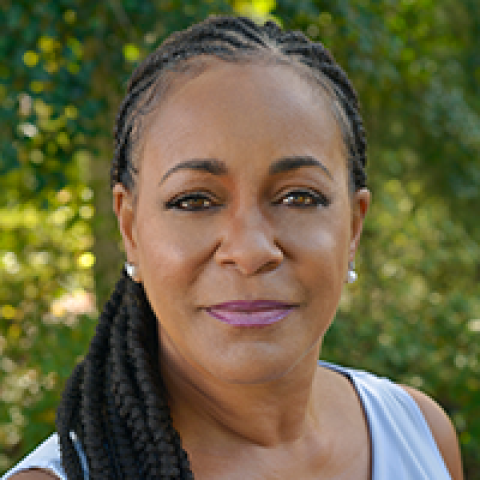
Susan Taylor Batten
Susan Taylor Batten serves as the president & CEO of ABFE: A Philanthropic Partnership for Black Communities, a membership-driven philanthropic organization that champions responsive and transformative investment in Black communities. Since 2009, she has spearheaded ABFE's philanthropic counsel and initiatives on responsive philanthropy for Black communities, aiding foundation leaders, donors, and partners.
Bringing over 25 years of leadership in both private and public sectors to ABFE, Susan previously held the position of senior associate at the Annie E. Casey Foundation's Community Change Initiatives Unit, managing a portfolio on equity, diversity and inclusion. Her career also includes a role as senior analyst at the U.S. Department of Agriculture, overseeing research and evaluation of food assistance programs and as an analyst for the Government of the District of Columbia, focusing on child and family support initiatives.
Susan serves on the boards of the Caribbean Philanthropic Alliance and Giving Gap and regularly lectures at HBCUs about philanthropy in Black communities. She holds a master’s degree in social work from Howard University and a bachelor's degree in English and political science from Fisk University.

Lyle Matthew Kan
Lyle Matthew Kan (he/him), a leader in social justice philanthropy, is the interim president and CEO of Asian Americans/Pacific Islanders in Philanthropy.
He previously held leadership roles at CHANGE Philanthropy, Funders for LGBTQ Issues, and Stonewall Community Foundation. He has served as a strategic advisor to the Edward W. Hazen Foundation, Equity in the Center, the Philanthropic Initiative for Racial Equity, and the Queer Youth Fund at Liberty Hill Foundation. An expert on trends, gaps, and opportunities in social justice grantmaking, he is well known for his reports and infographics on the scale and character of Asian American/Pacific Islander, LGBTQ and racial justice grantmaking. He is also a co-creator of the Diversity Among Philanthropic Professionals (DAPP) Survey and Report.
Lyle also serves as a trustee of the American LGBTQ+ Museum and Candid, and is on the advisory councils of CHANGE Philanthropy, the City University of New York (CUNY) LBGTQI Student Leadership Program and OutVote. Lyle holds a bachelor's in individualized study from New York University’s Gallatin School of Individualized Study and an master's in political sociology from the London School of Economics and Political Science. When not traveling for business or pleasure, he calls Chelsea in New York City home.
Key Lessons & Insights
Susan and Lyle acknowledge and normalize the feeling of fear that comes with speaking truth to power and moving racial justice agendas forward. “I think the fear just never goes away, but you get better at managing it, you get bolder, and you realize you have people behind you,” Lyle says, emphasizing the importance of coming together and finding solace in community in this moment. “It’s okay to be afraid, but it’s not okay to do nothing," he says.
Susan reminds us that “one way to deal with fear is to focus on what you can control,” and what philanthropy specifically can control, is how much money we give away.
- Amid fear and uncertainty, there are foundations that have been muting their racial equity commitments and efforts and others who have grabbed the mic to speak up. “Muting this work only hurts nonprofits…We have to continue to be loud on these issues,” Susan says, sharing a handful of examples including: Robert Wood Johnson Foundation’s statement on doubling down efforts amid the new administration, the Horizon Foundation’s statement on remaining steadfast to their DEI commitment, and READI’s statement on their commitment to race-explicit grantmaking.
- Susan offers us tangible examples of ways that foundations can fight back against this hostile environment. One specific example she shares is urging philanthropy to fund litigation strategies and legal support for nonprofits. Susan commented that she hopes “that more of us can push the sector to think about litigation. We should be funding litigation strategies.”
References & Resources
- READI’s curated resource list for philanthropy and non-profits on navigating the current legal landscape.
- Lawyers Committee for Civil Rights Under Law is a pro-bono legal initiative for nonprofits and small foundations that provide legal services and representation at no cost.
- Lori Villarosa is the executive director of the Philanthropic Initiative for Racial Equity.
- Peggy Saika was the previous executive director for AAPIP.
- Amanda Misiko Andere is the CEO of Funders Together to End Homelessness.
- Sophie Yem is a senior program officer at the Surdna Foundation.
Ongoing Reflections
- Lyle shares some of his moments of fear and reminds us that fear is a natural part of being human, but that we cannot let fear stop us from taking action. Take a moment to think about something that is bringing you fear. Next, think about who you can lean on when you feel fearful. Lyle and Susan shared the importance of community amidst difficulty and fear. Who or what is that community for you?
- Susan commented on philanthropy's role in getting us to where we are today - the complicity in retrenchment of advocacy and funding for racial equity. She asks us to turn the mirror on ourselves to consider what was our role? What did we do well? What could we have done better? She asks us to consider these questions so that we don’t repeat the mistakes of the past.
Credits
This episode of Can we talk about…? was produced by Aya Tsuruta, Emily Daman and our audio engineer Josh Suhy, with editing support from Karalyn Jenkins. Special thanks to Asha Hossain (Graphic Design), Nancy Sanabria (Intro/Outro Host), Komiku (Music). Thank you to the Ford Foundation for making this project possible.