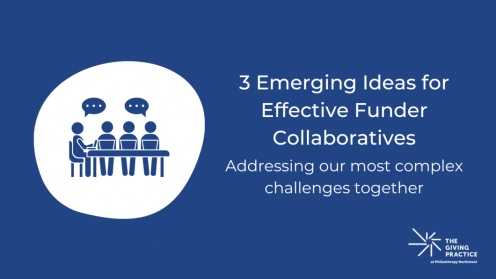
3 Emerging Ideas for Effective Funder Collaboratives: Addressing Our Most Complex Challenges together




Funder Collaboratives. Everyone wants to do it. But starting and sustaining one can be an uphill climb.
In this post, we’re excited to share our observations, reflections and lessons learned based on our experiences of engaging in, leading, and holding space for funder collaboratives. We define “funder collaborative” as “a group of funders coming together for a shared purpose.”
Note that we’ll be using the terms “funder collaborative” and “collaborative” interchangeably in our reflections.
In recent years, collaboratives have been gaining traction in the philanthropic sector as more of us want to address root causes – and not just the symptoms – and we realize that we cannot do it alone. The world’s most pressing problems are nuanced and complex, requiring collaboration and collective action to make progress.
Although there’s been growing interest and action in funder collaboratives—sharing resources, aligning funding and advocacy efforts, and learning together—moving from intent to sustained collective action has proven challenging and we’ve observed groups getting stuck or stalling out due to a myriad of factors:
Funding is limited. There's no dedicated staff to drive things forward. The group can't get past learning to action. Real institutional commitment is missing. Persistent tensions get ignored. People aren't aligned on the why. Ego gets in the way. These and other challenges are common. How to overcome them?
At TGP, we’re continuing to learn alongside our clients and partners to understand what makes for effective collaboration, and specifically in the context of funder collaboratives. As we build our knowledge, we wanted to share three emerging ideas to consider based on our experience to date:
1. Hold a network mindset
We've noticed how natural it is in philanthropy for people to show up to a collaborative leading with their own missions, priorities and answers. This is natural! We often see this play out in collaboratives when funders have a hard time departing from their own organization’s ideas and thinking.
I remember participating in funder collaboratives as a program officer and a key challenge was that everyone felt the need to brand and scale their own specific strategy.

Katie
Holding a network mindset means being willing to leave your organizational goals and priorities at the door and genuinely being open to the diversity of opinions in the room. Of course you are there because you are representing your organization and its mission and priorities, but the power of a collaborative can be unleashed if we are willing to think beyond our own organizational interests and participate in the collective space with curiosity and openness for emergent solutions to address a shared challenge and goal.
2. Define your shared "why." Then return to it again and again.
Defining why the group is wanting to collaborate is imperative to every funder collaborative’s success. And co-creating that “why” in an equitable way can be a challenge. Funder collaboratives can be driven by the interests of a few funders, particularly those who have more resources and/or perceived power and influence. Until the collaborative defines a shared goal, organizational goals will most likely occupy the space, making it more challenging for the whole collaborative to move and stay together towards a shared purpose.
On your journey to define a shared purpose, we’ve found that creating space for open, transparent conversations – transparency around why each individual is there, what their organization wants to accomplish, and what they personally want to learn – is a valuable exercise. This is not only an exercise of clarity and practicality, but also one of trust and relationship building. 3 Emerging Ideas Quotes - Mark.png
There is a sort of magic that happens when people in a collaborative share not only what their organization wants to accomplish but also what they personally want to learn and get out of the experience. There's a different energy when people share at that level. Things get moving.

Mark
Once you land on your shared purpose and story it’s important to keep revisiting it over and over and over so that people remember.
We spend most of our weeks and days in an organizational mindset so it's easy to stay in that mindset and forget about transitioning to that network mindset.

Abby
3. Invest in a weaver
Remembering to toggle from organizational to network mindset, developing relationships, deepening trust, aligning on a shared purpose and story…this is not easy work or one that will happen on its own. As Senior Advisors and consultants, we often play a “weaver” role – especially at the beginning of a collaborative – to surface that network mindset and intentionally create space for all voices to be heard, to move towards alignment, and to make this work easy and fun to engage in.
Like a weaver on a loom, "weavers" of collaboratives hold the individual threads of the group. They get to know the nuances of participating organizations — incorporating independent perspectives and experiences into a shared vision and creating something that is greater than the sum of their parts. Weavers also play an important role across transitions. People leave their organizations, new people cycle in and weavers hold the thruline across an evolving collaborative.

Emily
We’ve observed that collaboratives that continue to invest in or resource a weaver of some sort tend to have a much better chance of sustaining and continuing to advance the work of the group.
What have you observed or learned about funder collaboratives?
Let us know by heading to our LinkedIn post to join the conversation.
The Giving Practice (TGP) is the national consultancy of Philanthropy Northwest. Learn more here.
Looking for support for your funder collaborative? Reach out to us at hello@thegivingpractice.org.
Subscribe
Sign up for our quarterly newsletters to get the latest TGP reflections and resources right in your inbox.