At a time when we are increasingly facing a loss of community connection and public sector capacity to meet the growing needs of all young people, philanthropy is being asked to do more in terms of alignment and action.
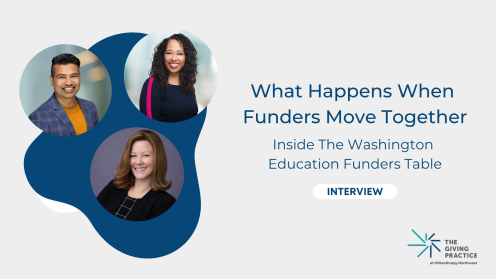
In November 2023, corporate and philanthropic funders who are supporting young people across Washington State began meeting, with support from The Giving Practice, to explore what they might accomplish together that they couldn't do alone. What started as an exploratory conversation has since evolved into The Washington Education Funders Table — an active network where funders learn from one another, align investments and take collective action across the state. Through conversations with Funder Table members Bish Paul and Angela Jones from the Gates Foundation and Traci McGlathery from STCU’s Here for Good, we heard a set of themes about what makes this kind of collective effort both meaningful and effective.
Collective action takes… a shared understanding that no one can do it alone
From the beginning, there was a clear recognition that the challenges facing young people, and the systems that support them, are too complex for any one funder to solve.
No single institution or entity can meet the moment alone, especially for young people. The funders table creates this rare space where we can listen across geographies, compare what we're seeing on the ground and move these isolated efforts to share strategy.

Traci
No one funder is going to have enough resources to fully support the entire continuum from birth to career. The most strategic use of our resources is to coordinate.

Bish
For Bish, this realization came from years of working as a grantee at a small nonprofit, looking at funder efforts across Washington.
Sometimes funders are not as coordinated, because there aren’t obvious incentives for why funders should work together, especially across differences. So I would see these random acts of programming.
Bish
Traci and Bish also noted the importance of bringing together perspectives from across the state — urban, rural and regional — helping funders better understand where resources are flowing and where gaps remain.
What we’re seeing: Collective action starts with a shared belief that working alone is insufficient.
Collective action takes…relationships and trust as the foundation
Before alignment, before co-investment and before action, there was relationship.
Bish, Angela and Traci described the early days of the Funders Table as relational, even informal. But that foundation proved essential.
We honestly started with a mindset of coming together to hear what others had to share. At its core, it was relational. Folks were coming because they cared about one another as individuals and funders. We’ve been friends in the work, and, with The Giving Practice’s support, that has evolved into a shared commitment to making an impact in Washington.

Angela
Trust created the conditions for candor, challenge and forward movement.
Building relationships and deepening trust first allowed us to get to the conversations on funding.
Angela
Angela also highlighted the value of learning across different types of funders, each with their own structures, timelines and constraints, which helped build understanding and more realistic expectations.
It created space for vulnerability — especially during a difficult time in the sector.
It was this ability to know we were in a very safe room to share the emotions together. The openness, the vulnerability, the ability to say, “I don't know."
Traci
What we’re seeing: Trust is the work. And without it, collective action stalls.
Collective action takes…moving from conversation to coordinated action
What is now a feature of this Funders Table is its movement toward action.
Traci described a shift from alignment to tangible outcomes:
At STCU we see peer influence as moving beyond coordination to alignment. It's reducing duplication, and it's taking concrete steps to work together, possibly co-investing and sharing data and knowledge.
Traci
This has shown up in tangible ways:
- Co-investing in statewide initiatives (e.g., FAFSA completion efforts, AI-enabled advising, digital ecosystem alignment)
- Scaling promising pilots from one region to multiple regions across Washington
- Connecting funders to new organizations and communities, particularly in underrepresented regions
- Coordinating advocacy insights and policy engagement across the state
- Reducing duplication and aligning investments across shared priorities
For example, what began as a shared conversation about FAFSA completion challenges evolved into coordinated efforts across institutions, leading to expanded access and new models of support across communities.
We bring ideas to the table that we want to share. And if people bite, they bite. But that has morphed into a co-investment of large proportions. Multiple funders came together to say we're in. Let's figure this out.
Angela
Knowing that there is active funder collaboration has also influenced other funders outside of Washington state to decide that they would invest in Washington and scale that pilot to three additional regions across the state.
Bish
Even seemingly small actions, such as sharing funding opportunities or connecting peers, had ripple effects.
Now we know when each other has a call for funding proposals. Access is part of the problem. If community partners don't know, they just don't know.
Angela
The Table also functions as a kind of real-time radar, helping funders stay attuned to emerging needs and policy shifts across the state.
What we’re seeing: Collective action is built through many forms of alignment — from small signals to large-scale co-investment.
Collective action takes…structures and facilitation that hold the work
While relationships and shared intent matter, participants were clear: this kind of collaboration doesn’t sustain itself. It requires intentional structure and facilitation:
This wouldn't happen if Katie Hong wasn’t facilitating. I do think that funder tables must have an individual that is corralling the herd…otherwise it would not keep moving forward.
Traci
And an acknowledgment of the realities of philanthropy:
There is no pre-existing systemic incentive for this work. That’s why we had to co-create one. For the first six months, there might not be as much uptake. You're just building relationships and trying to see if you can work together.
Bish
Get clear on what you believe, get clear on what you accomplish… get your evidence, get your data, make decisions, commit.
Angela
At its best, the structure becomes a container for momentum:
Once you build the momentum, it makes a huge difference. It can serve as a really great place for co-investment and attract national partners.
Bish
What we’re seeing: Collective action needs both a container and catalyst to move it forward.
The Washington Education Funders Table is a compelling example of how place-based funders, united by a shared commitment to a common population, can be effective — even without a single unified strategy. It offers a glimpse of what can emerge when trust and relationships lead the way, rather than a predetermined outcome.
The Washington Education Funders Table is facilitated by TGP Senior Advisor Katie Hong. Learn more about Katie here.
Looking to advance collective action through an emerging funders table or collaborative? Reach out to us at hello@thegivingpractice.org.
More from TGP
Subscribe to our newsletter to stay up to date on our latest reflections, insights, interviews and more.