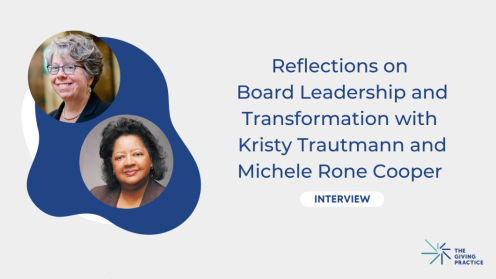
In 2022 we had the privilege of working with the board and staff of Grantmakers of Western Pennsylvania (GWP) as they embarked on a strategy process amidst the transition of a long-time leader. We were struck by the exceptional leadership of strategy committee co-chairs, Kristy Trautmann (current board member of GWP and executive director of FISA Foundation) and Michele Rone Cooper (former board member of GWP and retired executive director of McAuley Ministries) and the way that they led transformative work by the committee in service of the organization’s evolution at large.
Below, Kristy and Michele share an inside look at some of the key elements of the strategy process that ignited ideas, learning and momentum as the organization shaped its future vision.
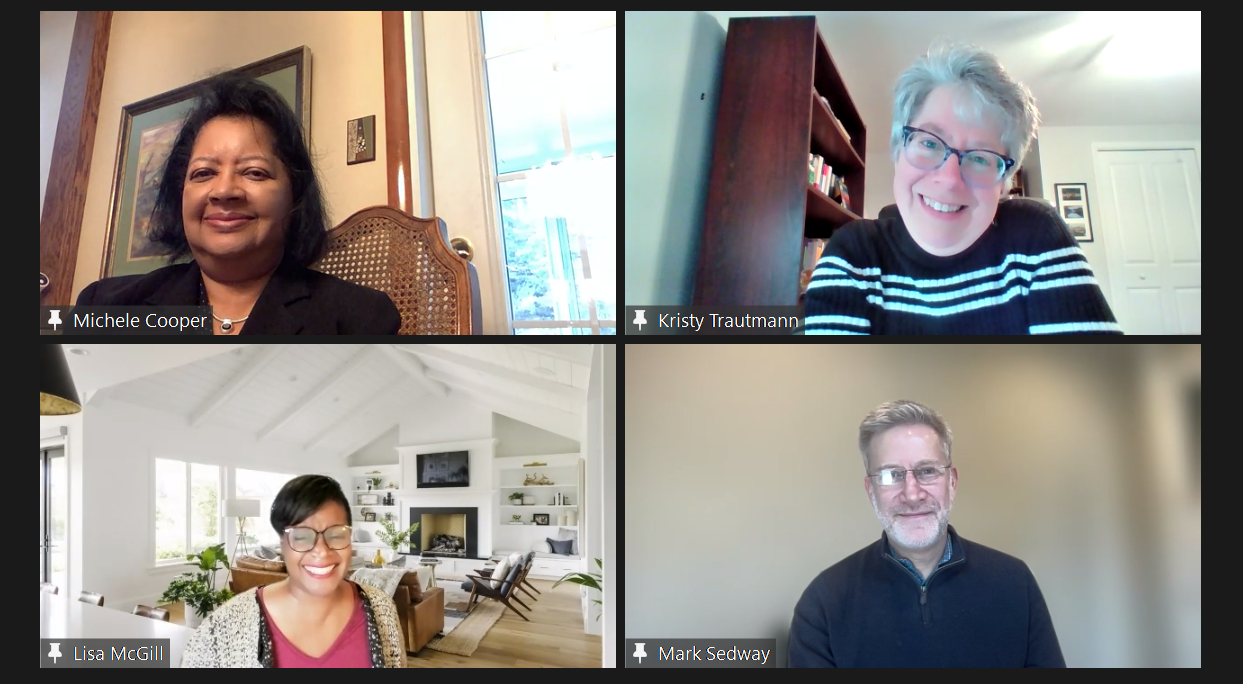
Thank you, Michele and Kristy, for your perspectives and insights.
What are your overall reflections on the strategy process?
What struck me was how our committee members brought their full selves across the entire process. I’ve facilitated and participated in a lot of strategic planning sessions over the years and continuously watched people check out throughout the process, but this committee was exceptional.
The design and length of our sessions were important to this as well. Each session was long enough to keep us moving towards our goal but short enough to maintain engagement and you kept it interesting with different exercises and formats while helping us stay on track. I was surprised at how effectively we were able to do this in a virtual setting too.
Michele
A specific exercise that really stood out to me in the process was identifying and articulating how our organization was evolving – from what, to what. There was a lot changing both internally and externally for GWP and the exercise was really engaging and helped us develop shared language for these evolutions.
And frankly I was stunned by how effective the strategic framework ended up being given how audacious the process felt at the beginning. We wanted everything but the kitchen sink at the beginning and I really appreciate how you balanced both accommodating and pushing us with that.

Kristy
What do you think makes the resulting strategic framework effective?
It’s important for a framework to provide a clear sense of what the organization’s purpose is, where it is headed and what its role is – and I think that is outlined in our framework.
Michele
And what ended up being just important as that high-level summary or one-pager of the framework was our companion document that captured the process.
At the beginning the companion document was a way to share where we were in the process and I thought ‘sure, timelines are important.’ But by the end it was helping us see how our framework was showing up in other ongoing work like conversations about membership dues with the finance committee, the ED search and nominations.
So it was both the framework for where we were going and the framework for where we were in the process – and how we would continue to live into the framework and flesh it out – that I found to be a surprisingly important tool.
Kristy
An important next step for the board in developing and living with the framework will be to continue fleshing out the values. We didn’t have enough time to do this in our process, but values are the real cultural foundation of the organization so having a clear understanding of the culture that will be the foundation of GWP going forward will be important.
Michele
Learn more about the Evolutions Exercise (From What, To What) that Kristy mentions above in this short video!
There was an explosion of energy when we did talk about values and culture — and specifically board culture and leadership. Can you share more about that experience?
100%. The culture of GWP’s board had historically been to check the box. Board service was treated as a bit of an obligation, or a peripheral priority. Through this process I think something fundamental shifted for all of us. We were no longer talking about an executive director or somebody else being the leader of this organization. We thought, ‘oh, we’re talking about us.’
Kristy
Kristy, I think you played a huge role in this. You did a phenomenal job of emphasizing the pivot in governance that we would need moving forward. And we also talked about enabling strategies for this pivot which was another important exercise in the process. This intellectual exercise that we went through for several months is what will make this strategic framework move forward rather than having a plan that just sits on a shelf. It’s how governance holds the ED accountable, how they hold each other accountable.
Michele
I also felt our committee members really rising up and jumping into this conversation around board engagement and leadership. People shared examples of other boards that had undergone reinventions of themselves and how a key part of the process was redefining what board leadership and engagement meant. And it was a conversation that kept coming around throughout our sessions. We were feeling it out and marinating in it; every time we talked about redefining our role and leadership as a board, it became more tangible to us.
For me personally, I feel like my engagement and investment in GWP is quadruple what it was at the beginning of the process and I’m super excited about the opportunities ahead. And as we have board members roll off and new people come on in this coming year, it’ll be important for us to figure out how to carry this culture through.
Kristy
What do you think enabled or empowered board members to engage deeply throughout the process?
I think really safe spaces were created for engagement. Often people stop participating in a meeting when they feel that they’re not being heard or respected. And I felt our process was one that was respectful of all voices and that we wanted to hear from all voices on the committee.
Michele
We all watched out for that too. Michele, I feel like you and I had each other’s backs about that and Mark and Lisa, that was intentional on your part too. As one person was going down a path, the other was really watching to make sure we weren’t skipping things or leaving people behind and that really made a difference.
Kristy
How do you see the role of boards evolving, both at GWP and for philanthropy serving organizations (PSOs)?
For GWP, owning the strategy was an important evolution for the board – and in fact, I would recommend that we don’t have a separate planning committee and that the full board should be engaged throughout in the future.
For PSOs, if they are to help their members be more effective, collaboration on big issues facing communities will be an important part of boards. As a board, how do we play a leadership role in bringing everybody involved that needs to touch that issue to make a change?
Michele
I think we’re seeing a shift in the way GWP and other boards are showing up in their roles as board members. Whereas reading the board packet on the elevator ride up to the meeting had once been the norm, today there is a recognition that really good boards become extensions of their organizations in critically important ways.
Kristy
You can learn more about Grantmakers of Western Pennsylvania’s work here.
If you are looking for support in your strategy or governance work, please reach out to us at hello@thegivingpractice.org
Mark Sedway and Lisa McGill are Senior Advisors at the Giving Practice. You can learn more about them on our team page here.