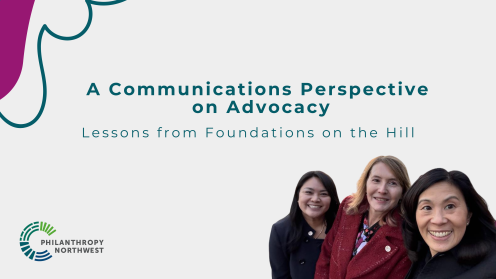
A Communications Perspective on Advocacy: Lessons from Foundations on the Hill

Foundations on the Hill (FOTH) brings together nonprofit and philanthropic leaders from across the country for a week of congressional meetings, policy sessions and peer exchange in Washington, D.C. As our vice-president for marketing and communications, I joined our Philanthropy Northwest delegation curious about how advocacy messages are shaped and received, what’s breaking through and where communications is helping move policy forward.

I wanted to learn how communications can help translate often complex policy issues across audiences, connect policy priorities to community impact and make our work clearer in the rooms we were in.
I came back with pages of notes and a few ideas that are already shifting how I approach communications. Advocacy doesn’t succeed or stall on policy details alone. It hinges on how clearly the work is understood, trusted messengers and whether people see themselves in what’s being asked. That showed up everywhere, from sessions to side conversations to our legislative meetings.
In those meetings, we talked about nonprofits navigating rising demand for services, limited resources and the complexity of partnering with government. But underneath all of that was something harder to name: a gap in trust. Not just between nonprofits and government, but between institutions and the public more broadly.
That gap is real. Fewer than half of Americans say they have confidence in nonprofits, according to Independent Sector, and perceived partisan alignment continues to erode trust. Even when the work is deeply community-rooted, if it is perceived as disingenuous, the conversation often ends before it begins.
Narrative Shapes What’s Possible
In that environment, communications is doing more work than we sometimes acknowledge. Not just getting the message right, but making the work feel credible, relevant and grounded in real community experience.
Narrative plays a central role here. It’s the story people carry with them about an issue — what's happening, who it affects and why it matters. When it’s treated as foundational, it shapes how issues are understood and which solutions feel possible.
That’s the piece I keep coming back to, and it’s shifting how I think about advocacy communications.
Turning Insight into Practice
Looking back on our time in Washington, D.C., one theme became clear. The moments that landed for organizations and coalitions weren’t just well-messaged, they were well-aligned.
Policy advocacy and communications were working together with shared clarity on the problem, the change they were driving and what they were asking people to understand and do.
That kind of alignment is easy to name and harder to build into how we actually work. It’s less about adding staff capacity and more about changing our habits:
- Building the reflex to partner with communications from the very beginning of an advocacy campaign.
- Deciding what you want your headline to be: the one thing you want people to understand or remember and organizing around it.
- Making sure the people closest to the work are shaping how it’s communicated, not just reviewing it at the end.
Without these habits, even strong ideas struggle to gain traction.
One of the reframes that stuck with me is that policy communications should be additive, not just more noise. Too often, we default to pushing out information like alerts, statements and calls to action, because the work moves quickly.
But the real opportunity is to treat it as an ongoing conversation. Creating space for people to understand what’s happening, what it means and where they fit. That only works if we’re listening to our audiences as much as we’re speaking.
And over time, that’s what builds trust with the people we are trying to reach including policymakers, partners and communities. Not just being clear in a single moment, but showing up consistently in a way that connects.
One of the more practical reminders I’m bringing back is about focus.
In a moment where everything feels urgent, the instinct is to say more and respond faster. But what cuts through is usually the opposite — deciding what matters most and staying focused.
We’ve seen this in our own work at Philanthropy Northwest. In our advocacy efforts around legislation like H.R. 9495 — a bill that raised concerns about due process protections for nonprofits — the work has landed most when we focused less on the minutiae of the bill and more on what it means for communities, and what’s at risk if those resources don’t reach them.
And honestly, this part hit close to home (in a good way). When policy and communications teams are truly aligned, that’s when things start to click. For our audiences, the messages become easier to understand, easier to connect to and are more likely to turn into action.
What I’m Taking Forward
One line from a keynote has stayed with me: “Hope isn’t optimism. It’s seeing clearly what’s at risk and choosing to act anyway.”
That feels right for this moment.
There’s a lot at stake for communities, nonprofits and the systems we’re all trying to change. But there’s also a real opportunity for philanthropy to show up with more clarity, stronger alignment and a more intentional use of voice grounded in community impact.
Because when narrative, policy and practice move together, that’s when things start to click. And when they do, change feels a lot more possible.
Join the Conversation
If this resonates, we’d love to continue the conversation. Join us for our upcoming network call on the Science of Persuasion and Social Movements, where we’ll explore how narrative, shared values and emotion shape what moves people and how that can strengthen advocacy in practice.