Musu:
I think generally saying no to donors is incredibly difficult, especially in the community philanthropy where relationships are everything. But I think in this work, I have learned that when we say no and explain why we're saying no to their funding, we're actually inviting most times donors into deeper, more meaningful partnerships. We're asking them to trust that we know our community and that we're willing to shift that approach to create something real and something that's also going to be very impactful. And then the change is very lasting.
Nancy:
From Philanthropy Northwest, this is, Can We Talk About...? A project to normalize the messiness of leading for racial equity in philanthropy, and reflect on what it takes to create lasting transformation. In season three, we're sharing stories inspired by our newest guide, Toward Transformation, on how a cohort of 20 community philanthropy organizations spent over a decade together working to advance racial equity. We're asking guests to practice vulnerability, explore sticky topics, and look for learning, and what we ask of you is to do the same.
Mares:
Hello everyone, and welcome to episode six of our third season of, Can We Talk About...? Philanthropy Northwest podcast on leading for racial equity in philanthropy. I'm Mares, and I'm the Associate Director of Programs at Philanthropy Northwest and your host for this season, where we are doing a deep dive into community philanthropy. So if you've been with us since the beginning of the season, you know that season three is based on our latest guide, Toward Transformation, which uplifts lessons from 20 community philanthropy organizations' journeys over 12 years.
Today is a little bit of an exception. We're talking about donors, which is obviously very central to the work that community philanthropy does, and we do touch on it very lightly on the guide. But this is really an area where many community philanthropy organizations have a long way to go, which is why we're so excited to have this episode of the podcast. And in the past 10 to 15 years, one of the things that I've heard from folks is that the way that we've been granting out money over these last however many years, has evolved so much, but the way that we're engaging donors has not evolved in the same way. And so many folks are finding themselves stuck in how to move equity work with their donors.
So if you've ever wondered when, "How do I say no to a donor?" Or "How do I bring donors along in our equity work?" this is the episode for you. And I'm so excited. And I also want to acknowledge that today we're talking about donors and traditional giving to institutions, but we also want to acknowledge that there are a lot of non-traditional structures and ways that communities give. People are giving in ways that are not captured by the tax system, and that is really important work. People are giving their time, people are giving all types of things in their communities to support folks. And so we do want to acknowledge and celebrate all those unique ways of giving. And today want to also be focused on the traditional ways that donors give.
So today, joining us for our episode is Musu with the Community Foundation of Snohomish County, Heidi ... I always want to say or, make it Frenchy, but that's not right. Heidi with the Yakima Valley Community Foundation. And Aisha with the Social Justice Fund Northwest. To get us started, I would love for each of you to share quick intros to yourselves about your role, because I know each of you have slightly different roles. Even though you're all in the donor and fundraising space, you have slightly different ways that you're doing that in your org. So would love if you could share a little bit about that as a way to start. So we'll start with you Aisha, and then go to Musu, and then end off with you Heidi.
Aisha:
Okay, great. Hi, like Mares said, my name is Aisha. I use she/her pronouns, and I am the development director at Social Justice Fund Northwest. We're an organization that's been around for about 47 years doing donor organizing and participatory grant-making in the Northwest. So we work in Oregon, Washington, Idaho, Montana and Wyoming. And I've been with the foundation for about 3.5 years. Time has been passing by really quickly. But as the development director, I have the opportunity to work with our donors through our donor organizing framework, which is all about increasing education on how to be a better donor, specifically how to be an anti-racist donor and one that works really in close alignment with progressive movements. So I get to do that through our donor education work, through workshops and trainings, and then also through moving money into our foundation and then supporting our work in participatory grant-making. So I'm really excited to be here today.
Musu:
Hi, my name is Musu. I use she/her pronouns. I am the director for fundraising and grants at the Community Foundation of Snohomish County. I have been in my role for almost two years. It's going to be two years, first week of November, so yeah, I can't believe.
Mares:
Yay. Happy two-year anniversary.
Musu:
Thank you. So in my role, I've been working with donors as far as building philanthropic partnerships that connect donors with communities' identified needs, particularly those of our priority population. So we work mainly with BIPOC, immigrant refugee, low income, and LGBTQ+ communities in Snohomish County. My work has also focused on educating and guiding donors to develop equitable given strategies that center community voices and address systemic barriers. I also would say stewarding donors relationships while ensuring our grant-making reaches and is led by the communities most impacted by inequities. So yeah, this is me. So excited to be here as well.
Mares:
Thank you.
Heidi:
Well, thank you. Thank you. Heidi. I use she/her pronouns, and I have the pleasure of serving as the chief development officer here at the Yakima Valley Community Foundation. We are centered in the middle of Washington state in apple country tree, fruit country, wine, hops. We're in ag space, a little bit different. I grew up in Seattle and moved to this community a little over five years ago, and have been serving in this role at the Community Foundation for the last 3.5 years. Really excited to be in this space. This has been a fun role for me. I help support our existing fund holders, whether that's donor-advised fund holders, field of interest fund holders, legacy donors in this community. And then I'm spending a good amount of my time working with the local nonprofits and how they can better have relationship-based fundraising models instead of transactional. And so much of that work here within the Yakima community is based around equity.
And where we're really looking at that from the Community Foundation's perspective is, how can we lead by example in this space? And so we've launched a lot of donor education events, and then we've also really just become more intentional about how we're communicating about the work that we're doing, so that hopefully that will rub off and we'll see other folks spend more time thinking strategically about how they're giving and addressing equity issues here in this community, which are real. So, really excited to be here for this conversation. This is something I'm really passionate about.
Mares:
Thank you all so much. And just some words that I wrote down that you all said was anti-racist, equitable giving strategies, relationship-based giving. So I think those are the frames and the big themes for the episode today that we really want folks to walk away with, and to be able to get some tangible ideas for how they can incorporate how you all are doing your work into ways that they can work with their donors. So to get us started, we are going to start with a quote, because we love a quote, and then would love to get your reactions and some ideas around how you work with donors.
So this is the quote, "We are willing to listen and to work with people who are willing to move forward, but sometimes we say no, we don't want your donor funds. And when you say no to donors and partners, that is an opportunity for new ones and you can stay values-aligned." So would love some reactions in regards to this quote, in regards to saying no to donors, in regards to turning a no into a yes. We had some really great conversation on the prep call and you all had great ideas. Heidi, you look like you want to say something off top, so I'll go to you first.
Heidi:
I think just one of the things that I really appreciated that was a clear takeaway for me during BCP, during Building Community Philanthropy work, was if we're more intentional and explicit about who we are, while that might turn off some in our community, or this is a pretty divided community politically, we're going to attract more folks who appreciate the explicitness of where we stand, and more will come alongside us. And so then it's not as much about turning down no's, it's about other folks coming to us and saying, "I really like what you guys are doing," and that's a yes.
Mares:
I love that, Heidi.
Musu:
I think generally saying no to donors is incredibly difficult, especially in the community philanthropy where relationships are everything. There's this consistent, I would say tension, where we're like, "Oh, we need resources to serve our communities." And also turning away willing donors can feel counterintuitive. And then there's the idea of the scarcity mindset, which is very real. What if they never come back? What if word spread and that we're difficult to work with? What if we can't meet community needs without the funding? But I think in this work, I have learned that when we say no and explain why we're saying no to their funding, we're actually inviting, most times, donors into deeper, more meaningful partnerships. We're asking them to trust that we know our community and that we're willing to shift that approach to create something real and something that's also going to be very impactful. And then the change is very lasting.
I want to give an example of a donor family who came to us wanting to establish scholarships, because for some reason a lot of donors just want to establish scholarships. And we're getting tired of it for so many reasons. First, because we've had from community that it is not the most impactful way. It's great that you're able to give $1,000 to $2,000, $3,000 scholarships, one-of scholarships, for that matter, with no potentials or even opportunities for them to be renewable. So you find that students who receive them most likely receive them in their freshman year, and that's it. They're likely not going to get funding for the remainder of the year. And the workforce really centers around how do we affect systemic changes? How do we inculcate or incorporate equity in that kind of work?
So hearing from communities telling us that scholarships are not the best way for them to make these real changes, this impact that they want to do in community. So I said no to the family, "We have more than enough scholarships." And they were a bit shocked in the beginning, but this is what I said. I was like, "Here's what I can offer. If you want to support the students," because they wanted the scholarship to go to a specific school," I was like, "You are still able to support that same school and the students. Open a donor advice funds instead. Give the same amount of money, but let them work together to identify the systemic needs. Maybe it's an emergency fund for students facing housing insecurity or wraparound support services, or funding that goes directly to organizations and serving communities who want the help."
And in the end they were able to say yes, because they trusted the guidance and they opened a donor advice fund. Now their giving is more flexible. It is more responsive to what the community actually needs. And frankly, it is more impactful than the traditional scholarships that has been. Because there's also this mentality around the savior complex, "Oh, I am giving a scholarship. My funding or my giving is going to create this impacts." And also, because if you think about the structures of the scholarships, they're having GPA requirements, like you have to participate in specific extracurricular activities. And we know the GPA requirements, the participation in specific extracurricular activities is very intentional as far as excluding specific students from certain demographics.
If I have to worry about my family putting food on the table, I would likely not have the time to do extracurricular activities. If I have to worry about A, B, and C, I may be really smart, but I may not have as much time on my hands as other students who have all the monies that they need, who have all the support. So because of that, also we felt like the scholarships are not really the best way of changing the narratives in our community.
Mares:
Thank you, Musu, and we were all nodding along so hard. I've heard that from other folks, that there is a need to talk to donors and work with donors to adjust scholarships. And I think there were some great tips there on how you can apply that to other conversations with donors. Sometimes it's not just a no and that's it. There's a, "Not this. We're going to have some other options, A, B and C, over here for you." Aisha, I would love to bring you in because you work across so many different states, and would love to hear about how you approach talking with donors about equity. What experiences have you had? What tips would you have for other folks? Especially because there are many folks who are working in a more conservative spaces or have more conservative donors and are really stuck in how to talk about equity, almost without using the words equity.
Aisha:
Yeah, there is a lot there. Before I jump into that, Mares, I wanted ask you a quick question, because I remember last time you told us who the quote was from or where it came out of, and that was really helpful. Could you say quickly what that was?
Mares:
Yeah, so over the 12 years of BCP, we did twice a year check-in calls, and then eventually once a year check-in call. So this quote came from, this is kind of like a melding of a couple different quotes in a check-in call that we had with one of the BCP partners who were talking about how they're trying to approach their donor work differently. And this isn't in the quote, but really the wider context was getting away from the scarcity mindset, and also getting away from the idea that like, "Oh my God, if we say no to a donor, then that's it, the relationship is done forever." Yeah.
Aisha:
Okay. Great. Thank you so much. Yeah, I would say Social Justice Fund, or SJF ... If you hear me say SJF, it stands for Social Justice Fund, and sometimes it's hard to get out of acronyms, but I'll try. But I would say we work at a very interesting intersection. We are technically a community foundation, but unlike a lot of other community foundations, our funding area is quite large. It's five entire states, some of whom, like Wyoming, have massive geographies, but then really small populations. And of course, with Washington and Oregon versus some of our more rural and Mountain West states, there's a really big difference in politics and how people tend to align politically. What I will say for us is that, the work we do is in our name, Social Justice Fund. So for the most part, donors do not come to us expecting that we're conservative or that we have more regressive policy. So that works in our favor that our name tells you what we're about before you get in the door.
So I will say one of the big ways that this comes up for us around saying no to donors, how this comes up in our work, is people negotiating how progressive they are or if they agree with certain policies and practices that we do. And I'll name an example just to drill into it. Over the past few years, at least 10 years, Social Justice Fund has been a very clear in its support of Palestinian liberation and supporting that kind of work. As we all know, living in the world, but in the States especially, this is a very polarizing topic. A few years ago we had put out a statement and one of our longtime donors who had been with us for decades ... And you know how special it is to have a donor who's been with you for decades. That is a really big deal, and you know that, for me at least, that all of the development folks who came before me have spent so much time stewarding that donor.
She came to us and she said, "If you guys don't take back the statement, I'm taking you out of my legacy plan and I will not support you anymore." That's an ultimatum. "If you don't do it, I'm going to walk away." And we've had this kind of situation come up a couple of times with a couple of different topics, especially ones that are very polarizing. And our team had to stop and think about, ultimately as a foundation the community that we are centered most around, that all of our work is around, is our grantees. And we know that it would not be in alignment with our values and our grantees' values to take the statement back. For us, it was just really critical to ground in our mission, our vision, and our values.
And for me, being able to ground in our values gives me a place to go to the donor with. So I'm not just arguing back and forth. We don't have to have the same kind of negotiation, but I can come in with the strengths of the organization and say, "One of the things you love about us are these values. And so based off of these values, we've come to a point where we have some disagreement about how they're actualized. But I want you to know as a donor, we're saying no to your ask, to your demand, based on these values." And so it puts the conversation in a different space than being like, "Well, is this or isn't true?" or getting into opinions. We're not really interested in negotiating with donors around that. And I think Heidi and Musu have named there. There's always a push and pull.
And there are also so many foundations in the world, and so we want to recognize we can't be everything for everyone, and we want to be really clear with folks about what we can offer. We're happy to be in dialogue to see if we're a good fit for you, and we'll also be honest about if we're not a good fit. And we'll even try to help connect you with people who are a good fit. But really grounding in our mission, our vision, and our values is what dictates our work, not what one particular donor wants to see us do.
Mares:
Thank you, Aisha for sharing that. Heidi, Musu, is there anything you would add on that point?
Heidi:
No, actually.
Musu:
She hit the nail on the head. I kept nodding, like ... Because I think one thing that is important is, when you are cultivating and finding donors who are value-aligned, I think first we lead with our values publicly. And I think it's important that Aisha mentioned that aspect of the work, where if you go on your website, already the name itself, Social Justice, what else do you expect if not equity and trying to put in place mechanisms that will address systemic issues that marginalized communities have been facing? So I think like our websites, for example, our communication materials, just our community presence, we lead publicly just talking about our values without having to massage the ego.
It's great that you have donors. That's how our work gets to operate. That's how we're able to support communities. But I think also being able to invite donors into learning to say that we want to be able to prioritize and value aligned with the communities that we serve, not necessarily the donors. So your dollar amounts are important to us, but also our values as an organization and standing in community with the people that we serve is most important to us. And making that known really would, I think to a large extent, the donors would respect you even more.
Heidi:
Right. Agreed. Only thing I was going to chime in on is, one thing that's been interesting for me to come to the realization being in Central Washington and a politically divided community, is that I never get pushback when I say, "Do you think that we have equity issues in this community?" Everyone agrees there is great wealth divide in this community. But when I say racial equity, not everyone's on the same page. And what are some of the reasons why we have equity issues? That's a hot topic out here, but it's still a sticky one and the current political rhetoric is making that conversation harder.
Mares:
Yeah, yeah. Okay, so actually we're going to do Mares' Soapbox ... We're going to do my Soapbox Snack Break. And I don't know if anyone will know what I am talking about for this one, because this might be niche. Because when I brought it up to other folks, they were like, "I don't know what products you're talking about." So maybe you three will know what I'm talking about, and the folks that are listening to this episode. So the Snack Break for today is products that make no fucking sense. Okay, this is the first time I'm cursing, and Aya and Emily told me episode one or two, they're waiting for it to happen. This is it. This is it. Okay. Do you all remember in the 2006 or 2008, Chef Emeril, and then he had a toothpaste partnership with Crest? Aisha's nodding, shaking her head. He had a toothpaste partnership with Crest and they made different flavored toothpaste. No one remembers this, but people were buying it.
Heidi:
I blocked that one out.
Mares:
People were buying it. I'm going to list out the flavors they had, okay? Wintergreen, Cinnamon Rush, Vanilla Mint, Citrus Breeze, Lemon Ice. And then a few years back, not a few years back, 10 years back, there was a Mint Chocolate flavor.
Heidi:
For toothpaste?
Mares:
I just have questions for product development, one, and then two, who are the people buying this toothpaste? Because y'all are acting like you've never heard of these. People were buying it because it was popular. He had advertisements on TV. Okay, the Cinnamon Rush, it said, "This will keep your taste buds tingling when you're brushing your teeth."
Heidi:
Am I thinking of the right Emeril when I'm saying, "Bam"?
Mares:
Yes. And that was in the commercial.
Heidi:
Bam, this sounds like a bad idea.
Mares:
Yeah, thank you. Yes. He was brushing his teeth in the ad, and he'll be like, "Bam, ooh, the flavor is so good." Sir, this is why we have cavities today. Okay. That was-
Aisha:
Mares, I do know someone who uses cinnamon toothpaste. I don't think it's this brand, but I do know a couple, a family member, who loves cinnamon toothpaste. So, there's a market.
Mares:
There is a market. So clearly there's people out here in your lives that are secretly using flavored toothpaste, and we don't-
Heidi:
I buy my dog chicken flavored toothpaste.
Mares:
And that's fine.
Heidi:
Does he love it? No.
Mares:
Oh.
Heidi:
He still runs away from me very, very quickly. But I buy it.
Mares:
See, and I support that because he's a dog.
Aisha:
Mares, I like the way you're saying this like there's secret people in your network, because it's reminding me just of, this is the new question. Not, "Who did you vote for?" But, "What kind of toothpaste are you using?"
Mares:
Yeah.
Musu:
We can judge.
Aisha:
What kind of toothpaste are you using, really?
Musu:
I went to the dentist last week because I now have my aligners in. They were trying to sell me this fancy toothpaste that is like vanilla mint and cotton candy. They're like, "It's good for ..." I was like, "Not going to work for me. The regular toothpaste is just fine."
Mares:
Cotton candy? See?
Musu:
Yes.
Mares:
There's a secret lobby. Someone is funding this. Someone is funding this work, you guys. Okay?
Heidi:
Bam.
Mares:
See, I found my people, I'm like-
Heidi:
Bam.
Mares:
I found my people. Keep saying bam. I had one other product I was going to talk about, but now we think we took up too much time. Move on.
Heidi:
Can I have two seconds-
Mares:
Yes. Please.
Heidi:
... on this same thing? Okay, so this is very Yakima specific, and I feel like I'm airing our dirty laundry, but for some reason we have, because it's election season, we're a week out in this recording, we elect our coroner. Which I don't understand why we do, why the general electorate is at all qualified to decide who the coroner is, the medical coroner. But what I don't understand is that it is ... You can Google this, there's been national news stories on this, but I won't get into that part of it. But for the new candidates that are running to replace the gentleman who was serving previously, restaurants are promoting and putting up signs for one candidate or another. I'm saying if you're promoting any candidate, I don't want to eat at your restaurant. Weird product placement.
Mares:
Oh my God. Oh my God. Oh my God. Oh my God. Okay. Okay. I don't know how we get back to-
Heidi:
Bam.
Mares:
Every time you say bam, I actually can't take it. Okay. Thank you for adding that in. Okay. That's a great Soapbox Snack Break. Thank you all for chiming in. And now we're thinking about electing coroners for the next week. Okay. Getting back into the convo ... See, it's just nice to have some levity because life is hard. Roles and structures. We talked a little bit about how y'all are talking to donors, but also want to talk about what structures and tools are you using in your work to shift from more donor-centric work to more community-centric development work? And Heidi, I would love for you to share about the community conversations that you're hosting in Yakima with donors, because I think that's a great example of something that other folks can also implement in their work.
Heidi:
Absolutely. We weren't doing any sort of fund-holder events, we weren't engaging professional advisors in a strategic capacity before I came on board. We just didn't have the bandwidth to do it. So that was one of the things that I really recognized that this is something I could help bring to the table, was to launch a new donor education series that we call Community Conversations. Conversations that we think Yakima should be having. And we're trying to highlight different problems that are going on that are multifaceted, that this is not a Black and white issue, that this is requiring philanthropy, government work, policy, structural change. And we've covered things from the overdose epidemic in this community, which I know every community is facing, that's a sticky one, to out of school time for kids and after school programming. Which is continuous need for investment here in the Yakima Valley, to things that we're really trying to be attractive to different types of fund holders or different members.
Looking at how are arts organizations in our community doing post-pandemic when audiences aren't returning or our viewership or participation in live art or theater or music is different with a changing demographic. And so we're trying to lead by example and have these conversations where it's generally a pretty light lift on our end. It's a panel conversation with a couple of different nonprofits. We also try to get elected officials in the room or on that podium, those that can help make change from government side of work, and really try to look holistically at one issue. And really try to emphasize to folks that philanthropy is one solution and we'd love to have them come on board, but how can they be an advocate for change if this is an issue that they care about. How can they be having conversations with their friends and neighbors in a thoughtful way that they're really pushing all the different levers to try to help move the needle on one specific issue at a time.
Mares:
Thanks, Heidi. And I think I just want to reiterate for folks listening, you always are having these conversations with an equity lens on each of those conversations. It's never just art in a vacuum.
Heidi:
Absolutely.
Mares:
Aisha, I would love for you to share a little bit about your work with donors specifically around the workshops that you all are doing on class. Because even though philanthropy is all about money, we rarely ever really talk about money and our attitudes around money. And I think the workshops that you all do are great with donors.
Aisha:
Oh my gosh, yeah. This is our bread and butter, because I think you're absolutely right, Mares, that not enough of us are talking about class, both our class of where we came from and then where we are now. Some of us in philanthropy come from really wealthy families and so we've always been aware of philanthropy. Some of us come from very low socioeconomic backgrounds and maybe didn't know what philanthropy was or the impact that it had, or didn't understand it in our lives. And we bring all of that to the work we're doing now. So I will say Social Justice Fund has a very particular view about building a multicultural cross-class base. We want to do that in our donor organizing, so in the way that we're moving funds into our organization. And then we also want to have that lens as we're moving money out of our organization through a participatory process.
One program we have that shows both in and out is our Giving Projects, which is a framework and a program that was started at Social Justice Fund in 2010 or 2011, and now there's a national network called the Giving Project Network and a couple of different organizations across the country who use this model. And it's a six-month-long program where 15 to 20 individuals come into a Giving Project, they learn about whatever issue area that year is. This year it was immigration justice. Those 15 folks came in, they learned more about immigration justice, they brought their own experiences, they were trained on how to fundraise in their communities. So then they went out and did that. And of course, when you're doing that, you're always coming up against class, your own class, the class of the people you're soliciting, so on and so forth. And then also in the Giving Project, they are then trained on how to be grantmakers. So then they read and score the grants that are submitted for this issue area topic.
So through the whole thing, it's a democratic participatory process, and the Giving Project for us is really how we want to be doing all of our work. So that is our flagship donor-organizing program, but we do that across all of our work. So in other ways that we hold this are through workshops like our Anti-Racist Giving Plan Workshop, which is how we take donors through this education experience to learn about what it means to be an anti-racist donor, to think about it in practice, to create a giving plan. Something we were coming up against with our donors over the past few years was really that a lot of our donors were reactionary. There was a hurricane, so now they're giving to the Red Cross. There was the murder of George Floyd, so now they're giving to Black-led projects. But because they were so reactionary, there wasn't enough long-term strategy.
And that is what we were hearing from our grantees as well, someone's in for a year, then they're out. We're applying for donations and grants that last six months a year, and you can't build a program like that. So something we've been trying to do is, one, on the philanthropy end, pushing other funders and ourselves to be giving longer term grants and to have that longer term vision. And at Social Justice Fund, we believe we have this unique opportunity to do that with donors as well and say, "What if you had this longer view of your philanthropy and the way you do work?" So that's underneath all of the different workshops that we do. We do a planned giving workshop, so thinking about legacy giving and doing that in a progressive lens.
So we have these different workshops, but they're really all about really contending with your class, specifically your class privilege, which is something that a lot of folks in philanthropy have and don't think about. And that's where I know was mentioned earlier that savior complex comes in a lot, especially around white savior complex of ... A conversation I have with donors more than I think that I is, "Why should I donate to Social Justice Fund when I can get more bang for my buck donating for malaria nets in sub-Saharan Africa? That seems like a better way for me to spend my money if I'm trying to ..." They're like coupon-coating philanthropy, which is so interesting to me. But we want to be real with those donors. And our answer to that is to think about having a cross-class multiracial lens to your work and thinking about where is local to you, where do you have influence to make a lot of change? And so we try to take that through all of our workshops.
Mares:
Aisha, I have a follow-up question for you. For folks who are probably thinking, "I am super uncomfortable talking about class with my donors, or if I bring up class with my donors, I'm just not sure how they will react," what advice or tips would you give to folks who have not yet been having class conversations with their donors but want to start?
Aisha:
Great question. I think, one, through having spaces that you can invite donors into instead of just going up to them, although that's also a good option. But I think the conversations that Heidi's facilitating and bringing people together, having an opportunity where people can opt in to the conversation is a great way to start. Because those people who are maybe those donors you have who are a little more adventurous or a little more comfortable, they'll be those first folks who come in. So it's kind of, what's easiest? Start there. Invite people who are interested to come in. And then with those folks and donors that maybe are less comfortable but who you are close with, I would ask them a question. I would ask them, "We at the foundation, we want to have more conversations like this and we know we need to pull donors in, but I am not quite sure how to do that. Do you have a suggestion? How would you wish that we would come to you with this information? Are there resources you're looking for?"
So I would say, one, inviting the low-hanging fruit into a conversation they can opt in to, and then, two, ask donors. I think that's something that community foundations and just fundraising organizations could do a lot better, is invite donors to be part of our strategy. That's your market that you should be surveying your donors. You should be asking them to invest in your programming. So I think those are two ways that I would suggest starting that work.
Mares:
Yeah. Heidi?
Heidi:
I would just say one of the tools and trainings that I've done that really helped me personally in helping enable these conversations, was I did 21/64 training and they give you some good tools on how to have conversations about money, about your background. And it made me reflect a lot among my own personal experience. What am I taking from that into my conversations with others? But that was probably one of the most beneficial trainings I've had in how to talk about money, how to talk about class.
Mares:
And Aisha, one of the things ... Because you were talking about, "Here's how you can approach it with the low-hanging fruit donors, the folks who are more adventurous. Here's how you can approach it with folks who are a little more hesitant." And I think that gets into one of the myths, which is I think sometimes the myth and it's a lot of fear is that folks are, "I don't have any donors that are pro equity. I don't have any donors who want to support equity work or anti-racist work." And I think it's very easy, especially now, for folks to be like, "I don't have any donors," or "Maybe I have three donors." But I think what I'm hearing from the three of you, especially because you are working across different types of geographic regions, is that really trying to encourage folks not to think about your donors as a monolith, but it's a spectrum.
Who are the folks who are super pro-equity? Even if it's just one person, there's always going to be at least one. Who are the folks who are more neutral? Who are the folks who are maybe furthest away from your equity values as a org? And then go from there. Because I think it's very overwhelming right now and it's very easy to think about my group of donors. "I'm in so-and-so area, we don't have anyone who's pro-equity." And that's not true. There are ways that you can. Even if you can't say equity, people are probably pro those values. They just are being tricked by the propaganda right now.
Musu, I would love to hear from you all, because you all have been doing at the Community Foundation of Snohomish County, a lot of community-centric fundraising work. You've been doing work with your donors, honor, incorporating the values of community-centric fundraising with them, and I know you've been doing some deep work with supporting BIPOC-led orgs, so would love for you to share. And even if you have a maybe one or two-sentence definition of community-centric fundraising that you want to share with folks who are unfamiliar with that.
Musu:
Cool, cool, cool. I've had the pleasure of working with the incredible Michelle Murray, who is one of the co-founders of the community-centric fundraising. So for the past 1.5 years we've been working together, she has been coaching me. And it's really been fun coming into, especially Snohomish County. We know what it looks like, equity-wise especially. So basically, community-centric fundraising is an approach to fundraising where you prioritize the needs, the values and voices of communities being served. So unlike traditional fundraising where you're prioritizing the donors in this, you're asking questions about instead of saying, "Oh, what would you like your fund to be used as?" You're like, "Here is what community is telling us to prioritize and this is where we think your giving should go in." And at our foundation, we've really been putting that to work, and this has reflected in several ways.
For example, starting off with our donor advice funds, structurally we've been having conversations with our donors around how they can give more to fewer organizations. Say for example, instead of taking $50,000 and spreading that across 20 organizations, for example, giving each $2,500, how about you give that $50,000 to one or two organizations in order to be able to support them in creating more sustainable programming, but programming that is also going to create more impact. Because I think that way it doesn't also feel like it's a transactional support where you're just giving one of $2,500, but rather you are really digging deeper into the work and asking community, "What other ways can we support you?" I think also what we have been doing is focusing on multi-year commitments, because we've seen with our donor advice funds, every year there's, "Oh, I should give to this organization, give to this organization." Would rather be like, "Last year you gave to these two organizations and you gave each $25,000," for example. "Would you like to give again to that same program so that they can replicate it in order to be able to create more sustainability?
And we've seen that a lot of the donors are very forthcoming with that. They want to be able to. They're listening to us. And I think starting with phrases like, "Here is what community is telling us. We have heard from community that A, B, and C is the best way of supporting them." And this also ties really well to our 15/50/5, which is 15 BIPOC-led organizations in Snohomish County, we have been giving them funding over the period of five years. So each of the 15 of organizations receives $50,000 each year, and this 15-50-5 came about when we did the annual surveys that we sent out to nonprofits that we support to say, "It's the end of the year. We want to hear from you. What have we done as a foundation that has been really supportive of your work? In what ways do you think we can do better to support your work even more?" and the idea of, "Give us more funding. Instead of smaller funding, give us more funding and give us multi-year funding."
And it is then that we were able to really identify 15 organizations in the communities who are trusted, who understand the nuances and the strengths of the populations that they serve, and who are able to address or addressing systemic barriers, not just providing like the band-aid solution. Food is what we need to deal with right now. We're going to deal with food insecurities. Instead of just saying, "Okay, we're going to be having weekly food drives," how about we deal with the systemic bias to food? Why are there food insecurities? Why is it that a specific community or a particular community is being impacted by this? In doing so, we were able to support these organizations. But this approach is different in the sense that we've been leading with community's expertise, not the donor preference, because obviously donors will come to you with the ideas that they have. So we didn't ask the donors which organizations they would like to support or had personal connections to.
Instead, we did the work to identify which BIPOC-led organizations, refugee, immigrant, and also LGBT+ organizations were most effective and most trusted by the organizations or the communities. So we prioritize that. Also, we're asking donors to trust us and our community knowledge, because I think that is very fundamental. Often, donors will come to you thinking they know what the communities need, but we are in community. We're working with these communities. So when we approach donors about this initiative, we were saying, "These are the organizations that need sustained investments. Will you join us in funding them?" We're inviting them basically into the strategy that we've developed based on the community's input, and not asking them to design the strategy. Because again, when we think about the savior mentality, we the donors know best, so we're going to create a strategy for you, but with this community-centric fundraising idea. Not just in the context of fundraising for us in order to give out the money to the nonprofits, but also even in our grant-making generally.
Mares:
Okay, so we would love to have you all share, maybe a couple of you share, what are some of the skills that you feel are important right now to be successful in a development function, especially when we think about development being connected to equity goals? So different kinds of skills that you feel like you're having to pull from, and knowledge that you're having to pull from that is different probably from the traditional fundraiser type of thing that folks are much more familiar with.
Musu:
Because I've benefited from the community-centric fundraising thing, I would say that really if you want to work in community, if you want to center community in the work that you're doing in this day and age as a fundraiser, having knowledge and understanding and awareness in community-centric fundraising is fundamental. It's been useful to me. And a lot of other people who are familiar, who have been exposed to it have also appreciated it. So I'd say that is very important.
Mares:
And I'll add, Musu, because you mentioned in our prep call, your organization has invested in you, also coaching, having coaching on that.
Heidi:
Absolutely. I would echo that one as well. Having a good team and great dialogue internally with those that have boots on the ground and relationships out in community. You can't do it all yourself. And having a good team to lean on. But then also I think for me, you have to be a phenomenal listener and have a good EQ, and listen for the things that aren't being said so you can help guide the conversation, and look for windows and opportunities for what's going to work well for the donor, what's going to work well for nonprofits, what's going to work well for community. And those stars might not all align, and that's fine, but it's pretty magical when it does.
Mares:
Yeah. With that, I want to take us to our final question, and that is, what do you think community philanthropy needs to start doing, or what do do you think community philanthropy needs to stop doing as it relates to working with donors on racial equity? Maybe I'll go with you, Aisha.
Aisha:
I could feel it coming. Okay.
Mares:
You have to go first.
Aisha:
I can go first. I was just trying to figure out how I want to say this, but I'll say it once and then if I need to repeat myself, I will.
Mares:
Yeah.
Aisha:
Something that I believe that we need to start doing is investing in our staff to develop race and class analysis, especially how those intersect. I think that's really connected to things that Musu and Heidi have been saying about the kind of conversations we're all having in community and with our donors. In order to do that as fundraisers, as individuals and foundations, we have to have some kind of framework. Even if it's evolving and we're trying to learn more and deepen, as we always should be, there has to be some kind of foundation and understanding about race and class for us to even have those conversations. So I think that's definitely something we need to be investing in our staff to do, and that means giving them time for professional development, so on and so forth.
Mares:
Yep. Thanks, Aisha. Musu?
Musu:
I think that it's important to build relationships with grassroots organizations before there's even money on the table. Because oftentimes relationships are very transactional in nature, you feel like, "Oh, I need to have money first before I am in community." But I think being in those communities, understanding and building relationships with them makes it more trusting. It makes the relationship more trusting. And then when money comes to play, you already have an idea of ways in which you're able to support. But I also think investing in those communities is fundamental as well, especially with transformational funding. So I would say these are some of the things that philanthropy needs to be doing, needs to start doing.
Mares:
Thank you. Yeah, you don't need to always know what the grant-making plan is-
Musu:
Yes.
Mares:
... in order to build the relationship. Heidi?
Heidi:
I would say, given that right now it is wild times out there, this is a crazy time to be doing this work, this is very challenging, I'm seeing a lot of philanthropy get analysis paralysis. And I want to go back to something that Aisha said, which is really rooting yourself in what are your mission, vision, values? What is your strategic plan? Is going back to this when this is getting so hard every day and we're getting bombarded from community members about emerging needs that are really tough, and there are fires all over the place. How do we think most strategically and calmly and make really good decisions and bring people to the table to come alongside us? Because it is really easy to get overwhelmed right now. And how can we make smart decisions with the resources that we have and utilize our voice in community to hopefully be a leader that is thoughtful and strategic about what is philanthropy's role right now?
Mares:
Thank you three so much. I think that's a great way to end the conversation. And I hope what folks take from this is, one, some of the great ideas that you all are implementing, and they can all be implemented, they're all doable. Two, I think I started the conversation by saying we have been able to move grant-making work, to evolve grant-making work to be more community-centric. And I would love for in 5, 10, 15 years, wherever we are politically, for the movement that we've seen on the grant-making front to be also mirrored in the development front. So I really hope that is what people take from you all today. And really, thank you, Heidi, Musu and Aisha again for being here. Bam. It don't work when I say it.
Heidi:
[inaudible 00:47:33] Every time you say it, I actually cannot [inaudible 00:47:36]
Aisha:
It's so funny. Heidi, that's a new job.
Mares:
Yeah.
Aisha:
That's a skill. That goes on your resume.
Heidi:
Yeah, thank you.
Aisha:
Going straight to the resume.
Heidi:
Thank you. I'm so proud of myself.
Nancy:
Can We Talk About...? is a podcast by Philanthropy Northwest, written and produced by Aya Tsuruta and Emily Daman, with production support by Podfly, and graphic design by Asha Hossain. Our episodes this season are hosted by Philanthropy Northwest's Associate Director of Programs, Mares. You can find more information on this episode, including guest bios and show notes, at philanthropynw.org. A special thank you to Philanthropy Northwest Building Community Philanthropy Cohort for their partnership on this project. I'm Nancy and we'll see you next time.
Season 3 episodes are inspired by our guide, Toward Transformation: A collection of lessons from 20 community philanthropies working to advance equitable philanthropy
Overview
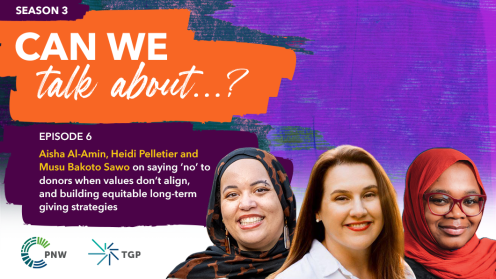
In episode 6 of our season on community philanthropy, Aisha Al-Amin (Development Director, Social Justice Fund), Heidi Pelletier (Chief Development Officer, Yakima Valley Community Foundation) and Musu Bakoto Sawo (Director of Fundraising and Grants, Community Foundation of Snohomish County), sit down with Mares to discuss that while grantmaking has shifted, donor relationships and fundraising is stuck in the past. They share both the challenges and joys of working with donors on creating more equitable and long-term giving strategies.
Together, they discuss what it looks and feels like to say “no” to donors, and how, by grounding fundraising in their organization’s values, these difficult conversations can ultimately strengthen donor relationships.
Finally, they share practical examples of how their foundations have worked to educate donors on issues such as class and race, which deepened their donors' alignment with the foundation and ultimately strengthened support for the community.
Aisha Al-Amin
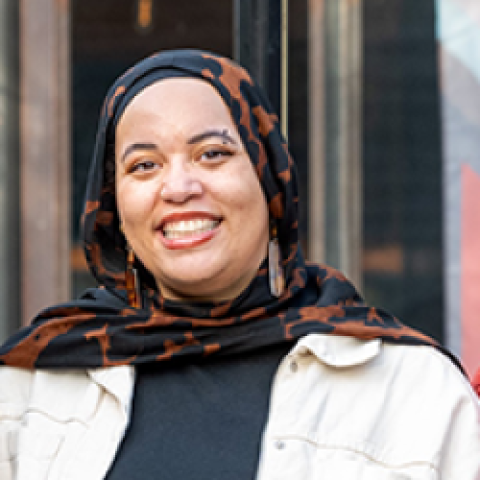
Aisha serves as the development director at Social Justice Fund Northwest (SJF), where she leads donor organizing and fundraising initiatives and supports communications strategy. Aisha Al-Amin grew up in rural Eastern Washington and identifies as a mixed-Black Muslim woman. She has worked primarily at youth-serving organizations as a direct fundraiser, facilitator and strategy consultant. Her personal life mission is to support communities of color to live liberated, self-reliant and dignified lives through community organizing and nonprofit leadership.
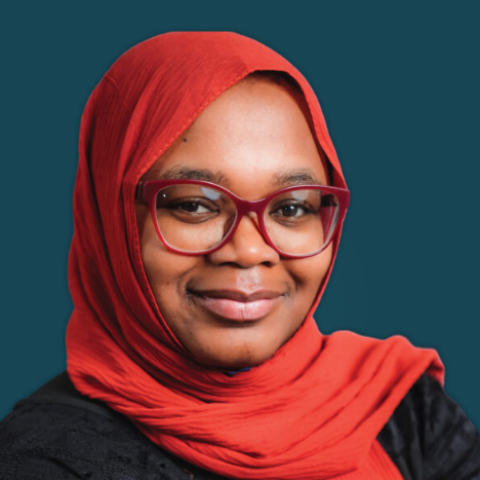
Musu Bakoto Sawo
Musu leads the Community Foundation of Snohomish County’s fundraising and grants efforts, supporting the organization’s mission to create lasting social change. She is passionate about connecting resources to initiatives that uplift the communities the foundation works with. Musu is originally from The Gambia, where she spent over 18 years advocating for women and children’s rights. With a background in human rights law and international peace studies, she has worked across Africa and beyond to uplift marginalized communities, focusing on gender justice and policy change.
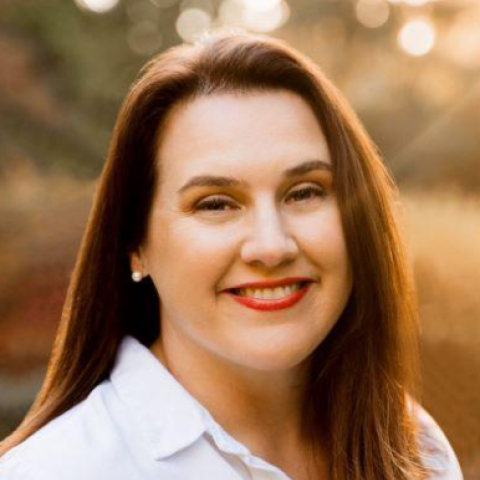
Heidi Pelletier
In her role as chief development officer at Yakima Valley Community Foundation, Heidi splits her time supporting fundholders and working closely with local nonprofits on cultivating relationship-based fundraising models. Prior to joining the foundation, Heidi partnered with benefactors to move forward the amazing mission and visions at Fred Hutchinson Cancer Center, Susan G. Komen for the Cure, Mary Bridge Children’s Hospital and Heritage University. She is a proud graduate of Washington State University. She is a 21/64 Certified Advisor, with extensive training in multigenerational family philanthropy.
Key Lessons & Insights
- Inviting Donors in to be Partners
Musu shares the importance of inviting donors into opportunities to learn and how by including donors as partners, this can build alignment with what the community is asking. Aisha expands upon this by suggesting that foundations invite donors to be part of the strategy, because not only are they a part of a foundation’s market, but they are also part of the community.
- Saying “No” to Donors
All three guests share the challenges and fear of saying no to donors, especially those who have donated to the foundation for a long time. Heidi shares that, “if we're more intentional and explicit about who we are, while that might turn off some in our community…we're going to attract more folks who appreciate the explicitness of where we stand, and more will come alongside us.” She iterates that, while these fears are real, the relationships with donors will become stronger when foundations align their fundraising efforts with their values.
- From One and Done to Long-Term Solutions
Aisha shares how the Social Justice Fund is working to shift donor funding from short-term, reactionary funding toward long-term, sustainable solutions. She shares that many times donors are “in for a year, then they’re out.” This applies to how donors can shift their donations, as well as to funders, who can give longer-term, multi-year operating grants.
- Understanding Donors Along a Spectrum
Mares reminds listeners that donors are not a monolith and that it is important to engage donors along a spectrum. Find even the one donor who is most aligned with your organization’s values and build upon conversations with those who are more neutral or willing to shift toward the foundation's values. Musu shares how the Community Foundation of Snohomish County has helped move donors along the spectrum by shifting the focus from donors to the community’s needs, and bringing along donors who are ready for this change.
References & Resources
- Throughout the conversation, our guests refer to Philanthropy Northwest’s Building Community Philanthropy (BCP) cohort, a program that provided shared learning opportunities for staff and board members across multiple community foundations, deepening their equity practice through collective reflection and action.
- SJF’s flagship donor organizing project, The Giving Project Network is a 6-month cohort program, focused on building a democratic and participatory process of fundraising and grantmaking that uses a cross-class, multi-racial lens.
- Heidi mentions the 21/64 training as a resource on how to talk about money and class, which can be especially useful when talking with donors.
- Musu discusses her work with Michelle Muri at Community Centric Fundraising. As Musu mentions, Community Centric Fundraising doesn’t center donors, but instead is “an approach to fundraising where you prioritize the needs, values and voices of communities being served.”
- Musu also mentions Snohomish County’s 15/55 initiative, which is a project that identified five BIPOC-led organizations in Snohomish County and gave them $50,000 each year for five years.
Starts & Stops
This season, we’re asking all guests what philanthropy ought to stop doing and what philanthropy needs to start doing. Here’s what Aisha, Musu and Heidi shared:
Start:
- Aisha: Investing in our staff to develop race and class analysis and how they intersect.
- Musu: Building relationships with grassroots organizations before there’s even money on the table.
- Heidi: Rooting yourself in mission, vision, and values to make strategic, thoughtful decisions during a difficult time and bring people to the table to come alongside us.
Stop:
- Heidi: Getting stuck in analysis paralysis.
Credits
This episode of Can we talk about…? was produced by Aya Tsuruta, Emily Daman, Mares Asfaha, and our audio engineer Josh Suhy, with editing support from Karalyn Jenkins. Special thanks to Asha Hossain (Graphic Design), Nancy Sanabria (Intro/Outro Host), Komiku (Music) and to our Building Community Philanthropy partners for their thought partnership and support.