Katie:
Equity is just about recognizing our humanness. It's recognizing like us as human being to other human being. How do we more be as opposed to do?
Nancy:
From The Giving Practice at Philanthropy Northwest, this is Can we talk about…? a project to normalize the messiness of leading for racial equity in philanthropy and reflect on what it takes to create lasting transformation? In season two, our hosts explore what it looks like for philanthropy to advance racial equity on the ground where the work can look quite different depending on the context, whether it's place, issue, area, or community served and in a world where our contexts are constantly shifting. We're asking guests to practice vulnerability, explore sticky topics, and look for learning. And what we ask of you is to do the same.
Hey, it's Nancy again. Before we begin today's episode, we want to note that due to some technical issues, you might notice that the audio quality is lower than normal. We apologize for that. Thanks for your understanding, and we hope you enjoy the episode.
Abby:
Oh my goodness, Katie Hong.
Katie:
Abby.
Abby:
Hello. I feel like it was just yesterday when we started the season together and we are at the end already. How did that happen?
Katie:
Yes, I have no idea. And I do feel like it went by so fast and given how much the world has changed, I'm like, that was October? Because the last couple of months has felt like dog years, to be honest. Hello my friend. Good to see you.
Abby:
Good to see you. Good to hear you. I know this whole process has been such an amazing transformation. I've learned so much. I've learned a huge amount, and I know today is what we're actually going to go into, what we've learned and what we've found and yeah.
Katie:
Absolutely. And I wonder, I know hopefully people who are listening in already know who we are as they should if they've been listening to this season two. But let's start off with intros just so that we can orient our audience members to who we are. Do you want to go first?
Abby:
That sounds good. I'm Abby, Abigail Sarmac. I'm a senior advisor at the Giving Practice at Philanthropy Northwest.
Katie:
My name's Katie . I'm also a senior advisor with the Giving Practice. And together we started off with another colleague, our colleague, Robin Martin, when we started the series. But the three of us, and then two of us at some point have been your podcast hosts for season two. And so it's really fun to come back together now to really reflect on what we've heard and learned and just to do some sense making together about season two. I guess just one reflection, I want to just appreciate, one, how much I've enjoyed meeting all of the different guests that I got a chance to speak to. But honestly, given how much we both shared, how much we love podcasts, I also feel like this helped fulfill my dream of actually doing a podcast episodes. So I'm also appreciating that.
Abby:
A dream that I never even knew I had.
Katie:
So just to remind people, I think to remember, and I think we said this at the opening episode that season one of this podcast series was really focused on governance and how we support board members and people in leadership roles in the philanthropic organizations. How do we support them on their equity journey and get them to really support efforts at the organizational level, the foundation level, to really support efforts to advance equity. But then we wanted to follow up with season two to talk about funders who are actually operationalizing this commitment who are already committed and doing the work, and they're doing the work in a diversity of context. And so we really set out to learn what are they doing, what are they learning, how are they navigating the current context and climate, and how are they as individuals, not just as organizational leaders, but as individuals finding courage and strength.
And I know we talked about this again at the opening that Philanthropy Northwest as an organization, we serve a six state region across Alaska, Idaho, Montana, Oregon, Washington and Wyoming. In the state of Washington, things are so different between Seattle and Yakima, but the nuances really cut across not only place, but also types and sizes of foundations and community served. And so we really set out to hear from a diversity of speakers and to understand the broad spectrum of approaches and strategies to advance equity. And what I'm really excited to reflect on with you today is to identify and reflect on some of the threads that pull us together, so where there are commonalities and where the important differences.
Abby:
Totally. And maybe before we jump into some of those nuances and reflections that we have, I can just recap who we talked to for our audience a little bit before we dive in deep. Does that sound okay? Anyway, so just in a nutshell, across 10 episodes this season, we connected with 15 guests and just as a few examples that we spoke to at the Community Foundation of Greater Birmingham in Alabama that serves the most fragmented communities in the southeast, we spoke with public foundation based in the Bay Area, building long-term power for Asia Native Hawaiian and Pacific Islander communities, the New Breath Foundation. We even talked with, I know you were able to talk with Katie. I was so bummed I wasn't able to do that, but you were able to speak with a capital investment fund based in Portland, Oregon, where I am advancing long-term prosperity for the black community here, the HNO-III fund. Who else did you speak with, Katie?
Katie:
Yeah, yeah, no, those are great examples. I personally got to talk with Kent McGuire, then who is at the Hewlett Foundation and Zoe Stem-Kelderon from the Ricks Foundation who have been working collaboratively with other funders to advance equitable education in our country. We also hosted a discussion that brought together leaders from APFE and APIP on their efforts to support racial equity and racial justice. I most recently spoke with Gloria Dixon at BECU to learn more about how they as a corporate philanthropy is advancing equity and equitable efforts. And then community foundation, you mentioned the one in Birmingham, but we also spoke to one that's based in eastern Washington about how they are continuing to refine and adapt their work based on what they're hearing from their community. So I really feel like we heard representative voices from all corners of philanthropy. Abby, two other points that I think are worth mentioning at the beginning.
One is just reminding ourselves and our audience of, again, why we were motivated to do this. I know at the beginning we said this is really about practices and lifting up practices, but I do think it would be helpful for both of us to surface again our why and why we think this is an important conversation. And then the second point is something that I said earlier at the beginning, which is just a reminder that we started recording episodes last October when it was challenging then too. I think some of the questions that we lifted up at the beginning felt relevant then, but it really feels even more relevant today given how much our current climate has changed. I guess just on our first point on talking about the why, what I remember from our initial conversation with the three of us, with you, me and Robin, is just us simply having the opportunity to define what does equity mean for us personally and why did we feel excited about this conversation?
And I think I remember sharing then that for me personally as an immigrant, as a child of immigrants and then now as a mom myself of young people in my life, that really equity to me simply means how do we ensure that everybody in our community, in our neighborhood are afforded the same equal opportunity to survive and thrive? When I think about equity and our drive to advance equity, it's simply that. How do we expand our notion of who belongs in our community? Who do we think of as our community members and our neighbors, and how do we care not just about who's in our own inner circle, but how do we broaden that inner circle to include everyone in our community? And in some ways, I think for me, as somebody who's worked in the philanthropic sector for a really long time, for over two decades, philanthropy in some ways is the direct result of inequitable systems.
And at the same time, I think really has the potential as a sector, we have the potential to play a critical role in providing flexible capital resources to support us, to support our community, to push for more equitable systems. So it's in that context, that's why for me, I felt so excited to set out to do this season two because we have the opportunity to really play an influential role. And we're not alone, even though at times it feels like we're alone. There are lots of us all over the country trying to do this important work in a diversity of different contexts. And so the more I think we share, the more we reach out, the more we share also what didn't work, I think the more collectively we could do this. So let me pause here and ask you, Abby, what would you add? Again, what do you think of when you hear that term equity and why did you feel motivated to be a host for this past season?
Abby:
Yeah, absolutely. Many of the things you've mentioned. I'm a mom myself. I've got two teenage sons and two teenage boys of color going into this world. And I love this world of philanthropy. I've been in this world of philanthropy for nearly 20 years now, and I can also be very open and honest and look it in the eye and say that philanthropy damaged me in many ways by kind of undermining me, by making me feel less than. And to me, that was why I wanted to do this was I don't want that for my children. I don't want it for me, frankly. And again, it's so difficult. I know everyone, I imagine that our listeners all feel the same way. You look out into the world and you can't... Maybe you feel like you can point to one person and blame it all on that one person, but we all contribute to this.
We all are contributing to this system that makes us feel terrible. That makes us feel less than. Very clear why I was just like, we can do better folks. So wanting to just create a space kind of like today, right? A space where we can reflect and think and begin to see together what are the themes that are helping people just stay the course in terms of equity and philanthropy? That was another one of my whys. I remember very clearly one of the reasons when we recorded that first episode, I remember going into it and being like, oh my gosh, this is so hard. How are people doing it? How are folks on the front lines keeping on holding the course? And I think that was in part that was a key question I had. I was so tired. I continue to, in many ways, be tired, but I wanted to learn more about how do people keep going because this is hard work. Finding that collectively is actually what has been super inspiring to me about this season and about the conversations we've both been able to have.
And I think what was inspiring to me when I stepped back and I began to reflect on what did we learn, what did we hear? And I think one of the pieces that has been really inspiring for me is that despite all the differences, when we recapped all the episodes and we were talking, we've talked with people all across the country, rural, urban, small foundations, big foundation, every stripe color or creed type. Despite those differences, I heard more things that we all have in common actually. And that was something that felt really inspiring to me is that the things that we think are going to divide us and make us different and the nuances, it actually... I heard a lot of similarities across all of these different organizations and people and types of philanthropy. So that's what I'm excited to talk about in today's episode.
Katie:
Yeah.
Abby:
Should we dive in?
Katie:
Yeah, absolutely. Yeah, I just wanted to build on what you were saying of this could feel so hard. I hear that a lot. I myself have said that especially now, this work can feel so hard. And yet what I was really struck by as I spent some time thinking about reflecting across the season, what we heard was actually how simple some of these practices are. So really basic things.
Abby:
That's right.
Katie:
The power of listening, really actively listening and not presuming that you have the answers to the problem. I think we kicked off the podcast series with a conversation with Zeke and Monica, who the Empire Health Foundation has renamed it themselves. They're now known as the Water Is Neat Foundation over in Spokane, Washington. And they just talked about how they've been able to evolve and refine their approach as starting out initially as a foundation, like many foundations who said, what are the issues that we want to focus on?
How do we find out what the best practice solution is? And then how do we bring those promising practices here and scale to one of, actually, let's go to the people who are most impacted or negatively influenced or affected by any particular issues. And really take the time to engage and to actively listen and to not assume that foundation staff have the solutions, but that their job is more to create containers in which they can hear, learn, and adapt. And I think whether it was that example, or again, even in my most recent conversation with Gloria Dixon at BECU, where she said, look, we operate in so many different geographic contexts.
So what equity means here in Seattle, it means very different in other parts of the country where we work. And so for us really listening to their members and asking them, what do you care about? What do you think is the right approach is how they think about advancing equity. And so I think just again, the power of listening, the power of entering lived experience. And I think by that too, it just means in whatever ways that makes sense. So sometimes it's spending time deeply in communities. Sometimes it means recruiting board members or staff from those communities. I know Abby, I think in your conversation with Eddie from New Breath, he talked a lot about that, but I don't know, what about you? What are some of the key lessons learned you feel like?
Abby:
Very much resonates with the pieces that you mentioned that these lessons are pretty simple in many ways. Even though, again, they're coming from super diverse contexts. Some of the lessons and pieces that felt the same across all of the group's experiences really felt around centering lived experience, listening to those with lived experience. And the example that I still refer to that conversation with Carmen at the Women's Foundation of the South, where the whole intention of that foundation is to support women and girls in the South and how do they do that? They actually support women and girls in the South. I mean, literally they're opening their way of going into a new place is to bring together women of color, girls of color in the specific state, the specific county, the specific neighborhood, bring them together and create and support development of a community. Those communities already exist, obviously, right?
But that they're providing more space and support to women and girls of color in the south and basically just supporting them with whatever they need in that moment and not pretty supposing that it's some sort of research that's been done on that community that indicates what your grant making strategy. No, it's just as simple as bring together the folks that you want to support and partner with and listening to them and giving them what they need.
And if that is a bed for the night, then you do that. If that is a loan to get them through shenanigans that are happening with a federal grant where they don't have funding coming through that they expected, it's that. And it's just doing whatever you need to do to support the people that you want to support. One of the pieces in that always feels so frustrating sometimes is we can get so caught up in our heads around what our theory of change is and what the right answer is, and commissioning all this research to figure out what it is you need to do. Some of those, the responses of the folks doing that work over the season that we've heard, it's pretty simple. It's pretty simple.
Katie:
I think it's really pointing out just that saying that everything moves at the speed of trust. And I know we say it's pretty simple. And at the same time, I think the aspects of it that make it difficult is that it is then a question of power and it's a question of control, and it's a question of what kind of outcomes and accountability and who are you accountable to? And so I don't mean to make it seem like, oh, it's so simple. I know there's all sorts of other dynamics that is important to mention.
But I do think what I was really struck by were just simply those true and tried kind of practices of recognizing, listening, building trust. And then another thing is just the power of collaboration so that this is also not about doing the work alone. That one of the important roles that a foundation could be playing is in working closely with other funders or so that was the example of the Hewlett Foundation and the Rakes Foundation, talking about not just the size of the different foundations of a national institution like Hewlett and a smaller foundation like the Rakes Foundation, but also intergenerationally that Kent and Zoe themselves represent different generations in the education and just the power of building collaboration and trust across generation so that you're also building your current efforts based on what's happened in the past. I think just the power of intergenerational collaboration and trust I think felt really important.
Abby:
I completely agree, and I'm glad you mentioned that because I think one of the conversations that really inspired me, and I just really felt that spark. I remember this moment talking with [inaudible 00:19:58] Esperanza at Seeding Justice around this whole idea of an intergenerational effort. One of the answers to that question that I'd started with, I was like, how do people continue doing this work? And how they really brought up, even in their own personal stories, that this work is so long and ongoing that you think of it as multi-generational, right?
Both [inaudible 00:20:23] Esperanza came from families of organizers, families of activists. They themselves have that mantle. And I feel this personally, I feel that I'm in this process of shifting my role now that I'm on the older side of the generation, that in a multi-generational effort, you have the time, the freedom, the opportunity to on many different roles in whatever capacity that the moment is calling you to be. And maybe in those younger generations, they're the front lines, they're the fighters, they're the agitators. Whereas later on, maybe we're stepping into a role where it's okay. We've been many decades now in this fight. What role now am I stepping into if I am so lucky as to have wisdom? What wisdom is there that we can now support and provide in this multi-generational intergenerational effort? And I found some comfort in that. I found some comfort in that at any given time, I don't need to be on the streets and agitating with the signs. And that's all right and good, and I think a great way to show up. But there are so many ways to show up in this world.
Katie:
I mean, I love that point that you're making. I think it's really drawing out that we all... It's like an ecosystem approach. Exactly. And we all play different roles. And to your point, that could change for us personally. But the other reason why I really appreciate that example is that I think one of the things that we also set out to learn was for us personally as individuals in this... We're not more than our professional roles, were individuals also in this.
And so what are the things that we heard from our guests and our speakers around what are they doing at the personal level to find their courage and their strength? And so I do think that I loved you bringing up Esperanza and her and Fiatim and them just reminding us of the long arc of the... Because I know for me that's an area where I could feel really discouraged, especially given again the current climate, is that sometimes it can feel hopeless. Oh my gosh, the whole weight of resistances could feel so big. But I think this is where I think it was them that talked about how do we want to think about time and what's the time required to truly support transformation? And it made me even think a lot about how do I think about time?
Sometimes I can really get into urgency and a speed go or really thinking about success in a relatively short timeframe. Whereas if you come up a level, really think about the seven generation framing, both the problem as well as the solution, what kind of transformation might actually be possible if we actually think about time, for example, in a different way or some of the other kind of personal level strategies I think some of our guests talked about was the power of naming fear, acknowledging that it is scary. That it can feel scary at multiple levels to be doing this work. And I think it was Susan from Appy who said, yeah, it can feel scary. And when it does name it, and then come back to identifying what is it that you can do. What is within your own six feet of influence?
And then Abby, some of the examples you mentioned though rest, if you're tired. Rest, you need to breathe, take a breath. I think that was it. But yeah, I'm curious what else is sitting with you as you reflect.
Abby:
Yeah, many of you and certainly Katie, that a lot of the pieces of what can you do right in these moments when you're just feeling so hopeless? And how do you keep on... I just love bringing up the pro-inspire self-to-system framework and the work at the four levels of yourself, your identity, your team, the interpersonal work, the organizational level, values that focus your organization and align your work. And then systemically, the collaboratives, the how do you work together, how do you work in networks? How do you work across people and across organizations at a systems level? But in a way, a lot of that has been a helpful framework to really understand one of the lessons that I gleaned and I reflected on over the season personally is that idea of we need to take care of ourselves, right? We are all only one individual person, and I really only have power over myself in many ways.
So it's like you said, when you feel tired, rest. When you feel alone, you find your people. I think that was probably one of the biggest things that I felt across the board, no matter where people were, no matter what theme they happened to be engaged in, what sector they were in or what role they had, it was find your people. I remember the example it just felt so inspired by was at the New Breath Foundation and where he was talking about he's in prison, right? He's in prison. And what gave him strength, where he found strength was in his own personal identity, understanding who he was and where he came from. And finding the cultural gift that our heritage gives us, that every single one of us on this planet has inherited that. And that is an incredible gift. And being able to look at that, research that. Find the pieces that resonate, whether it's music or it's food or it's the stories, the narratives of the strength of the communities that we come from and what you can bring forward into your own life currently and into the future.
And that really resonated for me. I mean, I also, being myself, AAPI, I'm of Philippine descent and connecting with New Breath in that way and connecting with my own Asian community here in the US, but also elsewhere, that is something that I know gives me a lot of personal inspiration and strength that when things get hard, I can find folks and folks who are just going to know in a shorthand way, they can look at my face and just know what's going on and what I need and maybe what I don't. And yeah, that really felt very cross-cutting across the board in order to stay in this work. It was finding your people.
Katie:
And I'll build on that. I think if there's lesson, even this is coming to me just as we're talking now, but I think if there's one key thing that I would say funders, if you are listening to this, what's one thing that I would really want you to consider is the importance of wellness grants actually. The importance of supporting people who are doing this work to rest. I'm just really struck listening to Carmen when she was talking about supporting women of color leaders. And I think one of the first things that she did was invite them to a retreat. And I think several of them were like, I'm me. And it's these women who have been lifelong tirelessly working ongoing nonstop, not just for themselves and their families and their communities, but just for the betterment of everybody in their community.
And this recognition that... It's almost like they needed somebody else to say before they allowed themselves to even do that for themselves. And so I just in our transactional context, I've worked in government for a long time before coming into philanthropy. Government would never fund wellness too. And I know a lot of funders themselves are like wellness, how does that get us to fighting for justice? But I just want to say these things matter because at the end of the day, also I think equity is just about recognizing our humanness. It's recognizing us as human being to other human being.
How do we more be as opposed to do? And I know that sounds super squishy, but I feel like I can't just... And this is just speaking from my own experience too, the more we can help support and help us remember. Because this is our birthright. This is who we are as human beings. We just forget it that when we get into these institutions, we ourselves are shaped by so much of what we think it should be that I think we just forget what it means to be human. And that sometimes that kind of connection that really pays off when it comes to then fighting for actual systems and systemic change.
And so that for me was a big aha, was just the importance of doing that, the importance of wellness and the fact that sometimes we also hear, and I hear this from just even some of my clients, that if funders don't specifically target and say, you have to use this for wellness, they themselves also don't want to use it because their whole world is on fire. And so it feels like it's indulgent when in reality again, it's all part of the work, it's all part of the work.
Abby:
That's right.
Katie:
Before we move on from this though, Abby, I do just... I feel like we've been so focused on saying there's commonalities and commonalities, but I think it's also worth noting some differences too, because if we didn't... I do think that a lot of these different types of funders work in different contexts. And so I'll just start by saying I think the one thing that we did hear from different leaders is the importance of language and how we talk about equity. What does equity mean? It just matters in terms of how you talk about it in Seattle, again, which is where I'm based or you're in Portland is different than the way that you have to talk about it in other communities. And so I think that's the other kind of key takeaway is that when we use terms equity and justice, it's just become so polarized.
So to the extent, I think one of my takeaways again, it's just what are the stories? What do we mean by equity? And I love Gloria Dixon again from the ECU talking about when she's talking about it in Spokane, she talks about, again, using the language of what she hears from her own members of it means having enough housing so that our children could come back into our community and afford to live here. Or means that if you study hard and you want to find meaningful employment, that you should be able to do that. Or the [inaudible 00:31:29] fund where they're talking about the black community in Portland, telling the story that they've always had wealth. It's just now expanding the definition of what wealth means and really helping to support the black community in Portland to really have access to all sorts of different types of wealth. So I was just also really struck by that. I think that's an important difference is that there were also important differences in the speakers.
Abby:
I think one of the other interesting differences was we were able in the season to speak with Lila Apip and this whole idea of there are differences in roles. And again, going back to the idea of this is a big fight and there is room, and in fact there's a requirement for many different kind of roles. And so as an example, one of the interesting insights that I've come to over the season has been in particular philanthropy infrastructure organizations and the critical role that philanthropies infrastructure organizations really being cover, really being able to say as a collective, things that perhaps an individual or a specific philanthropy or foundation can't say in part because they are trapped in a little bit more of a system that has some power inequities and inability to kind of say sometimes the hard thing for fear of jeopardizing your job or jeopardizing your goodwill or challenges within the specific culture you have within your organization or your team.
So in a way, the groups like a Philanthropy Northwest or groups like AFI or groups like APIP that are collectives within our field of philanthropy, also playing that really different and incredibly important role of cover to be able to say the hard things.
Katie:
Yeah. Yeah, I think that's such a good point.
Abby:
And put that out there as a collective what you as an individual within a philanthropy may not be able to do or say, but maybe allows you, gives you an in, something to point to start a conversation that can maybe begin shifting things within your space.
Katie:
I love that. Interesting. I really love that. Yeah, I think you're right. I was really struck by, there was some speakers we spoke with who were like, you just fight and you fund the litigation, or you start a C4 or you fund advocacy and you do it in a really proactive way. And other funders were like, that's not part of what is possible for us, but what is possible for us is to fund intermediaries so we are able to move money to new and innovative models like the New Breath Foundation or supporting the Indigenous Women's Flow Fund or the 1803 Project. So I do think that there are different models. Not everyone's showing up in the right way. And so this is where I think frameworks like the trust-based philanthropy, they recently have been circulating this pledge for funders to sign on that simply say in this moment, could you make a pledge, a commitment to do three things?
The first is just listen. Listen and check in. And you know what? Actually everyone could do that. It means calling your grantees and your partners and saying, how is it going? What's going on? Checking in. I would not underestimate the power of that, just that when you're in this work, the power of people just calling you and asking you how are you doing? That could be really, really meaningful. So that's action number one is are you taking time to do that? And then second is, what are ways that you could find ways to move resources and money? Because at the end of the day, as Susan said, when you feel fear, ask yourself what is your role? Where are areas that you can control? And as funders, that's what we do. We're here to move resources, whether it's dollars or beyond the grant check. And so how are you able to do that, again, by either funding directly or maybe funding indirectly through moving dollars through intermediary funds and foundations.
And then finally, what is your role in supporting innovation and inspiration? And this is where I think funding some of the wellness efforts that we talked about earlier, but even funding some of these innovative models like the 1803 fund that's really thinking of themselves as not just a grant maker, but as an investor, as a capital investor, and using all of the tools in the toolbox to be able to do that, I think it's super exciting. So I do think that the trust-based Philanthropy Pledge, if you're not familiar with it, please go on their website so that you can learn more and see if that's something your foundation is willing to sign on to.
But it really is... It's both a recognition that all of us are different. And to Abby, your earlier point that we all play different roles in the ecosystem. And at the same time, there are some I think basic frameworks of what role we could be playing that could be an important resource to us. When I feel, again hopeless or when I feel scared, I feel like, oh my God, what could I be doing? And is it making any difference at all?
Abby:
The other piece I'd add here, Katie, just came to mind to me, and it is also just part, also the trust-based philanthropy projects, just ethos of learning. We can learn from each other, keep questioning, and really emerging into this moment with the openness to know that we don't know everything and you're going to learn something new. The things we've talked about at our podcast today may be completely different tomorrow, as this past several months has told us. It feels like life is always just throwing new stuff at us. So just we're all learners. None of us as experts, we're all... Obviously we're experts in some particular things. In that particular moment, not being thrown. If tomorrow it's something new, it feels like something-
Katie:
Yeah, no, I think that's true. And I guess just in closing, I'm curious for you, what else is helping you in this moment? Where are you drawing your own inspiration or how is this current climate, what's happening now? How is it shaping you? How has it influenced you and what are you finding some joy and inspiration?
Abby:
Frankly, friend, it's stuff like this, right? It's the connection with my people, whether that's family or friends and just taking a break from whatever I need that moment or being able to... It really is a joy to be able to do this kind of work that it's such a privilege to be able to reflect, to take the pause, to take the time rather than just do one more conversation, one more thing. It's really what a gift this has been to reflect with friends, not just on what we're going to have for dinner tonight, but really deep, important things that really we all have a role in. Those are the things that are giving me joy. Those are the things that when all of those things overlap, when you've got both just personal connection, when you've got intellectual connection, when you're aligned in purpose, wow, what else do you really need? I think those are the things that have really kept me going.
Katie:
Yeah, that's so well said. What an amazing privilege we both have as senior advisors with the Giving Practice is that we get to really be in community and walk the journey in some ways with the people who we have the privilege to support is that we get to mirror and feel with them, their frustrations, their joys, their excitement. And I think just for me personally, I've been personally have just been going through a lot of change and transition both at a personal level. There's been several really significant death in my family with my sister a couple years ago, and then my father recently passed away, and both my children are going off to school. As I know your child is also leaving for school, so I feel like it's that saying of the only constant is change and really accepting that and learning how to hold it lightly.
Change is change. And I know that one of my own personal challenges is how do I be in a place where I both accept and acknowledge that when it feels scary or when it feels sad or when I'm grieving for kind of what was that I could do that. And at the same time, just know again that things are always changing and shifting. And that this time, while on one hand I could feel like it's the worst time ever, this could also be the best time ever fertile ground of the kind of trust building and the hope and the inspiration that we need to build to truly dismantle systems that aren't working. So on that level, my friend, I think that's just about all the time we have. But before we go, I wanted to, one, appreciate you, Abby, for being in this community with me, for taking the time, but also wanted to share a little preview of season three because I'm so excited that this podcast is continuing.
What I understand, we've already started recording. So what's really neat about what we're going to do next is that we're going to have an opportunity to go even deeper. And by that what I mean is deeper into, now that we've talked to a different diversity of different funders, for our next season, we get to go hone in even more and talk to a group of community philanthropy organizations. Because from 2012 to 2024, that's, oh my gosh, over 12 years, Philanthropy Northwest has been facilitating a cohort of 20 community philanthropy organizations who have been working to advance equity.
And so earlier this year, PNW released this amazing guide filled with data and lessons from this twelve-year cohort, and I'm so pleased that season three is really going to bring that guide to life and speak with particularly community foundations. And these are so important because they're foundations that are based in place that really are centering community to talk about what are key lessons learned about practices and structure and culture and organization. Plus, Morris Asfaha, who is our associate director of programs is hosting, and Morris is amazing and fabulous, and so really you all should just come on back to listen to that season because she's fabulous and you're going to really enjoy getting to know her better.
Abby:
Plus one to all of that, Katie, so everyone out there hope you join us for season three. Thank you all so much our listeners, for learning with us, for listening, and of course a huge thank you to all of the guests who took the time to share their stories with us. Thank you so much, Katie, as well. I've loved co-hosting with you. And a big shout-out, of course, the folks behind the scenes, our production team, Aya, Emily, Josh, thank you all so much for keeping us on time and moving forward. This has been absolutely so incredibly fun. Thanks everyone.
Katie:
And thanks for making my dream come true of being on this podcast. Now I can say yes, I've done that too.
Nancy:
Can We Talk About is a podcast by Philanthropy Northwest, written and produced by Aya Tsuruta and Emily Daman with production support by Podfly and Graphic Design by Asha Hossain. Our episodes this season are hosted by TGP Senior Advisors, Katie , Robin Martin, and Abby Sarmac. You can find more information on this episode including guest bios and show notes at thegivingpractice.org. And if you have a topic that you think philanthropy should be talking about more, let us know by emailing hello@thegivingpractice.org. A special thanks to our Philanthropy Northwest and Giving Practice teams for their thought partnership and the Ford Foundation for making this project possible. I'm Nancy Sanabria, and we'll see you next time.
Overview
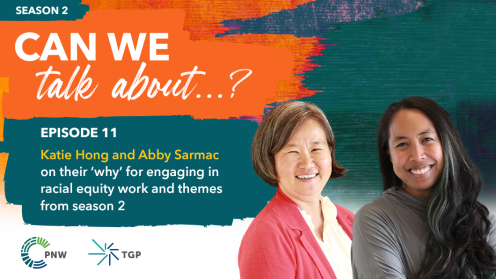
In our final episode of Season 2, Katie Hong and Abby Sarmac sit down to recap the season, recount their ‘why’ for engaging in racial equity work, and celebrate achieving their dream of hosting a podcast!
They ground the episode in what we set out to do this season, which was to uplift the nuances of operationalizing equity commitments across a diversity of contexts. From these various contexts, places and funding models, Katie and Abby found inspiration in the similarities that many guests share, specifically the importance of listening, showing up with care and going farther together.
Katie and Abby also highlight the unique roles different types of funders can play, from community foundations to intermediary funders to philanthropy-serving organizations, and how each can leverage its role to strengthen equity in our sector.
They bring in their personal and professional stories, reminding us of the importance of bringing our whole selves and our collective humanity to advance racial equity.
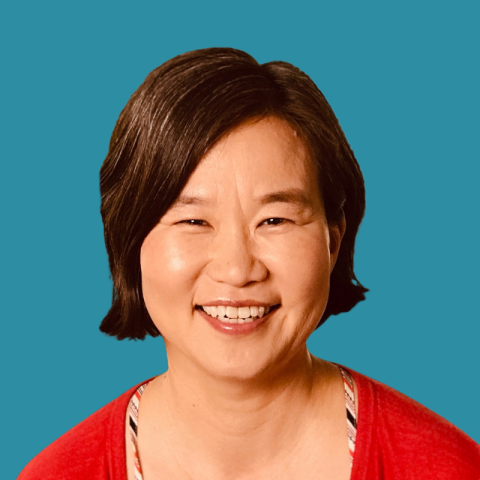
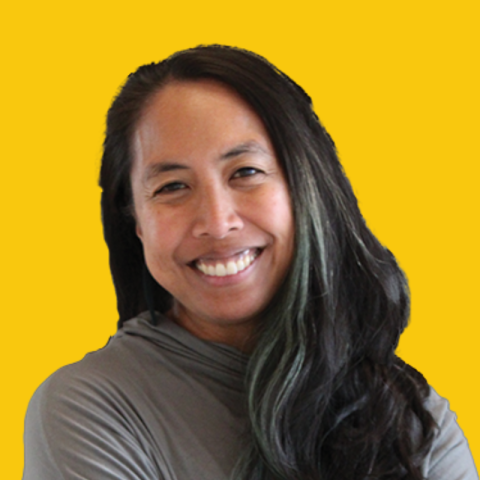
Katie Hong
Katie brings over 25 years of experience working in the philanthropic, nonprofit and government sectors to the conversation. She focuses the majority of her consulting work at The Giving Practice on supporting leaders and organizations that are working to advance racial equity and social justice. Prior to joining The Giving Practice, Katie worked as program director for the Raikes Foundation and previously led the Pacific Northwest Initiative for the Bill & Melinda Gates Foundation.
Abby Sarmac
For over 20 years Abby has worked with mission-oriented organizations, including philanthropy, non-profit, for-profit venture and sustainable community development in global south and emerging market countries. Before joining The Giving Practice, Abby worked with The Lemelson Foundation to develop grantmaking strategies and review grant and investment opportunities for entrepreneurs and triple-bottom-line companies. She also spent the first decade of her career focused on environmental policy with the United Nations and other environmental organizations.
Key Lessons & Insights
- The Power of Listening
Katie shares her appreciation that many of the guests highlighted the power of listening as an integral part of showing up and supporting the community. Philanthropy should not presume to have the answers, but instead take a listening stance, and then move money and support those who need it. As Abby reminds us, “It's just as simple as bringing together the folks that you want to support and partner with, and listening to them and giving them what they need. And if that is a bed for the night, then you do that, if that is a loan to get them through shenanigans that are happening with a federal grant, where they don't have funding coming through that they expected. It's that and it's just doing whatever you need to do to support the people that you want to support.”
- Collaboration
We heard a number of examples of collaboration throughout this season that highlight the importance of not doing this work alone. Katie discusses that one of her key lessons from this season was the importance of funders collaborating to advance equity. She shares, “what I was really struck by were just simply those true and tried kind of practices of recognizing, listening, listening, building trust, and then another thing is just the power of collaboration, so that don't that this is also not about doing the work alone, that one of the important roles that a foundation could be playing is in working closely with other funders.”
Additionally, this collaboration should be built upon intergenerational work, so that current efforts are built upon past work. Racial equity work is a long arc, and we are a part of that arc. Katie reminded us that we can easily limit our successes to a relatively short time frame, and she asks, “what kind of transformation might actually be possible if we think about time, for example, in a different way.”
Our Role
Abby continues this thread of intergenerational work by discussing how our role in this work shifts at various points throughout our lifetime, as well as in the different professional roles we hold. Throughout the season, our guests joined us from a variety of organizations, and a key thread across these unique foundations was that, as Abby shared, “This is a big fight, and there is room, and in fact, there's a requirement for many different kinds of roles.”Guests shared how they are showing up in partnership with their communities to move money and resources - whether as a community foundation that works to shift donor mindsets, as an intermediary funder showing up for their community, or by funding advocacy.
References & Resources
- Zeke and Monica joined us early in the season from Empire Health Foundation, which recently announced their new name: Waters Meet Foundation.
- Abby shared one of her favorite tools, ProInspire’s Self to Systems: Leading for Race Equity Impact that can help individuals and organizations deepen and sustain their racial equity work.
- As funders are asking how they can support their communities during this critical time, Katie shares the Trust-Based Philanthropy Project’s Meet the Moment Pledge. By signing on, funders can join together in solidarity, move money and build collective power.
Ongoing Reflections
- Abby shares her experience about her roles as an individual and within systems. What are some ways you can use your role, individually and within your organization, to deepen your equity work? For more information on leaning into your role, check out our Discover Your Role resource.
- Katie wraps up the conversation by asking Abby where she is finding joy and inspiration in this moment. Think about people, places or experiences that are fueling joy and inspiration to keep you going in this work.
Credits
This episode of Can we talk about…? was produced by Aya Tsuruta, Emily Daman and our audio engineer Josh Suhy, with editing support from Karalyn Jenkins. Special thanks to Asha Hossain (Graphic Design), Nancy Sanabria (Episode Host), Komiku (Music) and to our Philanthropy Northwest and Giving Practice teams for their thought partnership and support. Thank you to the Ford Foundation for making this project possible.