For nearly 25 years, TGP senior advisors have been designing and facilitating strategy projects for a wide range of clients from small family and community foundations to large private foundations, philanthropy serving organizations (PSOs) and funder collaboratives.
Across our team, we each bring our unique flavors, favorite tools and deep experiences to strategy work. Emily, for example, served as a deputy director for strategy at one of the largest philanthropic foundations worldwide while Mark has worked with just about every PSO in the country and Lalitha brings over a decade of experience at a social impact consulting firm to her practice.
Recently, the three of us sat down to reflect on what makes for effective strategy work. We found that our most successful projects in the eyes of clients are often ones that have had just the right balance between two fundamental elements of strategy projects: research and facilitation.
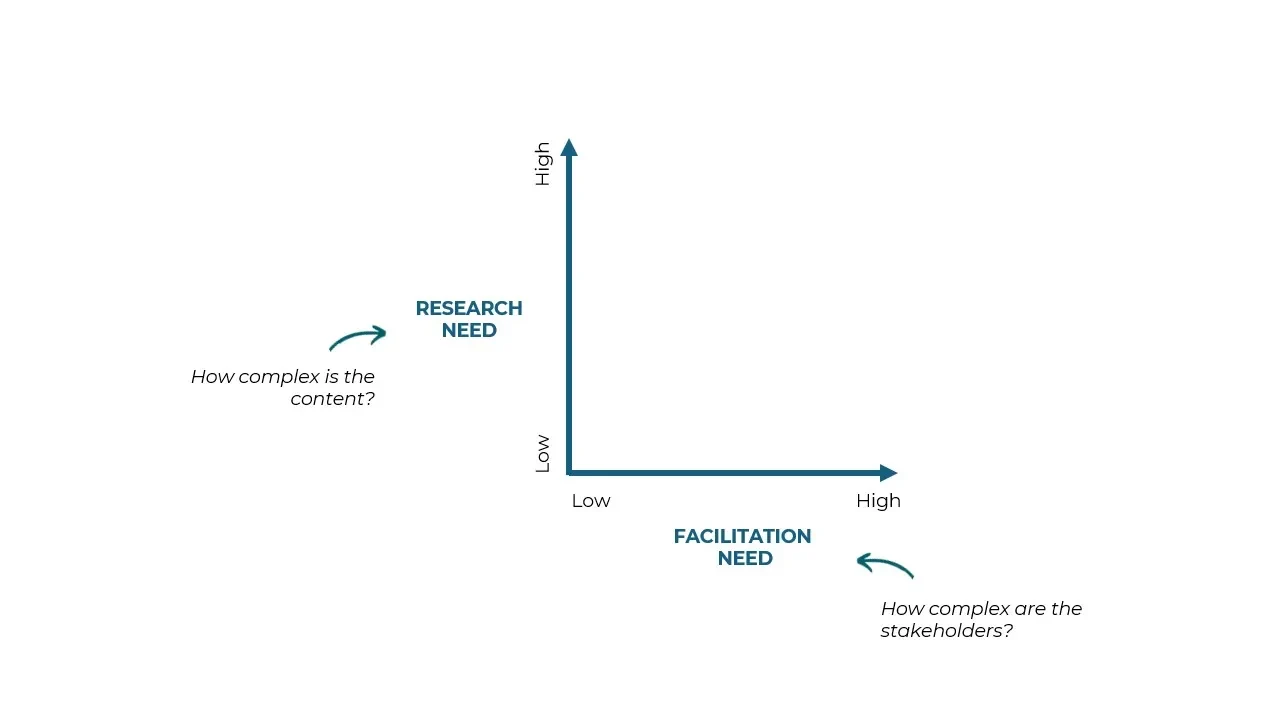
- Research includes collecting and analyzing qualitative and quantitative data
- Facilitation includes engaging, activating and aligning stakeholders
While finding the right balance tends to be more of an art than a science – and may require re-calibration as the work unfolds – there are two key questions you can ask yourself or together with your strategy consultant as a starting point as you design your strategy project:
1. How complex is the content you are addressing through your strategy? (i.e. the challenge, opportunity, issue area, etc.)
Content complexity can be assessed by factors like…
- Content type (i.e. identifying organizational vision, mission and values vs solving a major societal issue)
- Geographic reach of project
- Number and diversity of communities impacted
- Availability of existing work to date surrounding the issue and the efficacy of these efforts
- Rate of change of the content (i.e how dynamic is it?)
- Time horizon of the project
Higher complexity – i.e. addressing a dynamic societal issue impacting a large and diverse population over multiple years – will likely require more research. Whereas lower complexity – i.e. identifying a small, place-based family foundation’s vision, mission and values – will likely require less research.
Global health issues offer great examples of strategy projects with high content complexity. Developing a strategy to eradicate malaria, for instance, is a very complex problem with lots of data needed to even begin to understand how philanthropy can make a difference. Extensive qualitative and quantitative research would be required to understand key factors across multiple dimensions including scientific, economic, geopolitical, organizational, governmental and advocacy-related areas.
A strategy effort might begin with defining the problem, collecting data, drafting a theory of change and theory of action and testing and refining these ideas across multiple stakeholders before identifying specific interventions, allocating resources toward them and defining a measurement plan for ongoing learning and adjustment.

Emily
In addition to the complexity of the problem, the level of familiarity that your team or stakeholders have with the problem being addressed is another factor to consider.
2. How complex are the stakeholders involved in the process?
Stakeholder complexity can be assessed by factors like…
- # of stakeholders (internal and external)
- # of types of stakeholders (i.e. # of sectors, roles, etc.)
- Relationship and power dynamic between stakeholders
- Desired depth of engagement with stakeholders
- Alignment on scope of problem
- Leadership and personnel shifts (i.e. new ED, generational transitions in families, staff turnover, etc.)
- Decision-making culture (consensus vs hierarchical)
If you have a high number of stakeholders with varying relationships and dynamics, more facilitation is likely required.
Collective Impact work is a great example of projects with higher facilitation needs. Most that I’ve worked on have been cross-sector collaborative efforts involving stakeholders from government, the private sector, healthcare payors and providers, nonprofits, philanthropy and members of the community. While some research has been important, it’s been far more important to get the many players around the table to agree on a common agenda, shared measures and aligned strategies.
Different sectors typically operate in their own silos and what’s needed is to see the system as a whole to address any gaps and misalignments. The solutions to systems level issues that Collective Impact groups often tackle involve things like having access to common data sets, warm hand-offs across system boundaries and so on. These tend to come about primarily through facilitated conversations, aided by some targeted research.

Lalitha
Try this!
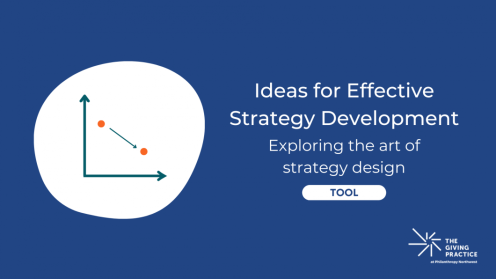
A helpful exercise to do with your project team – or a subset of your project team – is to have each individual plot where they think your strategy project falls on the chart below (you can create your own copy here). After plotting, have each individual share why. Observe where there’s alignment and where there are gaps, using your observations to inform your project needs.
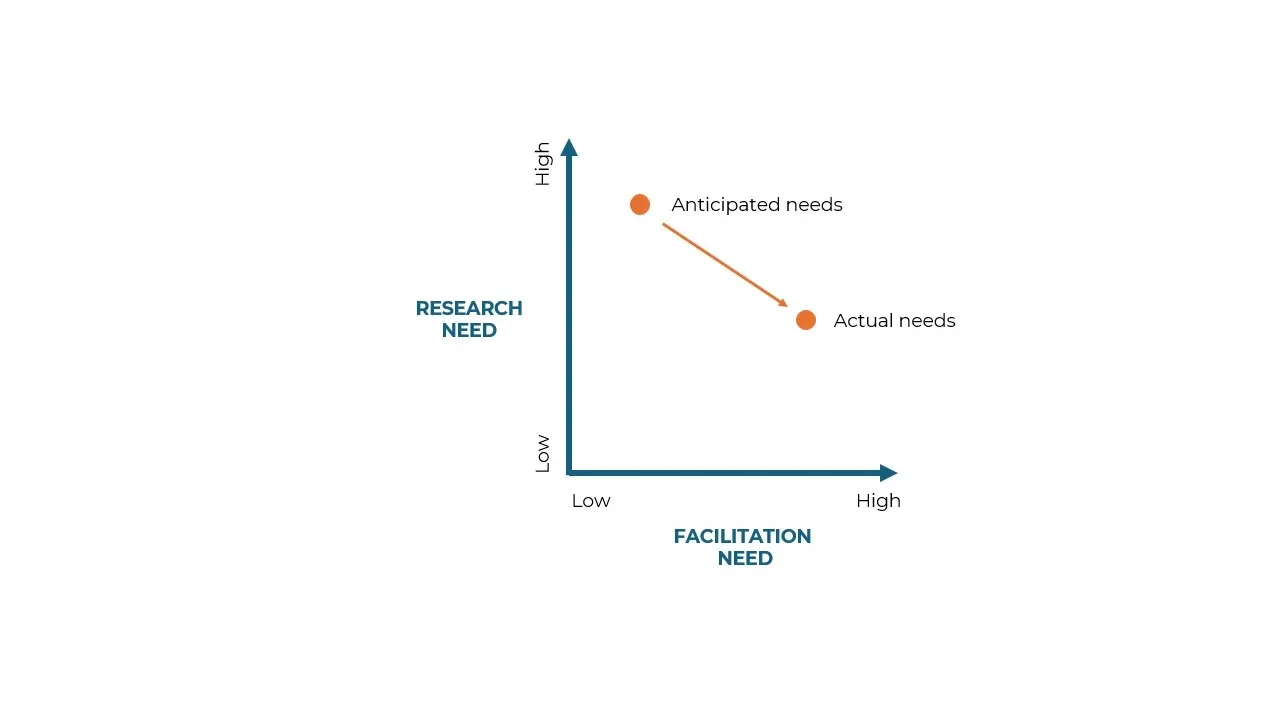
It’s not uncommon to start at one point and realize you need to be somewhere else as the project progresses.
When working with a funder collaborative to develop a shared strategy for their work on a complex regional issue, the group went in thinking that the first and main order of business was to do a landscape scan. The project began with a high research, low facilitation approach. While the data was helpful, it was hardly definitive. Most of the big ideas that ultimately shaped the strategy emerged through facilitated collaboration — surfacing the wisdom of the group.
And while figuring out the right strategy for the issue was a challenge, the real complexity we had to tackle was getting to alignment, cohesion and commitment among the group’s members. In the end, we discovered the project needed a high facilitation, medium research approach.

Mark
A note on the research trap:
All three of us reflected on projects that fell flat from an over-reliance on research. “It may be more comforting and seem less risky to think that strategy development can be informed purely by research but, in my experience, research alone is never sufficient,” Lalitha shared. "In philanthropy we are fundamentally trying to solve complex problems that involve many players across multiple sectors and a system that may be evolving over time. Such situations present multiple pathways for impact, using many different levers of change. Determining which pathway or lever a foundation will pursue can partly be informed by research, but then requires the organization to make some decisions amongst the choices present. This is where facilitation can be helpful to get alignment across the multiple stakeholders involved and to make choices about strategy."
The goal of this exercise is not to get the dot in the exact right place, but to begin thinking about the various factors that may shape the success of your unique strategy project so you can plan accordingly.
At TGP, this process also helps us identify the right senior advisors for each project and aids our scoping and budgeting processes.
Regardless of where you fall on the spectrum, we’re eager to partner with you as you work to maximize your impact on our communities.
Emily, Lalitha and Mark are senior advisors at TGP. You can learn more about our team here.
Looking for support for your next strategy project? Reach out to us at hello@thegivingpractice.org.