Amid uncertainty and attacks on our communities, the philanthropic sector has responded with a groundswell of pledges, commitments and statements of intention — each one an acknowledgment that this moment demands more.
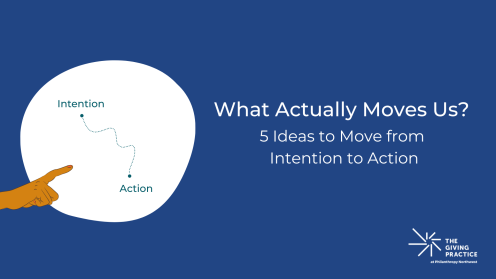
Alongside these commitments, a key question has emerged across our work with funders, philanthropy-serving organizations, and other philanthropic partners: how do we effectively move from intention to action?
At a sector-wide level, this question can feel overwhelming, so we brought it down to the individual level. How do we as individuals — in our work, our homes, our communities — influence action and change?
Specifically, we asked a wide range of people in our lives and work — foundation and PSO leaders, colleagues who work in local government, therapists, clients, friends, family members, even our kids — to tell us about a time when they influenced someone or someone influenced them, and what they noticed about how it happened.
As we listened to their stories, five key ideas emerged. Here's what we found:
1. If we want to move people to action, we have to make the first step feel possible.
Change is daunting. And when something feels too abstract or too far out of reach, we often don’t start at all. Across the stories we heard, influence showed up not as a grand push, but as a lowering of barriers. Sometimes it was as simple as making the first step easy.
One person shared how their wife gifted them a month of drum lessons after they had casually mentioned interest, creating just enough structure and accountability to try something new. They ended up sticking with it long after.
We also heard about the power of reframing expectations around action – from “going all in” to inviting small steps and imperfections. For example, a climate action program manager described piloting a new approach in one project before scaling it, rather than asking the organization to commit to a full shift upfront.
Change doesn’t have to be easy, but it does have to feel accessible.
2. Influence requires patience, consistency and a willingness to stay in the work longer than feels comfortable.
A hard pill for us to swallow is that change takes longer than we think or want it to. Many of the most meaningful examples of influence don’t happen in a single moment. In fact, some people we spoke to didn’t recognize they were being influenced until much later. A TGP senior advisor reflected on how a colleague shaped their understanding of what it means to be effective in their role. Not through direct instruction, but through consistently modeling authenticity and integrity over time.
Others described how small, repeated nudges eventually led to change. Over time, these moments accumulated until something shifted. Ellora LaShier, membership manager at Philanthropy Northwest, shared how in a previous role she worked with a donor over several years to redesign a scholarship process that had long created barriers for students. The change didn’t happen all at once, but through incremental shifts, trust-building and ongoing dialogue.
It can be tempting to look for immediate results. But the kind of change we’re talking about — shifting mindsets, behaviors and systems — rarely happens that way.
3. If we want to influence behavior, we have to invest in relationships.
Again and again, we heard that influence is deeply relational. One person put it simply: they are almost never influenced by online ads, but are consistently influenced by friends or people they trust — and are far more likely to try something new when invited by someone they know.
Furthermore, influence is rarely one-directional. It moves both ways. A therapist reflected on how, even in a profession designed to avoid direct influence, the exchange is mutual. Clients adopt behaviors they observe, and practitioners are influenced in return. A project manager described influence as a “never-ending cycle” — trying something new, then seeing it ripple through their network and back again.
In a field like philanthropy, where power dynamics are ever-present, this feels especially important. Influence rooted in trust creates positive conditions for change.
4. The behaviors we model can open up new possibilities for others.
Many of the most powerful examples of influence weren’t about persuasion at all, they were about behaviors modeled. One foundation staff described being influenced by how their CEO showed up: their authenticity, their vulnerability, their willingness to act differently. A history professor shared how a friend’s willingness to say “I don’t know” shaped how they themselves show up in conversations.
Others described learning through contrast and observing behaviors that didn’t work. One person reflected on how watching patterns of communication in their family influenced them to pause and ask deeper questions about their own reactions.
5. Change is fueled by meaning. If we want people to act, we have to connect the work to what matters to them.
At the center of many of these stories of change was a clear sense of why. Sometimes it was deeply personal and included identity, values or a moment that created an emotional connection. A nonprofit leader shared how seeing a single image as a teenager shaped their entire career path. Michaela Brown, program manager at Philanthropy Northwest, described how being invited by a friend to see art as play, rather than performance, helped her move past perfectionism and reconnect with creativity.
The same action can feel like a burden or an opportunity, depending on how it’s positioned. Reframing “I have to” into “I want to” can shift motivation in meaningful ways. And importantly, the “why” doesn’t have to be perfect or pure. Even small elements of self-interest or curiosity can be enough to get started.
As we reflected on these stories, one thing became clear: There is no single lever that moves people.
Influence is relational, iterative and maybe even invisible in the moment. It happens through small actions, over time, grounded in trust, shaped by meaning and made possible when change feels within reach.
For those of us working in philanthropy, this raises a set of ongoing questions:
- How are we making change feel accessible for the people we work with?
- Where are we investing in the relationships that make influence possible?
- How are we modeling the shifts we hope to see?
- How are we naming and revisiting our “why”?
- And how might we create stronger forms of accountability to one another?
In a moment that calls for action, these questions don’t offer quick answers. But they may help us focus on what actually moves people and, in turn, what might move our field forward.
More from TGP
Subscribe to our newsletter to stay up to date on our latest reflections, insights, interviews and more.