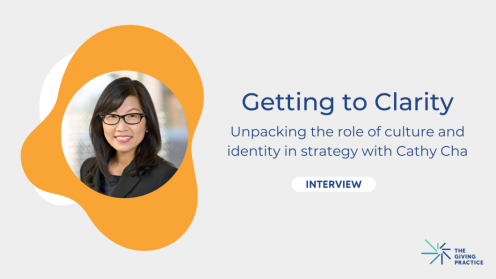
Getting to Clarity: Unpacking the role of culture and identity in strategy with Cathy Cha


As we support clients on their strategy development journeys, we often refer to the quote “Culture eats strategy for breakfast,” (inspired by Peter Drucker, an influential figure in business management). One year after our engagement with Evelyn and Walter Haas Jr. Fund came to an end, we received a note from their leader, Cathy Cha, who went even further to say, “Culture eats strategy for breakfast, lunch and dinner.”
We recently sat down with Cathy to dive deeper into the relationship between culture and strategy. As we reflected on Haas Jr.’s journey, we observed that a strong organizational culture begins with clarity in organizational identity - and that the value of having that clarity cannot be underestimated. So what does it look like to get to a clear identity? What does it take? What impact does it have? We talk about these questions and more in our conversation below.
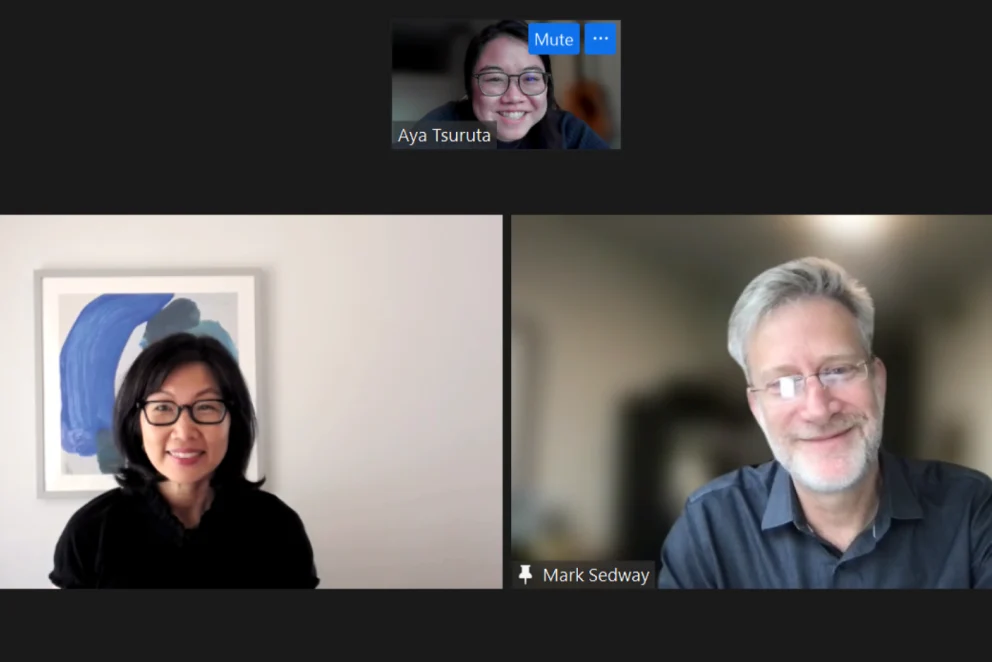
Thank you, Cathy, for taking your time to share your perspective with us.
Can you provide insight into Haas, Jr.’s strategy development process and approving it as the pandemic was hitting? What was that like?
Crazy. We worked fast and furiously across 11 months, and admittedly it was pretty tough on our team at points. We didn't want to be one of those foundations that took years to do a strategic planning process; it felt unfair to put our grantee partners on hold for a long time while we sorted out our internal pieces, but I get it now. This work takes time.
Fast forward to the end and we felt we had landed very well - we had clarity about who we are and we had a lot of exciting work. Then the pandemic hit, we closed down the office and six days later, we took the strategic plan to our board via Zoom. And for me, that was the third time I had ever used Zoom in my entire life. So it was hilarious because we weren't the Zoom university graduates that we all are now, and it wasn't what we had planned. It was kind of a classic scenario of best laid plans thrown out the window and us adjusting. And while the value of adjusting, or what we call "test and learning," had emerged from our strategy process, looking back, I don't think we had anticipated putting it into action so soon, and how essential it would be in the coming years.

Cathy
What was most challenging for your team?
What was hard was the pace. We were all challenging ourselves to try new things, interact differently, explore questions we hadn't explored before. All of that was new behavior and, in truth, some of the things that we did together in the strategic process as a board and staff were incredibly illuminating about our culture - about what we needed to change and what we needed to keep working on. And there was the question of our new program priorities, which in itself is a lot of work and many of our team members could easily have spent more time researching and learning about the issues.
Cathy
It sounds like there were two core components to the strategy development process: organizational culture and impact. Can you speak more to that and how you connected the two?
One of my priorities going into this (based on other strategic planning efforts that I had been involved in) was to figure out who we are first - what we’re good at, what we’re not good at - and then look at the waterfront of incredible needs out in the world and see where we could move the needle. We are not a funder that wants to be transactional. We don’t want to measure our success by the number of grants or amount of money we put out. We want to see people’s lives changed. And we want to be able to have a lasting impact, but we also know we’re not good at everything, and that we have limited dollars. And so the first task at hand was to think about who we are as a family foundation. What really makes our family board tick. And then look out to the world.
And that’s a little different from your traditional strategic planning process, but it is actually one of the things I would highly recommend to other foundations because it is too hard to be in that room with 60 or more possible needs that you could do something about and try to whittle that down in some other way. When you have a sense of identity, you can look at the needs with clarity and say “you know, we care about that deeply and actually we can do something about that.
Cathy
Let’s dive deeper into organizational identity. How would you define identity and what does getting to clarity of identity look like?
I would define identity as “the essence of us.” I had a wise person put it this way: “What are we about at Haas, Jr. even if none of us are in this room?” And I think what that means is, no matter who’s on staff, who’s at the helm, and who’s on the board, we have a clear sense of the values that will guide our grantmaking. Apple, for example, is always going to be about beautiful design. To me that’s one of the essences of Apple. Something that is enduring and has nothing to do with the names on the website.
I feel very fortunate that the Haas’ have a strong identity, and what this strategic planning process allowed us to do was unpack the pieces of the Haas Jr. identity and name those pieces more clearly. For example, we haven’t limited ourselves geographically, but we got clarity that as a proud San Francisco family, our work is inspired by local San Francisco values. And we continue to fully lean into that local heritage.
Being early on the curve had been another big piece of our identity, and in the process of naming that we had some rich conversations about risk, because early on the curve means you could be alone, and it can be controversial. Like when we entered the field of gay rights and gay marriage 21 years ago, or 10 years ago when we were standing up for undocumented young people and Dreamers. We got some criticism for the early work that we did because it was controversial. And in the planning process we were able to unpack questions like, “are we okay with that?” To which the answer was absolutely an affirmative yes when it’s something we believe in.
We’ve always been kind of an edgy funder, but we had never unpacked it with that clarity and connected identity to our culture, our history and our program strategy.
Cathy
What were some specific exercises or aspects of the process that helped lift these values and definitions up?
One thing that I think was admittedly hard for the Haas Jr. staff was that in a lot of ways they wanted the clarity of a roadmap and steps. And what I appreciated about the TGP team was the course correction along the way, based on what you were sensing and learning about our team. And what became really clear during the process was that we needed a better way to let people contribute to the process in a more comfortable and safe way. Not just listen to the presentation at an all-staff meeting where it’s one-way communication, but design spaces where every staff person could genuinely participate, add their voice, add value and figure out where we were going to go. So TGP recommended, part-way through, to break folks up into smaller workgroups based on very specific tasks. This is one of the things that is still going on today and has been pivotal in having an entire staff team that shares the mission and values of this organization, and I’m really proud of that as we approach the end of 2021.
Another exercise that helped was that nine months before we put out our RFP, we reflected on a set of core questions: Do we really need a strategic planning process? And if so, what are the burning questions we want to answer? These questions helped position us for a more productive session with you all, and then there’s been a long tail of that afterwards. Our work didn’t end when TGP left. We are still going strong, and we’re trying some new things - some of which we learned from the strategy process. And I think that’s the arc of culture change and of true adoption and implementation. After the board vote we could have easily said, okay we’re done, we’re tired. Let’s not think about this. But I just knew deep in my gut that if we didn’t keep going and take advantage of this opportunity that we would slide. It’s a marathon, not a sprint.
Cathy
Towards the beginning of our conversation, you mentioned how one of the values that emerged from the strategy process, "test and learn," became central to Haas, Jr.'s work. Can you talk more about this?
Philanthropy historically has taken a “plan and implement” approach. You’re in your office alone or maybe with a couple of other funder colleagues and you start with research by commissioning a study from a university or a think tank on some issue. A year and a half to two years later, you release that study and start to develop some ideas about what can be done. And I just want to note that I used to take this approach too, but I think what the last two years have shown us is that we can’t work like that anymore. Philanthropy needs to be more agile, and sometimes what I say is, “imagine yourself as a soccer goalie.” Trying to imagine where the ball is going to come is the reality of the world we’re living in.
Just this week in California, we went from drought to atmospheric river and flooding. In any given week, we don’t know what’s around the corner. So one of our culture priorities has become to take a “test and learn” approach instead, which TGP introduced us to and I have fully embraced it. Within this approach, we bring community leaders in as early as we can to shape strategies and initiatives with us - and in fact I often say, “there’s no such thing as bringing in community partners too early.” And that's also very much one of our values - that those closest to the problems are closest to the solutions.
In response to the riots in Oakland and trying to figure out what to do after the murders of George Floyd and Breonna Taylor, for example, we and a few Black leaders co-designed an initiative called the California Black Freedom Fund to give Black communities voice, agency and resources to build Black power across the state. We also jump started a movement-building initiative for Asian American Pacific Islanders that emerged out of the Atlanta shootings. Neither of these were on anybody’s plan, and it’s a great example of the importance of being a soccer goalie.
And it’s a big change to get to a place where we’re going to try some things, learn and have the right people around the table as we try. We’re going to fail fast and we’re going to be a lot more agile as we try to meet our goals.
Cathy
What are the mindsets, approaches, and habits of mind and action that you need as a leader to be a good tester and learner, and what do you think stands in the way? What's the gravitational force of “planning and implementing” that you have to be mindful of and manage in doing that?
I think one of the things that I've realized is that there are people who are very excited when they see a blank canvas and other people who are very frightened. And so as part of my role, I'm trying to help people see the beauty and the excitement of that blank canvas. Let’s not be fearful of the blank canvas. But rather ask, what is the opportunity here?
And I think the other thing is that there’s an aspect of “test and learn” that should be really comforting. I used to be a program officer where I needed to say, “this is exactly how it’s going to turn out. I have a plan - you have to trust me and my guess of how this will all go.” “Test and learn” is like “let’s just learn and try to figure it out alongside our community partners.” It’s okay if it doesn’t work. We just want the lessons from mistakes and course correction to happen so we’re better positioned to try something else. I’m trying to emphasize the comfort of that. If it doesn’t go according to plan, you’re not going to get punished or judged, and that should be liberating. It’s a recognition that when you take on complex problems, the solutions are not simple or obvious.
Cathy
Take full advantage of the strategy process in that it’s your chance to put all of the questions on the table. And don't take just the first three questions, but really dive down and put those next three - the hardest ones - on the table. It requires some courage, but after going through some of those conversations that we wrestled with and getting to clarity on who we are, we’re now an aligned organization - which makes every week and every year easier because we know what we're about and we know where we’re going.
Cathy
Learn more about Evelyn and Walter Haas Jr. Fund here.